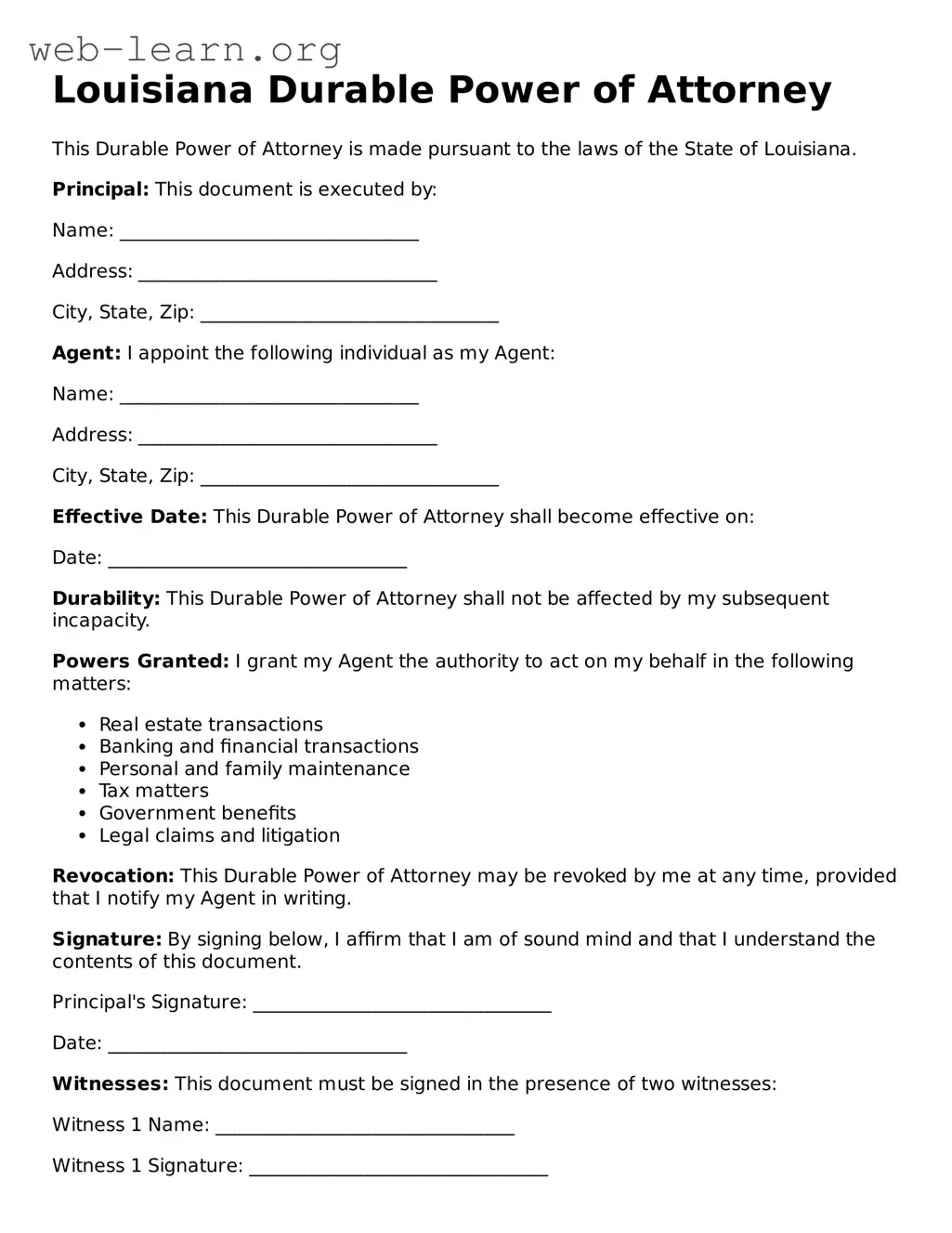
In Louisiana, a Durable Power of Attorney (DPOA) serves as a vital legal tool, empowering individuals to designate someone they trust to manage their financial and legal affairs when they are unable to do so themselves. This form remains effective even if the principal becomes incapacitated, providing peace of mind for both the principal and their loved ones. It outlines the specific powers granted to the agent, which can range from handling bank transactions to making healthcare decisions. The DPOA can be tailored to meet individual needs, allowing for broad or limited authority as desired. Importantly, the form must be executed in accordance with Louisiana law to ensure its validity. Understanding the intricacies of this document is essential for anyone looking to safeguard their interests and ensure that their wishes are honored during challenging times.
Louisiana Durable Power of Attorney
This Durable Power of Attorney is made pursuant to the laws of the State of Louisiana.
Principal: This document is executed by:
Name: ________________________________
Address: ________________________________
City, State, Zip: ________________________________
Agent: I appoint the following individual as my Agent:
Name: ________________________________
Address: ________________________________
City, State, Zip: ________________________________
Effective Date: This Durable Power of Attorney shall become effective on:
Date: ________________________________
Durability: This Durable Power of Attorney shall not be affected by my subsequent incapacity.
Powers Granted: I grant my Agent the authority to act on my behalf in the following matters:
Revocation: This Durable Power of Attorney may be revoked by me at any time, provided that I notify my Agent in writing.
Signature: By signing below, I affirm that I am of sound mind and that I understand the contents of this document.
Principal's Signature: ________________________________
Date: ________________________________
Witnesses: This document must be signed in the presence of two witnesses:
Witness 1 Name: ________________________________
Witness 1 Signature: ________________________________
Date: ________________________________
Witness 2 Name: ________________________________
Witness 2 Signature: ________________________________
Date: ________________________________
Notarization: This Durable Power of Attorney must be notarized:
Notary Public Signature: ________________________________
Notary Seal: ________________________________
Date: ________________________________
| Fact Name | Description |
|---|---|
| Definition | A Louisiana Durable Power of Attorney allows you to designate someone to make financial and legal decisions on your behalf, even if you become incapacitated. |
| Governing Law | This form is governed by the Louisiana Civil Code, particularly Articles 2980-2993, which outline the rules for powers of attorney in the state. |
| Durability | The "durable" aspect means that the authority granted continues even if you become mentally or physically unable to make decisions. |
| Agent Authority | Your chosen agent can handle a wide range of financial matters, including managing bank accounts, paying bills, and making investment decisions. |
| Revocation | You can revoke the Durable Power of Attorney at any time, as long as you are mentally competent to do so. |
| Witnesses and Notarization | To be valid, the form must be signed in the presence of a notary public and two witnesses, ensuring that your intentions are clear and legally binding. |
Filling out the Louisiana Durable Power of Attorney form is an important step in ensuring that your financial and legal matters can be managed by someone you trust in the event you are unable to do so yourself. Here’s how to complete the form effectively.
Completing the Louisiana Durable Power of Attorney form is just the beginning. It's essential to discuss your choices with your agent and ensure they understand your wishes. This proactive approach can help avoid confusion in the future.
A Durable Power of Attorney (DPOA) is a legal document that allows one person, known as the principal, to appoint another person, called the agent or attorney-in-fact, to make decisions on their behalf. This document remains effective even if the principal becomes incapacitated.
Any competent adult can be appointed as an agent. This includes family members, friends, or professionals. It is important to choose someone you trust, as they will have significant authority over your financial and legal matters.
The principal can grant a wide range of powers to the agent, including:
However, the principal can also limit the powers granted in the DPOA, specifying what the agent can and cannot do.
To create a DPOA in Louisiana, the principal must complete a written document that clearly states their intention to create a Durable Power of Attorney. The document must be signed by the principal and witnessed by at least one person or notarized. It is advisable to consult an attorney to ensure that the document meets all legal requirements.
Yes, a principal can revoke a Durable Power of Attorney at any time, as long as they are competent. This can be done by creating a new DPOA or by providing a written notice of revocation to the agent and any relevant institutions.
If the appointed agent is unable or unwilling to serve, the Durable Power of Attorney may include alternate agents. If no alternate is named, a court may need to appoint a guardian or conservator to manage the principal’s affairs.
Filling out a Louisiana Durable Power of Attorney (DPOA) form is an important task that allows individuals to designate someone to make decisions on their behalf. However, many people make common mistakes that can lead to complications down the line. One significant error is failing to specify the powers granted to the agent. It is essential to clearly outline the scope of authority. Without this clarity, the agent may not have the necessary power to act in the intended situations.
Another frequent mistake is neglecting to date the document. A DPOA should always include the date it was signed. This date serves as a reference point for when the authority begins. If the form is undated, it may create confusion regarding its validity and the timing of the powers granted. This can lead to disputes or delays when the agent attempts to act on behalf of the principal.
People often overlook the importance of having witnesses or a notary present during the signing of the DPOA. In Louisiana, the law requires that the document be signed in front of a notary or two witnesses. Failing to meet these requirements can render the DPOA invalid. Therefore, it is crucial to ensure that the signing process adheres to legal standards to avoid any future issues.
Lastly, individuals sometimes forget to communicate their decisions with the appointed agent. It’s not enough to simply fill out the form; discussing the role and responsibilities with the chosen agent is vital. This conversation helps ensure that the agent understands the principal’s wishes and is prepared to act accordingly. Open communication can prevent misunderstandings and ensure that the DPOA serves its intended purpose effectively.
A Louisiana Durable Power of Attorney (DPOA) form allows an individual, known as the principal, to appoint someone else, called the agent, to make decisions on their behalf, particularly in financial and legal matters. Alongside this important document, several other forms and documents can enhance its effectiveness or address related needs. Here are six commonly used forms that complement the DPOA:
Using these documents in conjunction with a Louisiana Durable Power of Attorney can help ensure that an individual's wishes are respected and that their affairs are managed according to their preferences, both during their lifetime and after their passing.
The Durable Power of Attorney (DPOA) form is an important legal document that allows someone to act on your behalf in financial or medical matters. Several other documents serve similar purposes, providing authority and guidance in various situations. Below are eight documents that share similarities with the DPOA:
Each of these documents plays a crucial role in ensuring that your wishes are respected and that someone you trust can make decisions on your behalf when needed.
Filling out a Durable Power of Attorney (DPOA) form in Louisiana is an important step in ensuring your wishes are respected if you become unable to make decisions for yourself. Here’s a guide to help you navigate this process effectively.
By following these guidelines, you can create a Durable Power of Attorney that reflects your wishes and protects your interests. Remember, this is about your future and ensuring your voice is heard, even when you cannot speak for yourself.
Understanding the Louisiana Durable Power of Attorney (DPOA) is essential for anyone considering this important legal document. Here are ten common misconceptions about the DPOA form, along with clarifications to help clear up any confusion.
While many people use a DPOA for financial decisions, it can also cover healthcare decisions, depending on how it is drafted.
Your agent can be anyone you trust, including friends or professionals, as long as they are legally capable of acting in that role.
A Durable Power of Attorney becomes effective immediately upon signing, unless specified otherwise in the document.
While it is best to revoke a DPOA in writing, you can also do so verbally, provided you inform the agent and any relevant parties.
Each state has its own laws regarding DPOAs, so it’s important to use the form specific to Louisiana.
The agent must act in the best interest of the principal and follow their wishes as outlined in the DPOA.
A DPOA remains effective until the principal revokes it, passes away, or becomes legally incompetent without a DPOA in place.
A DPOA and a living will serve different purposes and can be used together to ensure your wishes are honored.
The powers granted to the agent can be limited or specified in the DPOA, depending on the principal's preferences.
Having an open conversation with your agent about your wishes and expectations is crucial for effective decision-making.
By dispelling these misconceptions, individuals can better understand the importance and function of a Louisiana Durable Power of Attorney. It’s always advisable to consult with a legal professional when drafting or executing such documents to ensure they meet your needs and comply with state laws.
When considering a Durable Power of Attorney (DPOA) in Louisiana, it’s essential to understand its implications and how to effectively use the form. Here are some key takeaways:
Understanding these key points can help you navigate the process of creating and using a Durable Power of Attorney in Louisiana effectively.
Power of Attorney Michigan - A Durable Power of Attorney can be a safeguard against unexpected health issues or accidents.
Free Printable Durable Power of Attorney Form Alabama - It is a practical solution for anyone wanting to plan for the unexpected.
Power of Attorney Illinois - The form can be customized to include specific limitations or conditions for the agent’s authority.
How to Get Power of Attorney in Florida - It allows your agent to make decisions that reflect your personal values.