The Louisiana Deed form serves as a crucial legal document in real estate transactions within the state, outlining the transfer of property ownership from one party to another. This form encompasses essential details such as the names of the grantor and grantee, a clear description of the property being transferred, and the terms of the conveyance. Additionally, it may include information about any encumbrances or liens on the property, ensuring that all parties are aware of any existing obligations. The Louisiana Deed form also requires the signatures of the parties involved, often necessitating notarization to enhance its legal validity. Understanding the nuances of this form is vital for both buyers and sellers, as it safeguards their rights and interests throughout the property transfer process. Properly executing this document can help prevent disputes and ensure a smooth transaction, making it an indispensable tool in Louisiana's real estate landscape.
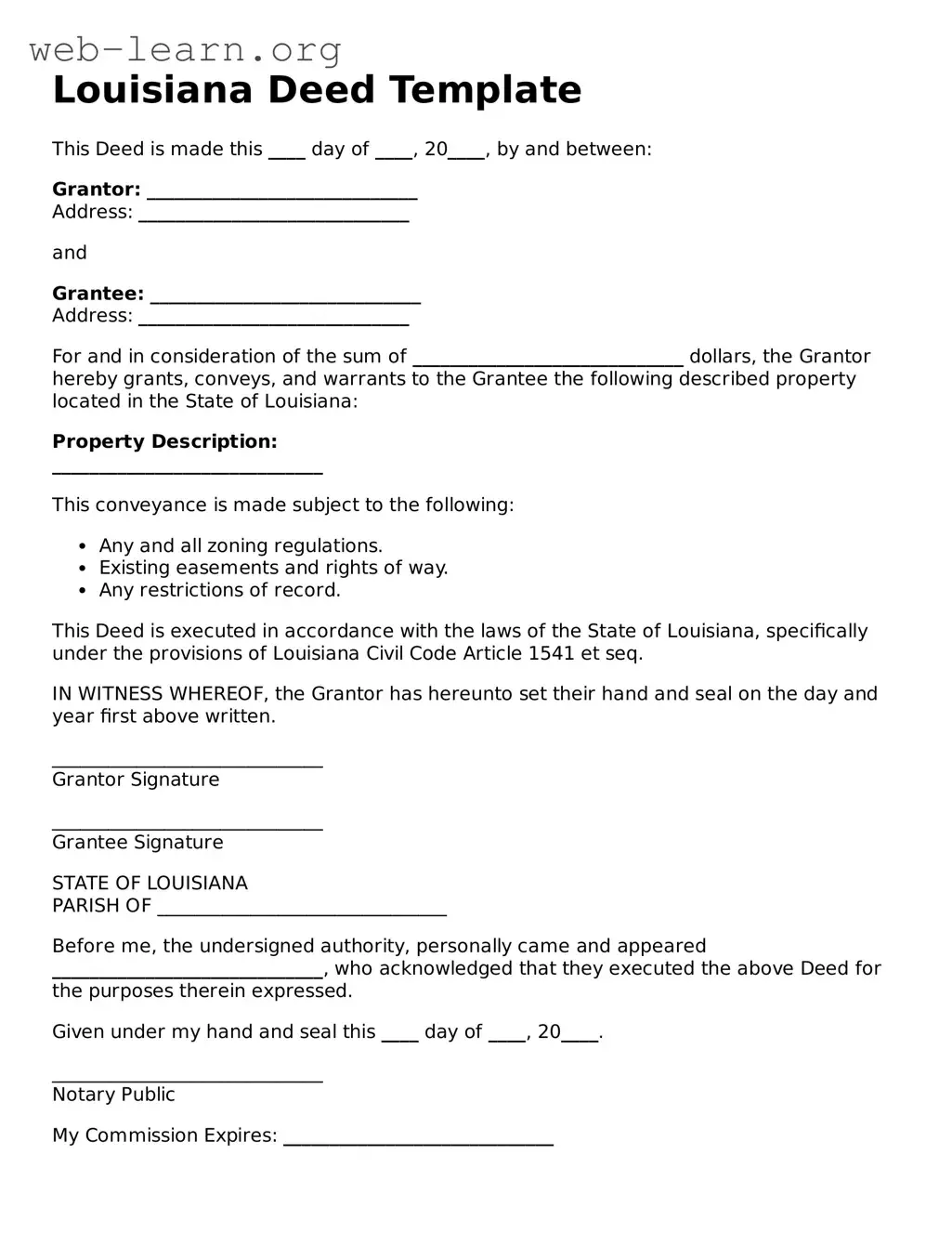
Louisiana Deed Template
This Deed is made this ____ day of ____, 20____, by and between:
Grantor: _____________________________
Address: _____________________________
and
Grantee: _____________________________
Address: _____________________________
For and in consideration of the sum of _____________________________ dollars, the Grantor hereby grants, conveys, and warrants to the Grantee the following described property located in the State of Louisiana:
Property Description:
_____________________________
This conveyance is made subject to the following:
This Deed is executed in accordance with the laws of the State of Louisiana, specifically under the provisions of Louisiana Civil Code Article 1541 et seq.
IN WITNESS WHEREOF, the Grantor has hereunto set their hand and seal on the day and year first above written.
_____________________________
Grantor Signature
_____________________________
Grantee Signature
STATE OF LOUISIANA
PARISH OF _______________________________
Before me, the undersigned authority, personally came and appeared _____________________________, who acknowledged that they executed the above Deed for the purposes therein expressed.
Given under my hand and seal this ____ day of ____, 20____.
_____________________________
Notary Public
My Commission Expires: _____________________________
| Fact Name | Details |
|---|---|
| Governing Law | The Louisiana Deed form is governed by the Louisiana Civil Code. |
| Purpose | This form is used to transfer ownership of real property from one party to another. |
| Types of Deeds | Common types include warranty deeds, quitclaim deeds, and special warranty deeds. |
| Signature Requirement | The deed must be signed by the grantor (seller) and notarized. |
| Recording | To protect the buyer's interest, the deed should be recorded in the parish where the property is located. |
| Consideration | The deed must state the consideration (price) paid for the property. |
| Legal Description | A complete legal description of the property must be included in the deed. |
After completing the Louisiana Deed form, it will be necessary to submit it for recording with the appropriate parish clerk’s office. This step is crucial to ensure that the transfer of property is officially recognized and documented in public records.
What is a Louisiana Deed form?
A Louisiana Deed form is a legal document used to transfer ownership of real property from one party to another. This form outlines the details of the transaction, including the names of the parties involved, the property description, and any conditions of the transfer.
What types of deeds are available in Louisiana?
In Louisiana, several types of deeds can be used, including:
How do I complete a Louisiana Deed form?
To complete a Louisiana Deed form, follow these steps:
Do I need a notary for the Louisiana Deed form?
Yes, a notary public must witness the signing of the deed. This step is essential to ensure the document is legally valid and can be recorded with the parish clerk of court.
How do I record a Louisiana Deed?
To record a Louisiana Deed, take the signed document to the parish clerk of court's office where the property is located. There, you will submit the deed and pay any required recording fees. Once recorded, the deed becomes part of the public record.
Are there any fees associated with the Louisiana Deed form?
Yes, there are typically fees involved, including:
What should I do if I have questions about the Louisiana Deed form?
If you have questions, consider consulting with a real estate attorney or a professional experienced in property transactions. They can provide guidance specific to your situation and ensure that you complete the process correctly.
Filling out a Louisiana Deed form can be a straightforward process, but many individuals make common mistakes that can lead to complications down the line. One frequent error is failing to include all necessary parties involved in the transaction. It’s essential to list not only the seller and buyer but also any co-owners or heirs who might have a claim to the property. Omitting a party can create legal issues that may require additional time and resources to resolve.
Another common mistake is not providing the correct legal description of the property. Instead of simply writing the address, the deed must include a detailed description that outlines the boundaries and specific characteristics of the property. This description is crucial for identifying the property in legal terms. Inaccuracies can lead to disputes and confusion over property lines.
People often overlook the importance of having the deed properly notarized. A deed must be signed in the presence of a notary public to be legally valid. Failing to do this means the deed may not hold up in court, which could jeopardize ownership claims. Always ensure that the signatures are witnessed and notarized to avoid potential challenges in the future.
Additionally, many individuals neglect to check for existing liens or encumbrances on the property. Before finalizing the deed, it is wise to conduct a title search. This step helps to uncover any debts or legal claims against the property, which could affect the buyer’s ownership rights. Ignoring this can lead to unexpected financial burdens.
Another mistake is not providing adequate consideration in the deed. Consideration refers to the value exchanged for the property, whether it’s money, services, or other assets. If the consideration is not clearly stated, it may raise questions about the legitimacy of the transaction. Clarity in this area helps to establish the intent of both parties.
Lastly, many people forget to file the deed with the appropriate local government office after it has been completed. This step is crucial for making the transfer of ownership official. If the deed is not recorded, it may not be recognized by third parties, potentially leading to disputes over ownership. Always ensure that the deed is filed promptly to protect your property rights.
When completing a property transaction in Louisiana, several forms and documents may accompany the Louisiana Deed form. Each of these documents serves a specific purpose and helps ensure that the transaction is legally sound and properly recorded. Below is a list of commonly used forms.
These documents collectively contribute to a smooth property transfer process in Louisiana. Understanding each one can help individuals navigate the complexities of real estate transactions more effectively.
The Deed form is similar to several other legal documents that serve various purposes in property and ownership transactions. Here are ten documents that share similarities with the Deed form:
When filling out the Louisiana Deed form, it's essential to approach the task with care. Here’s a helpful list of dos and don'ts to guide you through the process.
Following these guidelines will help ensure that your Louisiana Deed form is filled out correctly and efficiently.
Understanding the Louisiana Deed form can be challenging due to various misconceptions. Here are ten common misunderstandings, along with clarifications:
The Louisiana Deed form is the same as a deed in other states. Each state has its own requirements and formats for deeds. Louisiana's unique legal system, based on civil law, influences its deed structure.
A Louisiana Deed must be notarized to be valid. While notarization is highly recommended for authenticity, the deed can still be valid without it, provided it meets other legal requirements.
All Louisiana Deeds are public records. While most deeds are recorded and accessible, certain types, such as those involving privacy concerns, may not be publicly available.
A Louisiana Deed automatically transfers property ownership. Ownership transfer occurs only when the deed is delivered and accepted by the grantee, not merely by signing the document.
Only licensed attorneys can draft a Louisiana Deed. While it is advisable to consult an attorney, individuals can draft their own deeds as long as they comply with legal standards.
All Louisiana Deeds must include a legal description of the property. Although it is best practice, a deed can still be valid if it provides sufficient detail to identify the property, even if not in legal terms.
The Louisiana Deed form is a one-size-fits-all document. Different types of deeds, such as warranty deeds and quitclaim deeds, serve different purposes and should be used accordingly.
Once a Louisiana Deed is signed, it cannot be changed. Deeds can be amended or revoked, but this typically requires a new deed to be executed.
Property taxes are automatically transferred with the deed. While the deed transfers ownership, the new owner must ensure that property taxes are updated and paid accordingly.
There are no specific requirements for witnesses on a Louisiana Deed. While witnesses are not always required, having them can provide additional validation and protection against future disputes.
When filling out and using the Louisiana Deed form, there are several important points to keep in mind. Here are some key takeaways to help you navigate the process smoothly:
By following these key points, you can ensure that your Louisiana Deed form is completed correctly and that the property transfer goes smoothly.
What Does a House Deed Look Like in Ny - This document serves as proof of a transfer of title from one party to another.
How to Get a Copy of a Deed in Arkansas - It is important to ensure that the Deed form is executed in the presence of witnesses, if required by state law.
Indiana Quit Claim Deed Form - They can also outline responsibilities for property maintenance.