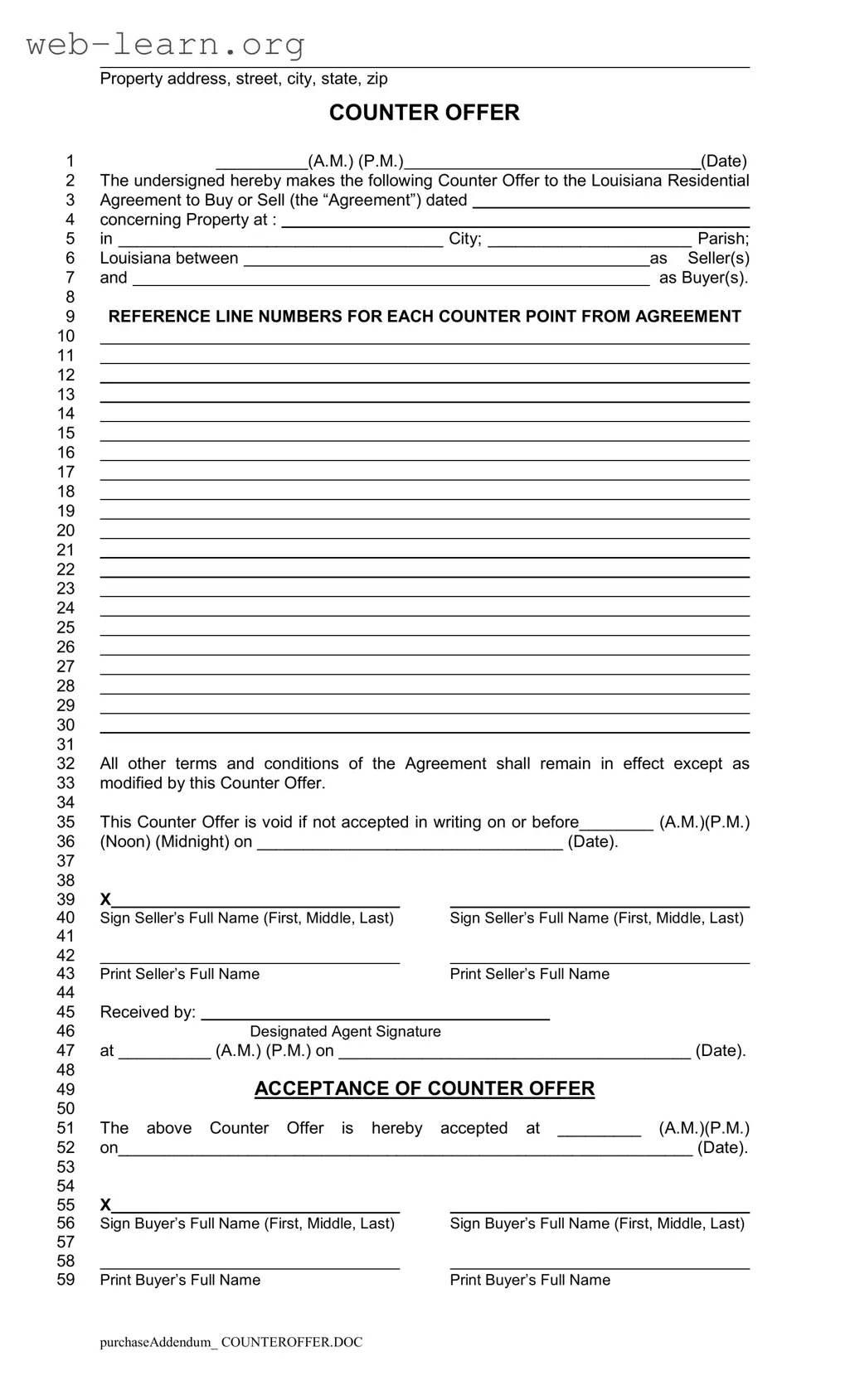
The Louisiana Counter Offer form is a crucial document in the real estate transaction process, serving as a tool for buyers and sellers to negotiate terms after an initial offer has been made. This form allows the seller to present modifications to the original agreement, specifying changes to key aspects such as price, closing date, or contingencies. It includes sections for both the seller and buyer to provide their names, the property address, and the date of the counter offer. Additionally, it references specific line numbers from the original agreement, ensuring clarity in the proposed changes. The form emphasizes that all other terms and conditions of the original agreement remain intact unless explicitly altered by the counter offer. Importantly, the counter offer must be accepted in writing by a specified deadline to be valid, underscoring the time-sensitive nature of real estate negotiations. By understanding the components and implications of this form, both parties can navigate the negotiation process more effectively, aiming for a successful transaction.

Property address, street, city, state, zip
COUNTER OFFER
1 |
__________(A.M.) (P.M.) |
_(Date) |
|
|
|
|
|
2The undersigned hereby makes the following Counter Offer to the Louisiana Residential
3 Agreement to Buy or Sell (the “Agreement”) dated
4 concerning Property at :
5 in ___________________________________ City; ______________________ Parish;
6 |
Louisiana between |
|
as Seller(s) |
|
7 |
and |
|
as Buyer(s). |
|
8 |
|
|
|
|
9REFERENCE LINE NUMBERS FOR EACH COUNTER POINT FROM AGREEMENT
10
11
12
13
14
15
16
17
18
19
20
21
22
23
24
25
26
27
28
29
30
31
32 All other terms and conditions of the Agreement shall remain in effect except as 33 modified by this Counter Offer.
34
35 This Counter Offer is void if not accepted in writing on or before________ (A.M.)(P.M.) 36 (Noon) (Midnight) on _________________________________ (Date).
37
38
39 X
40 |
Sign Seller’s Full Name (First, Middle, Last) |
Sign Seller’s Full Name (First, Middle, Last) |
|||
41 |
|
|
|
|
|
42 |
|
|
|
|
|
43 |
Print Seller’s Full Name |
Print Seller’s Full Name |
|||
44 |
|
|
|
|
|
45 |
Received by: |
|
|
||
46 |
|
Designated Agent Signature |
|
|
|
47at __________ (A.M.) (P.M.) on ______________________________________ (Date).
49
50
51 The above Counter Offer is hereby accepted at _________ (A.M.)(P.M.)
52on______________________________________________________________ (Date).
55X
56 |
Sign Buyer’s Full Name (First, Middle, Last) |
|
Sign Buyer’s Full Name (First, Middle, Last) |
57 |
|
|
|
58 |
|
|
|
59 |
Print Buyer’s Full Name |
|
Print Buyer’s Full Name |
purchaseAddendum_ COUNTEROFFER.DOC
| Fact Name | Fact Description |
|---|---|
| Purpose | The Louisiana Counter Offer form is used to propose changes to the original terms of a real estate transaction. |
| Governing Law | This form is governed by Louisiana state law, particularly the Louisiana Civil Code. |
| Acceptance Deadline | The Counter Offer must be accepted in writing before a specified time and date to remain valid. |
| Property Details | It requires specific information about the property, including address and parish. |
| Seller and Buyer Information | Both the seller and buyer must provide their full names and signatures on the form. |
| Modification Clause | All other terms of the original Agreement remain effective unless specifically modified by the Counter Offer. |
| Reference Line Numbers | It includes a section for referencing specific line numbers from the original Agreement for clarity. |
| Agent Signature | A designated agent must sign and date the form upon receipt of the Counter Offer. |
| Counter Offer Acceptance | The form includes a section for the buyer to accept the Counter Offer, requiring their signature and date. |
Once you have the Louisiana Counter Offer form in hand, it's essential to fill it out accurately to ensure clarity in your negotiations. Follow these steps carefully to complete the form. Ensure you have all necessary information ready before you begin.
The Louisiana Counter Offer form is a legal document used in real estate transactions. It allows a seller or buyer to propose changes to the original terms of a purchase agreement. This form is specifically designed for use in Louisiana and ensures that all parties are aware of the modifications being suggested.
A Counter Offer form should be used when one party wants to change specific terms of the original purchase agreement. For example, if a buyer wants to adjust the purchase price or change the closing date, they would submit a counter offer to the seller. This form facilitates communication and negotiation between the parties involved.
The Counter Offer form requires several key pieces of information:
The Counter Offer is only valid until the specified deadline mentioned in the document. If the counter offer is not accepted in writing by that time, it becomes void. It is essential to keep track of this deadline to ensure that negotiations can continue smoothly.
If the Counter Offer is accepted, both parties must sign the document to formalize the agreement. Once signed, the modified terms will replace the original terms in the purchase agreement. All other conditions of the original agreement remain in effect unless explicitly changed in the counter offer.
Yes, multiple Counter Offers can be made. However, it is important to ensure that each counter offer is clearly documented and that all parties are aware of the status of negotiations. Each counter offer should reference the previous ones to avoid confusion.
While it is not mandatory to seek legal advice when using a Counter Offer form, it can be beneficial. Consulting with a legal professional can help ensure that all terms are clearly understood and that the counter offer complies with state laws and regulations.
If you have questions about completing the Counter Offer form, consider reaching out to a real estate agent or a legal consultant. They can provide guidance on how to accurately fill out the form and ensure that your interests are protected during the negotiation process.
When filling out the Louisiana Counter Offer form, many people make mistakes that can lead to confusion or disputes later on. One common error is failing to include the correct property address. It's essential to ensure that every detail is accurate, including the street, city, and parish. Omitting or miswriting any part of this information can complicate the agreement.
Another frequent mistake is not referencing the correct line numbers from the original agreement. The Counter Offer should clearly point out which terms are being modified. If these reference lines are incorrect or missing, it can create misunderstandings about what is being agreed upon.
Some individuals forget to fill in the deadline for acceptance. This date is crucial, as it specifies when the Counter Offer will become void if not accepted. Leaving this blank can lead to uncertainty and potential disputes about the validity of the offer.
Additionally, people often overlook the importance of both sellers signing the document. If one seller fails to sign, the Counter Offer may not be legally binding. It's vital that all parties involved give their consent and acknowledgment to avoid issues later.
Another mistake is neglecting to print the names of the sellers and buyers clearly. While signatures are essential, printed names help to clarify who is involved in the transaction. This step is often skipped, leading to potential confusion about the parties in the agreement.
Some individuals may also forget to include the time of day when the Counter Offer is made. This detail is important, as it can affect the timing of the offer's acceptance. A lack of specificity can lead to misunderstandings about when the offer was officially presented.
Moreover, failing to communicate any modifications clearly can lead to problems. If the Counter Offer does not explicitly state what changes are being proposed, it can create confusion and disputes between buyers and sellers.
Lastly, people sometimes neglect to keep a copy of the completed Counter Offer. It's vital to retain documentation for your records. Without a copy, you may find it challenging to reference the terms agreed upon later.
The Louisiana Counter Offer form is an essential document in real estate transactions, particularly during negotiations between buyers and sellers. Several other forms and documents often accompany it to ensure that all aspects of the transaction are clearly defined and legally binding. Below is a list of these documents, each with a brief description.
Each of these documents plays a vital role in the real estate transaction process. They help clarify the responsibilities of both parties, ensure compliance with legal requirements, and protect the interests of everyone involved. Understanding these forms can significantly enhance the transaction experience for buyers and sellers alike.
The Louisiana Counter Offer form serves a specific purpose in real estate transactions, but it shares similarities with several other important documents. Each of these documents plays a crucial role in the negotiation and finalization of agreements between parties. Below is a list of ten documents that are similar to the Louisiana Counter Offer form, along with an explanation of how they relate to it.
When filling out the Louisiana Counter Offer form, there are several important practices to keep in mind. Here’s a list of things you should and shouldn’t do to ensure your counter offer is clear and effective.
This is not true. A counter offer does not automatically cancel the original offer. It simply presents new terms for consideration. The original offer remains valid until it is explicitly rejected or accepted.
A counter offer can modify any terms of the original agreement. It allows the seller or buyer to propose changes while still negotiating the deal.
Not at all. The counter offer only becomes legally binding once it is accepted in writing by the other party. Until then, it is simply a proposal.
Acceptance must be in writing to be valid. Verbal agreements are not enforceable in this context, so always ensure you have a written acceptance.
There is a deadline for acceptance specified in the counter offer. If not accepted by that time, the offer becomes void.
While many terms can be negotiated, some may be non-negotiable due to legal or contractual obligations. Always review these carefully.
This is a common misunderstanding. A counter offer is a new proposal, while acceptance is agreeing to the original terms without changes.
Using the counter offer form is highly recommended. It provides clarity and ensures all parties are on the same page regarding the changes being proposed.
The Louisiana Counter Offer form allows sellers to propose changes to the terms of an existing purchase agreement. This form must be filled out accurately to reflect the desired modifications.
It is essential to specify the property address clearly, including the city and parish, to avoid any confusion regarding the transaction.
The counter offer must be accepted in writing by the other party before the specified deadline. If not accepted by the given time, the counter offer becomes void.
All terms and conditions of the original agreement remain effective unless explicitly modified by the counter offer. This ensures clarity and continuity in the transaction.