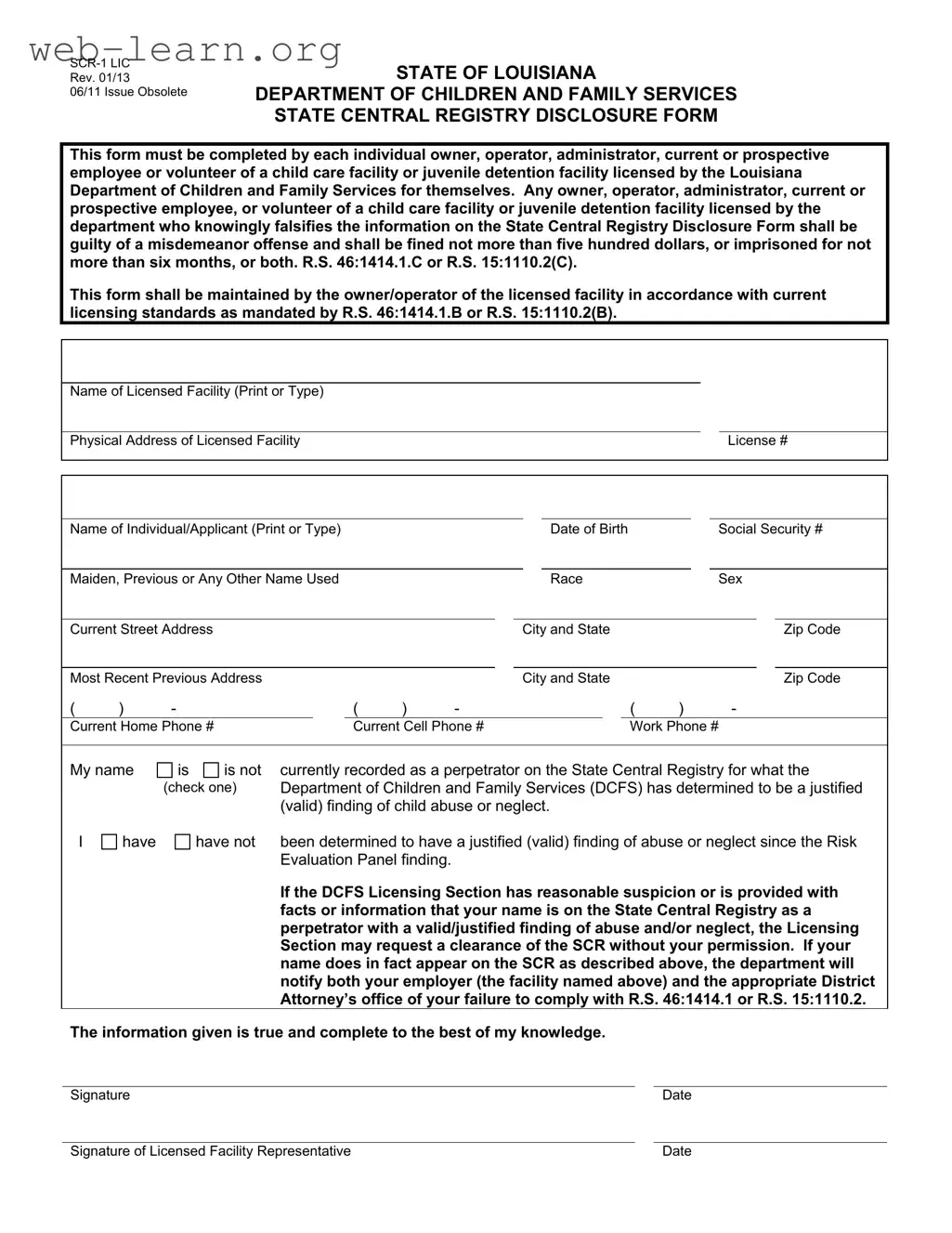
The Louisiana Central Registry Disclosure Form plays a crucial role in ensuring the safety and well-being of children in care facilities across the state. This form is required for every individual involved in a licensed child care or juvenile detention facility, including owners, operators, administrators, employees, and volunteers. It collects essential personal information, such as names, addresses, and social security numbers, to verify the background of those who work with vulnerable populations. Notably, the form also addresses the serious implications of providing false information, which can lead to misdemeanor charges, fines, or imprisonment. The importance of transparency is underscored by the requirement that the form be maintained in accordance with state licensing standards. Additionally, individuals must disclose whether they have been identified as perpetrators of abuse or neglect, highlighting the state’s commitment to safeguarding children. This process not only protects children but also holds individuals accountable for their actions, fostering a safer environment for all involved.
Rev. 01/13
06/11 Issue Obsolete
STATE OF LOUISIANA
DEPARTMENT OF CHILDREN AND FAMILY SERVICES STATE CENTRAL REGISTRY DISCLOSURE FORM
This form must be completed by each individual owner, operator, administrator, current or prospective employee or volunteer of a child care facility or juvenile detention facility licensed by the Louisiana Department of Children and Family Services for themselves. Any owner, operator, administrator, current or prospective employee, or volunteer of a child care facility or juvenile detention facility licensed by the department who knowingly falsifies the information on the State Central Registry Disclosure Form shall be guilty of a misdemeanor offense and shall be fined not more than five hundred dollars, or imprisoned for not more than six months, or both. R.S. 46:1414.1.C or R.S. 15:1110.2(C).
This form shall be maintained by the owner/operator of the licensed facility in accordance with current licensing standards as mandated by R.S. 46:1414.1.B or R.S. 15:1110.2(B).
Name of Licensed Facility (Print or Type)
Physical Address of Licensed Facility |
|
|
|
|
|
|
|
|
|
|
|
License # |
||||||||
|
|
|
|
|
|
|
|
|
|
|
|
|
|
|
|
|
||||
|
|
|
|
|
|
|
|
|
|
|
|
|
|
|
|
|
||||
|
|
|
|
|
|
|
|
|
|
|
|
|
|
|
|
|
||||
Name of Individual/Applicant (Print or Type) |
|
|
|
|
|
Date of Birth |
|
|
|
Social Security # |
||||||||||
|
|
|
|
|
|
|
|
|
|
|
|
|
|
|
|
|
||||
Maiden, Previous or Any Other Name Used |
|
|
|
|
|
Race |
|
|
|
Sex |
||||||||||
|
|
|
|
|
|
|
|
|
|
|
|
|
|
|
|
|
||||
Current Street Address |
|
|
|
|
|
|
|
City and State |
|
|
|
|
|
Zip Code |
||||||
|
|
|
|
|
|
|
|
|
|
|
|
|
|
|
|
|||||
Most Recent Previous Address |
|
|
|
|
|
|
City and State |
|
|
|
|
|
Zip Code |
|||||||
( |
) |
- |
|
|
|
( |
) |
- |
|
|
|
|
|
|
( |
) |
- |
|
|
|
Current Home Phone # |
|
|
|
Current Cell Phone # |
Work Phone # |
|||||||||||||||
|
|
|
|
|||||||||||||||||
My name |
is |
is not |
currently recorded as a perpetrator on the State Central Registry for what the |
|||||||||||||||||
|
|
(check one) |
Department of Children and Family Services (DCFS) has determined to be a justified |
|||||||||||||||||
|
|
|
|
(valid) finding of child abuse or neglect. |
|
|
|
|
|
|
||||||||||
I |
have |
have not |
been determined to have a justified (valid) finding of abuse or neglect since the Risk |
|||||||||||||||||
|
|
|
|
Evaluation Panel finding. |
|
|
|
|
|
|
|
|
|
|
|
|
|
|||
If the DCFS Licensing Section has reasonable suspicion or is provided with facts or information that your name is on the State Central Registry as a perpetrator with a valid/justified finding of abuse and/or neglect, the Licensing Section may request a clearance of the SCR without your permission. If your name does in fact appear on the SCR as described above, the department will notify both your employer (the facility named above) and the appropriate District Attorney’s office of your failure to comply with R.S. 46:1414.1 or R.S. 15:1110.2.
The information given is true and complete to the best of my knowledge.
Signature |
|
Date |
|
|
|
Signature of Licensed Facility Representative |
|
Date |
| Fact Name | Description |
|---|---|
| Purpose | The Louisiana Central Registry Disclosure Form is required for individuals involved with licensed child care or juvenile detention facilities. |
| Who Must Complete | Each owner, operator, administrator, employee, or volunteer must fill out the form. |
| Falsification Penalty | Knowingly providing false information can lead to a misdemeanor charge, with fines up to $500 or six months in jail. |
| Governing Laws | The form is governed by R.S. 46:1414.1.C and R.S. 15:1110.2(C). |
| Maintenance Requirement | Licensed facilities must keep the form on file according to R.S. 46:1414.1.B and R.S. 15:1110.2(B). |
| Information Accuracy | Applicants must ensure that all information provided is true and complete. |
| Notification of Findings | If an individual is found on the registry, both their employer and the District Attorney will be notified. |
Completing the Louisiana Central Registry form is an essential step for individuals involved in child care or juvenile detention facilities. After filling out the form, it will be submitted to the appropriate authority for processing. Ensure that all information is accurate and truthful, as any discrepancies could lead to legal consequences.
What is the Louisiana Central Registry form?
The Louisiana Central Registry form is a document required by the Louisiana Department of Children and Family Services (DCFS). It must be completed by individuals involved with licensed child care or juvenile detention facilities. This includes owners, operators, administrators, employees, and volunteers. The form collects personal information and verifies if the individual has a history of child abuse or neglect.
Who needs to fill out this form?
Every owner, operator, administrator, current or prospective employee, and volunteer of a licensed child care or juvenile detention facility must complete the form. It ensures that all individuals working with children are screened for any past findings of abuse or neglect.
What happens if someone falsifies information on the form?
If an individual knowingly provides false information on the Louisiana Central Registry form, they may face serious consequences. This includes being charged with a misdemeanor, which can result in a fine of up to five hundred dollars or imprisonment for up to six months, or both.
How is the information on the form used?
The information collected on the form is used to assess whether the individual has a justified finding of child abuse or neglect. If there are concerns, the DCFS Licensing Section may investigate further. The form is also maintained by the facility’s owner/operator to comply with licensing standards.
What should I do if my name appears on the State Central Registry?
If your name is on the State Central Registry as a perpetrator of abuse or neglect, the DCFS will notify your employer and the local District Attorney's office. It’s important to be aware of this and to address any findings as needed.
What information do I need to provide on the form?
You will need to provide various personal details, including:
How does the DCFS verify the information?
The DCFS may conduct checks against the State Central Registry to confirm whether your name is listed as a perpetrator of child abuse or neglect. If there are any suspicions or reports, they may request additional clearance without your permission.
Where should I submit the completed form?
The completed Louisiana Central Registry form should be submitted to the owner or operator of the licensed facility where you are applying or currently working. They will maintain the form according to the required licensing standards.
Completing the Louisiana Central Registry Disclosure Form is a critical step for anyone involved with child care or juvenile detention facilities. However, there are common mistakes that individuals often make when filling out this form, which can lead to delays or complications. Understanding these pitfalls can help ensure a smoother process.
One frequent error is failing to provide accurate personal information. Applicants must ensure that their name, date of birth, and Social Security number are entered correctly. Any discrepancies can lead to difficulties in processing the form and may even raise red flags during background checks.
Another common mistake involves neglecting to check all required boxes. The form includes important sections where individuals must indicate whether they have been determined to have a justified finding of abuse or neglect. Omitting this information, whether intentionally or accidentally, can result in significant legal repercussions and may delay approval.
Some applicants also overlook the importance of using current contact information. Providing outdated phone numbers or addresses can hinder communication between the applicant and the licensing department. It is essential to ensure that all contact details are up-to-date to facilitate any necessary follow-ups.
Additionally, individuals often forget to sign and date the form. A missing signature can render the form invalid, meaning that the application will not be processed. It is crucial to double-check that both the applicant and the facility representative have signed and dated the document.
Another issue arises when applicants fail to disclose previous names. If an individual has changed their name, it is vital to include all maiden, previous, or any other names used. This information helps the department conduct thorough background checks and ensures that no relevant history is overlooked.
Some individuals may also misinterpret the legal language of the form. It is important to read each section carefully to understand what is being asked. Misunderstanding the requirements can lead to incomplete or inaccurate submissions, which can complicate the approval process.
Finally, not keeping a copy of the submitted form is a mistake that many make. Retaining a copy of the completed form can be invaluable in case any questions arise later or if there is a need to reference the information provided. It serves as a record that can help clarify any potential misunderstandings in the future.
By being aware of these common mistakes, individuals can take proactive steps to ensure that their Louisiana Central Registry Disclosure Form is completed accurately and thoroughly, facilitating a smoother application process.
The Louisiana Central Registry form is an essential document for individuals involved with child care or juvenile detention facilities. In addition to this form, there are several other documents that may be required during the licensing and employment process. Below is a list of some common forms and documents that often accompany the Louisiana Central Registry form.
These documents collectively help ensure that individuals working with children are properly vetted and trained, promoting a safe environment for all. It is important for applicants to be aware of these requirements as they navigate the licensing process in Louisiana.
The Louisiana Central Registry Disclosure Form serves an important role in ensuring the safety and well-being of children in care facilities. It is similar to several other documents that also aim to verify the background and qualifications of individuals working with vulnerable populations. Here are six documents that share similarities with the Louisiana Central Registry form:
When filling out the Louisiana Central Registry form, it’s important to follow certain guidelines to ensure accuracy and compliance. Here are some do's and don'ts:
Misconceptions about the Louisiana Central Registry form can lead to confusion and unnecessary anxiety for those involved in child care and juvenile detention facilities. Here are ten common misconceptions, along with clarifications to help set the record straight.
This is not true. The form must be completed by each owner, operator, administrator, current or prospective employee, and volunteer of a licensed facility. Everyone involved has a responsibility to provide accurate information.
In reality, completing this form is mandatory for anyone associated with a licensed child care or juvenile detention facility. Failure to do so can lead to serious legal consequences.
While the form is intended to protect sensitive information, it is important to note that if there is reasonable suspicion of abuse or neglect, the Licensing Section may disclose information without your consent.
This misconception can be misleading. Even individuals without a history of abuse must complete the form to ensure compliance with licensing standards.
Current employees, as well as new hires, must fill out the form. This ensures that all individuals working with children are properly vetted, regardless of their tenure.
On the contrary, knowingly providing false information on the form is a serious offense. It can result in a misdemeanor charge, fines, or even imprisonment.
In fact, the form can be reviewed at any time, especially if there are concerns about an individual's conduct or if new information arises.
This is a misconception. If any personal information changes, such as a name or address, it is essential to update the form to maintain accurate records.
While some details may be accessible to certain parties, much of the information is protected and not available to the general public.
While the Central Registry form is crucial, it is just one part of a broader set of requirements, including background checks and training, that ensure the safety of children in care.
Understanding these misconceptions can help individuals navigate the requirements of the Louisiana Central Registry form with greater clarity and confidence. Always ensure that you are informed and compliant to foster a safe environment for children.
Understanding the Louisiana Central Registry form is crucial for anyone involved in child care or juvenile detention facilities. Here are some key takeaways to keep in mind:
Completing this form accurately is not just a formality; it plays a significant role in ensuring the safety of children in care. Always provide truthful information and keep your records updated.