When it comes to planning for the future, many individuals overlook the importance of a Living Will. This crucial document serves as a guide for healthcare providers and loved ones when it comes to making medical decisions on your behalf. It outlines your preferences regarding life-sustaining treatments and end-of-life care in situations where you may be unable to communicate your wishes. Key aspects of a Living Will include specifying whether you want to receive resuscitation, mechanical ventilation, or feeding tubes in the event of a terminal illness or irreversible condition. Additionally, it often addresses your preferences for pain management and palliative care. By clearly articulating your desires, you not only relieve your family of the burden of making difficult choices but also ensure that your values and wishes are respected during critical moments. Understanding the components of a Living Will can empower you to take control of your healthcare decisions and provide peace of mind for both you and your loved ones.
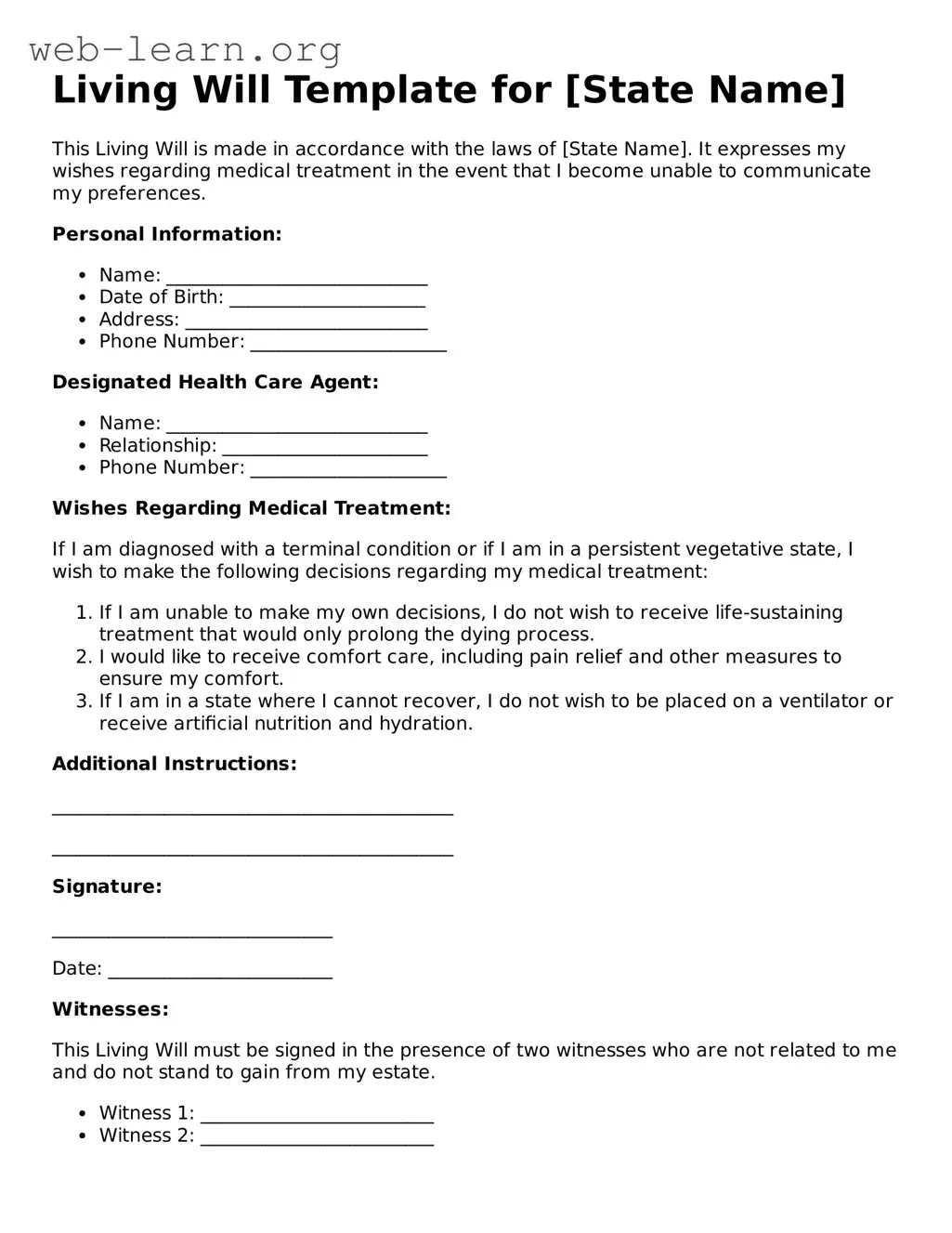
Living Will Template for [State Name]
This Living Will is made in accordance with the laws of [State Name]. It expresses my wishes regarding medical treatment in the event that I become unable to communicate my preferences.
Personal Information:
Designated Health Care Agent:
Wishes Regarding Medical Treatment:
If I am diagnosed with a terminal condition or if I am in a persistent vegetative state, I wish to make the following decisions regarding my medical treatment:
Additional Instructions:
___________________________________________
___________________________________________
Signature:
______________________________
Date: ________________________
Witnesses:
This Living Will must be signed in the presence of two witnesses who are not related to me and do not stand to gain from my estate.
By signing this document, I affirm that I am of sound mind and am making these decisions voluntarily.
| Fact Name | Description |
|---|---|
| Definition | A Living Will is a legal document that outlines a person's preferences for medical treatment in case they become unable to communicate their wishes. |
| Governing Law | In the United States, Living Wills are governed by state law, which can vary significantly from one state to another. |
| Purpose | The primary purpose of a Living Will is to provide guidance to healthcare providers and loved ones regarding end-of-life decisions. |
| Requirements | Most states require that a Living Will be signed in the presence of witnesses or a notary public to be considered valid. |
| Revocation | A Living Will can be revoked at any time by the individual, as long as they are mentally competent to do so. |
| State-Specific Forms | Each state has its own specific form for a Living Will, which must comply with that state's laws to be valid. |
| Durable Power of Attorney | A Living Will is often used in conjunction with a Durable Power of Attorney for healthcare, which designates someone to make decisions on behalf of the individual. |
| Accessibility | It is crucial to share copies of the Living Will with family members, healthcare providers, and anyone involved in the individual's care. |
Filling out a Living Will form is an important step in expressing your healthcare wishes. After completing the form, you will need to sign it and share copies with your healthcare providers and loved ones. This ensures that your preferences are known and respected when it matters most.
What is a Living Will?
A Living Will is a legal document that outlines an individual's preferences regarding medical treatment in situations where they are unable to communicate their wishes. This typically occurs in cases of terminal illness, severe injury, or unconsciousness. The purpose of a Living Will is to ensure that healthcare providers and family members understand and respect the individual's desires regarding life-sustaining treatments.
Who should have a Living Will?
Anyone over the age of 18 should consider having a Living Will. It is particularly important for individuals with chronic illnesses, those facing major surgeries, or anyone who wishes to have control over their medical care in the event they cannot express their wishes. Having a Living Will can provide peace of mind for both the individual and their loved ones.
What should be included in a Living Will?
A Living Will should clearly state the individual's wishes regarding various medical treatments. Common topics include:
Specific instructions can help avoid confusion and ensure that healthcare providers follow the individual's wishes.
How does a Living Will differ from a Power of Attorney for Healthcare?
A Living Will specifically outlines an individual's medical treatment preferences, while a Power of Attorney for Healthcare appoints someone to make medical decisions on behalf of the individual if they are unable to do so. Both documents can work together to ensure that an individual's wishes are honored, but they serve different purposes.
Is a Living Will legally binding?
Yes, a properly executed Living Will is legally binding in most states. To ensure its validity, the document must typically be signed by the individual and witnessed or notarized, depending on state laws. It is important to check local regulations to ensure compliance and that the document will be honored by healthcare providers.
Can a Living Will be changed or revoked?
Yes, an individual can change or revoke their Living Will at any time, as long as they are mentally competent. To make changes, it is advisable to create a new document that explicitly states the updated wishes. Informing healthcare providers and family members about the changes is crucial to avoid any confusion regarding the individual's preferences.
Where should I keep my Living Will?
It is essential to keep the Living Will in a safe but accessible location. Common recommendations include:
Ensuring that the document is easily accessible will help ensure that your wishes are followed in critical situations.
Creating a Living Will is an important step in ensuring that your healthcare preferences are respected in times of medical crisis. However, many individuals make common mistakes when filling out this vital document. Understanding these pitfalls can help you avoid them and ensure your wishes are clearly communicated.
One frequent mistake is failing to clearly define your wishes regarding life-sustaining treatments. It is essential to be explicit about what types of medical interventions you do or do not want. Vague language can lead to confusion and may result in medical professionals making decisions that do not align with your values.
Another common error is neglecting to update the Living Will as circumstances change. Life events such as a new diagnosis, changes in family dynamics, or shifts in personal beliefs can all impact your healthcare preferences. Regularly reviewing and updating your Living Will ensures that it remains relevant and accurately reflects your current wishes.
Many people also overlook the importance of discussing their Living Will with family members and healthcare providers. Without these conversations, loved ones may be left uncertain about your desires during critical moments. Open dialogue can provide clarity and peace of mind for everyone involved.
In addition, some individuals forget to sign and date the document properly. A Living Will that is not signed may be deemed invalid, leaving your wishes unfulfilled. Ensuring that you follow all necessary steps for execution, including witnessing or notarization if required by state law, is crucial.
Another mistake is not designating a healthcare proxy. While a Living Will outlines your preferences, appointing someone to make decisions on your behalf if you are unable to do so is equally important. This person can advocate for your wishes and ensure that your values are upheld in medical situations.
Additionally, individuals sometimes fail to provide copies of their Living Will to relevant parties. Distributing copies to your healthcare providers and loved ones ensures that everyone is aware of your wishes and can act accordingly in a medical crisis.
Lastly, some people mistakenly assume that a Living Will is only necessary for the elderly or those with serious health issues. In reality, anyone over the age of 18 should consider having a Living Will. Life is unpredictable, and having this document in place can provide peace of mind at any age.
By being aware of these common mistakes, you can take the necessary steps to create a Living Will that accurately reflects your healthcare preferences and provides guidance for your loved ones during difficult times.
A Living Will is an important document that outlines your wishes regarding medical treatment in case you become unable to communicate. However, there are several other forms and documents that can complement a Living Will. These documents help ensure that your healthcare preferences are understood and respected. Below is a list of related forms often used alongside a Living Will.
Having these documents in place can provide peace of mind. They ensure that your healthcare preferences are clearly communicated and respected. It’s advisable to review these forms regularly and update them as needed to reflect any changes in your wishes or circumstances.
The Living Will form is similar to several other documents that relate to healthcare decisions and end-of-life planning. Here are eight documents that share similarities with a Living Will:
When filling out a Living Will form, it’s important to be thoughtful and careful. Here are some guidelines to help you navigate the process:
By following these guidelines, you can ensure that your Living Will accurately reflects your wishes and provides clarity for your loved ones and healthcare providers.
Living wills are important documents that express a person's wishes regarding medical treatment in the event they become unable to communicate those wishes themselves. However, several misconceptions exist about living wills that can lead to confusion. Here are seven common misconceptions:
This is not true. Anyone, regardless of age, can benefit from a living will. Accidents or sudden illnesses can happen to anyone, making it wise to have a plan in place.
While both documents deal with medical decisions, they serve different purposes. A living will outlines your wishes for treatment, while a durable power of attorney designates someone to make decisions on your behalf.
Not all states recognize living wills in the same way. It's essential to understand the laws in your state to ensure your wishes will be honored.
This is a misconception. You can update or revoke your living will at any time as long as you are of sound mind.
Living wills can address a variety of medical situations, not just those at the end of life. They can guide decisions about life-sustaining treatments in any critical condition.
This is incorrect. A living will does not prevent you from receiving medical care; it simply outlines your preferences regarding specific treatments.
Living wills can vary widely based on individual preferences and state laws. It's important to tailor the document to reflect your specific wishes.
Understanding these misconceptions can help individuals make informed decisions about their medical care and ensure their wishes are respected.
Filling out a Living Will is an important step in ensuring your healthcare wishes are respected. Here are some key takeaways to keep in mind:
Taking these steps can provide peace of mind, knowing that your healthcare choices will be honored when it matters most.