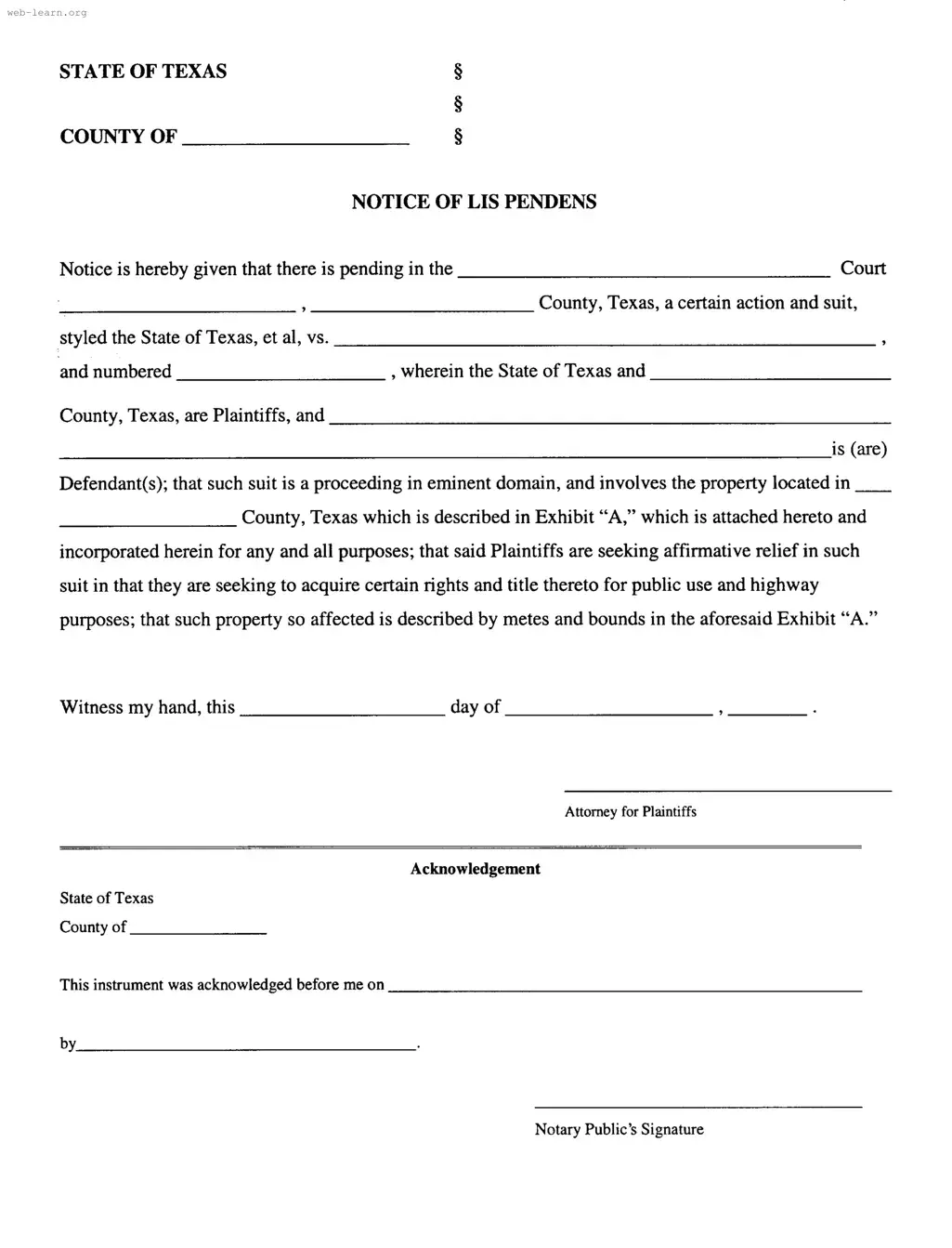
The Lis Pendens form in Texas serves as an important legal notice regarding ongoing litigation that may affect a property. When a lawsuit is filed, particularly in cases involving eminent domain, this form alerts potential buyers or interested parties that a legal claim exists against the property in question. The notice includes details about the court handling the case, the parties involved, and a description of the property affected, often referencing an attached exhibit that provides specific metes and bounds. This proactive measure aims to protect the interests of the plaintiffs, who are typically seeking to acquire rights to the property for public use, such as highway construction. By filing a Lis Pendens, the plaintiffs ensure that anyone considering purchasing or investing in the property is aware of the pending legal action, which could significantly impact their decision. Understanding the implications of this form is crucial for both property owners and prospective buyers in Texas, as it plays a key role in real estate transactions and the protection of property rights.
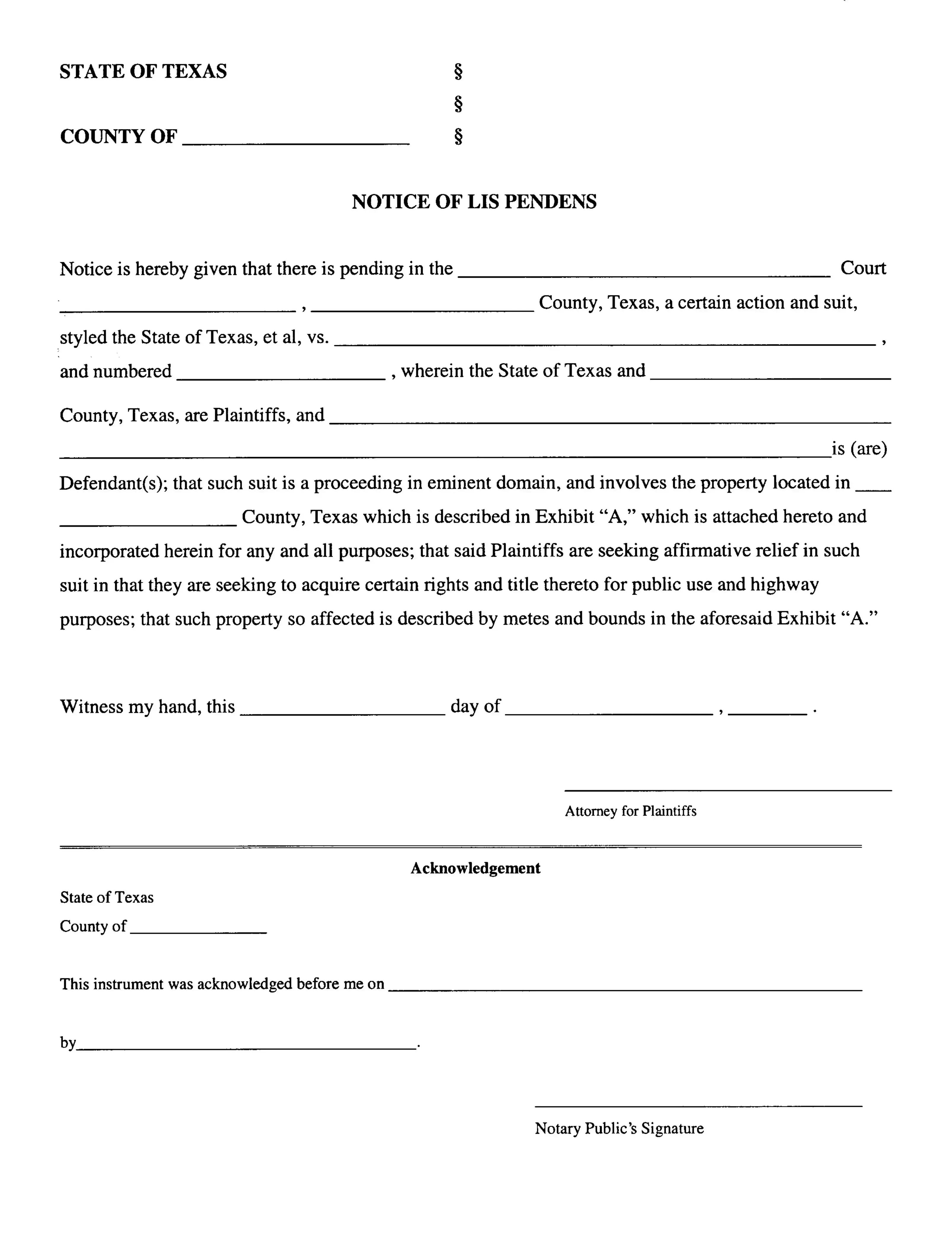
| Fact Name | Details |
|---|---|
| Definition | A Lis Pendens is a legal notice indicating that a lawsuit has been filed concerning a specific property. |
| Purpose | This form serves to inform potential buyers or lenders that there is an ongoing legal dispute involving the property. |
| Governing Law | The use of Lis Pendens in Texas is governed by Texas Property Code, Section 12.007. |
| Filing Requirements | The Lis Pendens must be filed in the county where the property is located to be effective. |
| Notice to Parties | Once filed, the notice provides public awareness, protecting the plaintiffs' interests in the ongoing litigation. |
| Content Requirements | The form must include details such as the court name, case number, parties involved, and a description of the property. |
| Duration | A Lis Pendens remains effective until the lawsuit is resolved or the notice is formally released. |
Filling out the Lis Pendens form in Texas is an important step when there’s a pending legal action that affects a property. Once you complete the form, it will need to be filed with the appropriate county clerk's office. Be sure to keep a copy for your records and confirm that it has been recorded properly.
A Lis Pendens is a legal notice that indicates a lawsuit has been filed concerning a specific piece of property. It serves to inform potential buyers or interested parties that there is an ongoing legal action that may affect the property’s title or ownership. In Texas, this notice is often used in cases of eminent domain, where the government seeks to acquire private property for public use.
You should file a Lis Pendens when you have initiated a lawsuit that involves a claim to real property. This is particularly important if you believe that the outcome of your case could impact the property’s ownership or rights associated with it. Filing the notice helps protect your interests by ensuring that anyone considering purchasing or financing the property is aware of the pending legal action.
To file a Lis Pendens in Texas, you must prepare a notice that includes specific details about the lawsuit, such as the court where the case is filed, the names of the parties involved, and a description of the property in question. After drafting the notice, you will need to file it with the county clerk in the county where the property is located. It’s advisable to consult with an attorney to ensure that the document meets all legal requirements.
A Lis Pendens must include the following information:
Additionally, the notice should be signed by the attorney representing the plaintiffs and may require acknowledgment by a notary public.
If you fail to file a Lis Pendens, you risk losing the ability to protect your claim against the property. Without this notice, potential buyers or lenders may not be aware of the ongoing legal action, and they could proceed with transactions that could undermine your rights. Filing the notice is a crucial step in preserving your legal interests.
A Lis Pendens remains in effect as long as the underlying lawsuit is pending. Once the case is resolved, the Lis Pendens should be formally withdrawn or canceled. This typically involves filing a notice of withdrawal with the county clerk to clear the title for any future transactions involving the property.
Yes, you can remove a Lis Pendens. If the lawsuit is resolved or if you decide to withdraw the notice for any reason, you can file a notice of withdrawal with the county clerk. This action will officially remove the Lis Pendens from the property records, allowing for clear title transfer in future transactions.
Filing a false Lis Pendens can lead to serious legal consequences, including potential liability for damages. If someone files a notice without a legitimate legal claim, they may face lawsuits for slander of title or other claims. It is essential to ensure that the underlying lawsuit is valid and that the Lis Pendens is filed in good faith.
While it is possible to file a Lis Pendens without legal assistance, it is highly recommended to consult with an attorney. Legal professionals can help ensure that the notice is correctly drafted and filed, reducing the risk of errors that could jeopardize your case. Their expertise can be invaluable in navigating the complexities of property law.
Filling out the Lis Pendens form in Texas can be a straightforward process, but mistakes can lead to complications. One common error is failing to include all necessary parties. The form requires the names of all plaintiffs and defendants involved in the case. Omitting even one party can create confusion and may delay the proceedings.
Another frequent mistake is neglecting to provide a clear description of the property. The form requires a detailed description, typically found in Exhibit “A.” If this description is vague or incomplete, it can lead to disputes about the property in question. Clarity is crucial to ensure all parties understand what is being referenced.
People often forget to specify the court where the action is pending. This information is vital as it indicates the jurisdiction handling the case. Without the correct court details, the Lis Pendens may not be properly filed, potentially invalidating the notice.
Inaccurate information about the nature of the suit is another issue. The form must clearly state that the suit involves eminent domain and the purpose of acquiring rights for public use. Misrepresenting this can lead to legal challenges and confusion about the intent of the filing.
Additionally, failing to sign the document can render it ineffective. The form must be signed by the attorney representing the plaintiffs. An unsigned form cannot be properly acknowledged by a notary, which is a critical step in the process.
People sometimes overlook the acknowledgment section. This part requires a notary public to verify the identity of the person signing the document. If this section is not completed correctly, the Lis Pendens may not hold up in court.
Another mistake is not adhering to the filing deadlines. Timeliness is essential in legal matters. If the Lis Pendens is filed too late, it may not serve its intended purpose, and rights to the property could be compromised.
Lastly, individuals may fail to keep a copy of the filed Lis Pendens. Having a record of the filed document is important for future reference and can help in case any disputes arise regarding the filing or the property in question.
When dealing with a Lis Pendens in Texas, several other forms and documents may be relevant to your case. Understanding these documents can help clarify your rights and obligations throughout the legal process. Below is a list of commonly used forms that may accompany a Lis Pendens.
Being aware of these documents can facilitate a smoother legal experience. Each form plays a significant role in the proceedings and helps ensure that all parties are informed and prepared. Always consider consulting with a legal professional for guidance specific to your situation.
The Lis Pendens form in Texas serves as a notice regarding pending legal actions affecting real property. Several other legal documents share similarities with the Lis Pendens form in terms of purpose and function. Below is a list of documents that resemble the Lis Pendens form, along with a brief explanation of how they are similar.
When filling out the Lis Pendens form in Texas, it’s important to pay attention to detail. Here are some dos and don’ts to keep in mind:
By following these guidelines, you can help ensure that your Lis Pendens form is filled out correctly and efficiently. Proper attention to detail can make a significant difference in the legal process.
Misconceptions about the Lis Pendens Texas form can lead to confusion regarding its purpose and implications. Here are four common misconceptions:
Understanding these misconceptions can help individuals navigate property disputes more effectively.
When dealing with the Lis Pendens form in Texas, keep the following key takeaways in mind:
By following these guidelines, you can effectively fill out and utilize the Lis Pendens form in Texas.