When individuals or businesses find themselves in a dispute that may lead to legal action, a Letter of Intent to Sue serves as a crucial first step in the process. This document is not merely a formality; it acts as a formal notice to the opposing party that you are considering legal action due to grievances that have not been resolved through other means. By outlining the specific issues at hand, the letter can clarify the nature of the dispute and the potential claims being considered. Additionally, it often includes a demand for resolution or compensation, which may prompt the other party to reconsider their position before the situation escalates to court. Importantly, this letter can also serve as a tool for negotiation, allowing both parties to engage in dialogue and possibly reach an amicable settlement without the need for litigation. Understanding the components of a Letter of Intent to Sue, including its tone, content, and delivery method, is essential for anyone contemplating legal action, as it can significantly influence the outcome of the dispute.
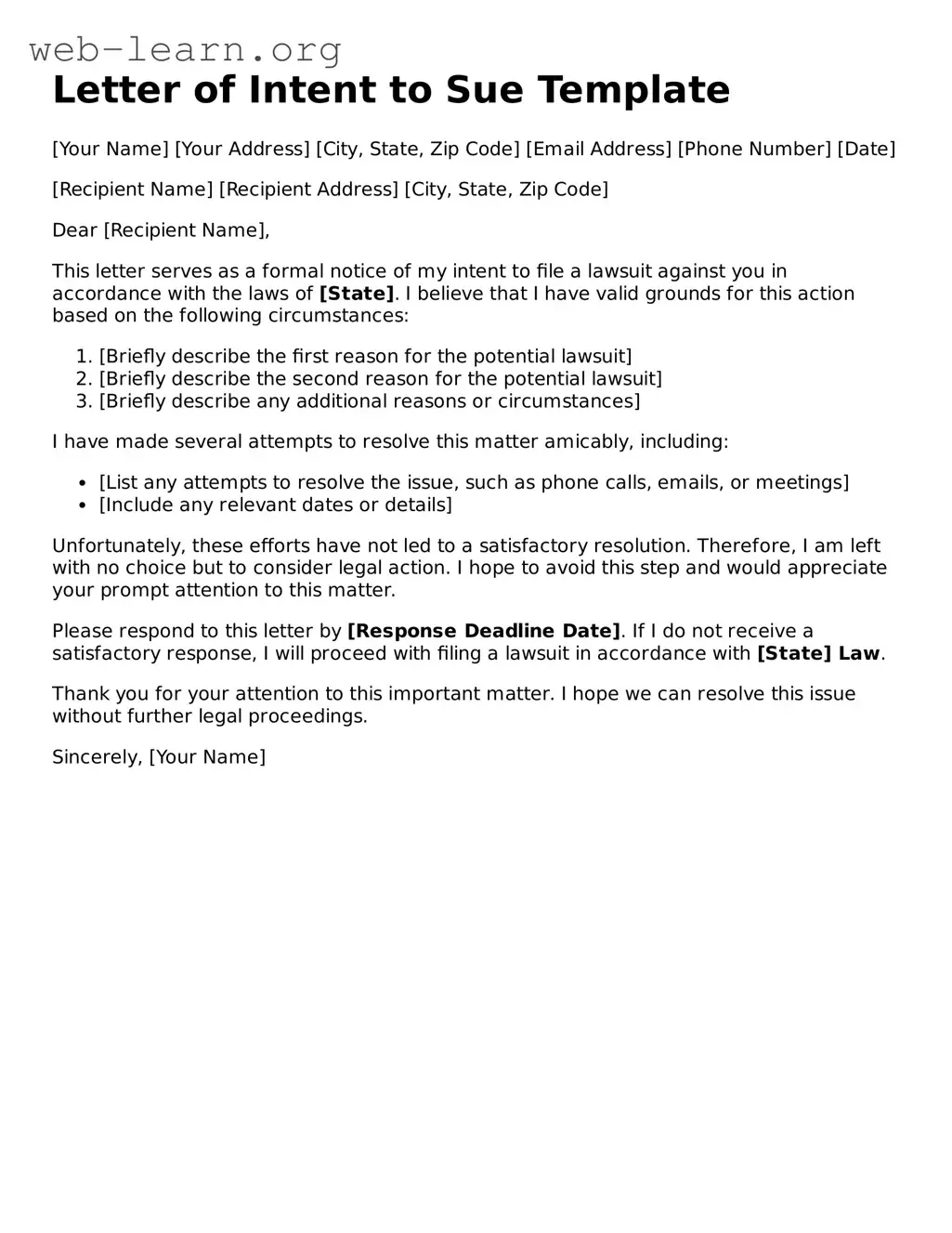
Letter of Intent to Sue Template
[Your Name] [Your Address] [City, State, Zip Code] [Email Address] [Phone Number] [Date]
[Recipient Name] [Recipient Address] [City, State, Zip Code]
Dear [Recipient Name],
This letter serves as a formal notice of my intent to file a lawsuit against you in accordance with the laws of [State]. I believe that I have valid grounds for this action based on the following circumstances:
I have made several attempts to resolve this matter amicably, including:
Unfortunately, these efforts have not led to a satisfactory resolution. Therefore, I am left with no choice but to consider legal action. I hope to avoid this step and would appreciate your prompt attention to this matter.
Please respond to this letter by [Response Deadline Date]. If I do not receive a satisfactory response, I will proceed with filing a lawsuit in accordance with [State] Law.
Thank you for your attention to this important matter. I hope we can resolve this issue without further legal proceedings.
Sincerely, [Your Name]
| Fact Name | Description |
|---|---|
| Purpose | A Letter of Intent to Sue formally notifies the other party of your intention to pursue legal action. |
| State-Specific Forms | Different states may have specific requirements for this form, so it’s important to check local laws. |
| Governing Laws | In states like California, the form may be governed by Civil Code Section 1714. In New York, it can relate to Article 15 of the Civil Practice Law and Rules. |
| Delivery Method | Sending the letter via certified mail is recommended to ensure proof of delivery. |
After completing the Letter of Intent to Sue form, the next steps involve submitting it to the appropriate party and preparing for any potential legal proceedings. This form serves as a formal notification of your intent to take legal action, which may lead to discussions or negotiations before a lawsuit is filed.
A Letter of Intent to Sue is a formal notice indicating that a person intends to file a lawsuit against another party. This document serves to inform the other party of the potential legal action and outlines the reasons for the intended suit.
You should consider sending this letter when you believe you have a valid claim against someone, and you want to give them an opportunity to resolve the issue before proceeding with legal action. It can often lead to a settlement without the need for a lawsuit.
Your letter should include:
No, this letter is not a legally binding document. It serves as a notice and a way to express your intentions. However, it can be an important step in the legal process and may be considered in court if the matter escalates.
You can deliver the letter via certified mail, personal delivery, or email, depending on the situation. Certified mail provides proof of delivery, which can be useful if the dispute escalates.
If you do not receive a response by the deadline specified in your letter, you may proceed with filing a lawsuit. Keep a copy of the letter and any proof of delivery for your records.
Yes, you can draft and send the Letter of Intent to Sue yourself. However, consulting with a legal professional may provide additional insights and help strengthen your position.
If the other party responds with an offer, carefully evaluate it. You can negotiate further or accept the offer if it satisfactorily resolves your issue.
Using a template can be helpful, but ensure that you customize it to fit your specific situation. Each case is unique, and your letter should reflect the details of your dispute.
Filling out a Letter of Intent to Sue form can be a daunting task, and many individuals make mistakes that could delay or even derail their legal intentions. One common error is failing to provide complete contact information. Without accurate details, the recipient may not be able to respond, which can hinder the entire process.
Another mistake is neglecting to clearly state the reason for the lawsuit. It's crucial to articulate the specific issues at hand. Vague descriptions can lead to misunderstandings or misinterpretations, which may weaken your position.
Many people also overlook the importance of including all relevant dates. Missing key dates can create confusion about the timeline of events. This information is essential for establishing a clear narrative and supporting your claims.
Additionally, some individuals forget to attach supporting documents. Evidence, such as contracts, emails, or photographs, can significantly bolster your case. Without these attachments, your claims may lack the necessary support.
Another frequent oversight is not reviewing the form for errors. Typos or incorrect information can undermine your credibility. Taking the time to proofread can make a significant difference in how your intent is perceived.
People often fail to sign and date the form. A signature indicates that you stand behind the information provided. Without it, the form may be considered incomplete or invalid.
Some individuals do not keep a copy of the submitted form. This can lead to complications if you need to reference it later. Always retain a copy for your records to ensure you have access to all pertinent information.
Another mistake is not understanding the legal implications of the form. It’s important to recognize that submitting this letter can initiate a legal process. Being aware of this can help you approach the situation with the seriousness it deserves.
Additionally, many people fail to follow up after sending the letter. If you don’t receive a response in a reasonable timeframe, it’s wise to reach out. This shows that you are serious about your intentions and can prompt action.
Lastly, individuals sometimes underestimate the importance of clarity and professionalism in their writing. Using a respectful tone and clear language can help convey your seriousness and commitment to resolving the issue. A well-crafted letter can significantly impact how your intentions are received.
A Letter of Intent to Sue is a crucial document that indicates a party's intention to initiate legal proceedings. However, this letter is often accompanied by several other forms and documents that help clarify the situation and provide necessary information. Below is a list of commonly used documents that may accompany the Letter of Intent to Sue.
These documents play vital roles in the legal process, providing structure and clarity to the proceedings. Understanding each of these forms can help individuals navigate the complexities of legal actions more effectively.
The Letter of Intent to Sue form serves as a preliminary notice indicating a party's intention to pursue legal action. Several other documents share similarities with this form, often serving as initial communications or formal notifications in various legal contexts. Below is a list of nine such documents, each highlighting its connection to the Letter of Intent to Sue.
When completing the Letter of Intent to Sue form, it’s important to follow certain guidelines to ensure clarity and accuracy. Below are some key dos and don’ts to consider.
The Letter of Intent to Sue form often generates confusion. Here are four common misconceptions about this important document:
Understanding these misconceptions can help individuals navigate the complexities of potential legal disputes more effectively.
When filling out and using the Letter of Intent to Sue form, it is essential to keep the following key takeaways in mind:
Intent to Vacate Letter Template - Serves as a record of communication between the tenant and landlord.
Homeschool Letter of Intent - This document is a way to communicate your educational philosophy and approach to your local education authorities.