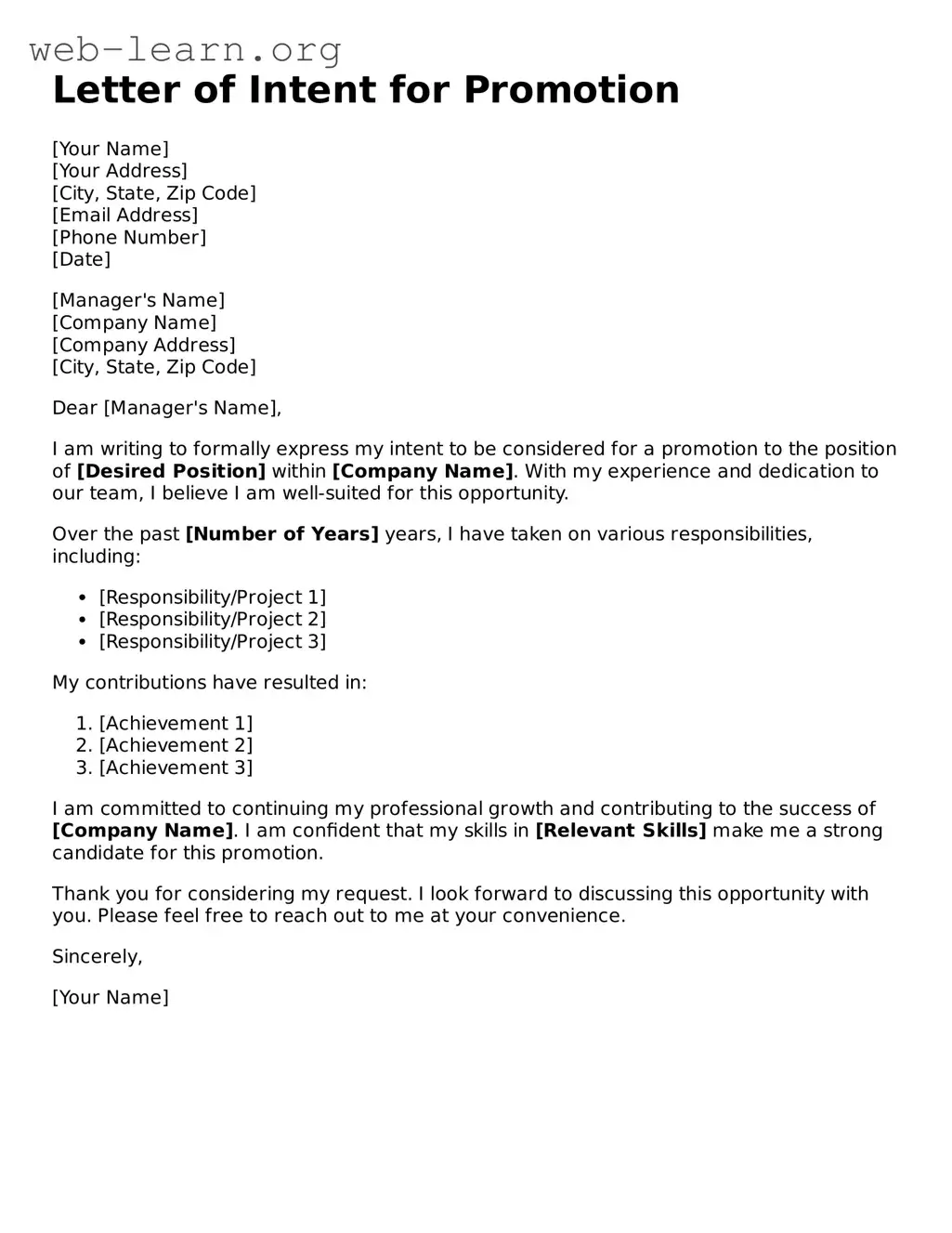
The Letter of Intent for Promotion form serves as a crucial tool in the career advancement process within many organizations. It outlines an employee's intention to pursue a higher position, providing a structured way to communicate aspirations and qualifications to management. This form typically includes sections for detailing the employee's current role, highlighting relevant achievements, and specifying the desired position. Additionally, it may require the inclusion of a personal statement that articulates the employee's vision for their future contributions. By using this form, employees not only express their ambition but also demonstrate their commitment to the organization’s goals. The submission of this form can initiate important conversations about professional development, mentorship opportunities, and the potential for upward mobility within the company. Understanding the nuances of this form can empower employees to advocate effectively for their career advancement.
Letter of Intent for Promotion
[Your Name]
[Your Address]
[City, State, Zip Code]
[Email Address]
[Phone Number]
[Date]
[Manager's Name]
[Company Name]
[Company Address]
[City, State, Zip Code]
Dear [Manager's Name],
I am writing to formally express my intent to be considered for a promotion to the position of [Desired Position] within [Company Name]. With my experience and dedication to our team, I believe I am well-suited for this opportunity.
Over the past [Number of Years] years, I have taken on various responsibilities, including:
My contributions have resulted in:
I am committed to continuing my professional growth and contributing to the success of [Company Name]. I am confident that my skills in [Relevant Skills] make me a strong candidate for this promotion.
Thank you for considering my request. I look forward to discussing this opportunity with you. Please feel free to reach out to me at your convenience.
Sincerely,
[Your Name]
| Fact Name | Description |
|---|---|
| Purpose | A Letter of Intent for Promotion outlines an employee's desire to be considered for a promotion within the company. |
| Format | The letter is typically structured formally, including a header, salutation, body, and closing. |
| Content | It should detail the employee's qualifications, accomplishments, and reasons for seeking the promotion. |
| Submission | Employees usually submit this letter to their direct supervisor or HR department. |
| Timing | Submitting the letter at the right time, such as during performance reviews, can enhance its impact. |
| State-Specific Forms | Some states may have specific guidelines or forms for promotions; check local employment laws. |
| Governing Laws | Employment laws vary by state; refer to local labor regulations for compliance. |
Once you have gathered all necessary information and documents, you can proceed to fill out the Letter of Intent for Promotion form. Completing this form accurately is crucial for ensuring that your request for promotion is considered appropriately.
What is a Letter of Intent for Promotion?
A Letter of Intent for Promotion is a formal document that an employee submits to express their interest in being promoted within their organization. This letter typically outlines the employee's qualifications, achievements, and reasons for seeking advancement. It serves as a way for the employee to communicate their career aspirations to management and can be an important step in the promotion process.
Who should submit a Letter of Intent for Promotion?
Any employee who believes they meet the qualifications for a higher position within their company should consider submitting this letter. It is particularly relevant for those who have taken on additional responsibilities, demonstrated leadership, or have consistently exceeded performance expectations. Employees should assess their readiness and the specific requirements of the desired position before proceeding.
What should be included in the Letter of Intent for Promotion?
When drafting a Letter of Intent for Promotion, several key elements should be included:
How should the Letter of Intent for Promotion be formatted?
The letter should be formatted professionally, resembling a business letter. This includes using a standard font and size, such as Times New Roman or Arial in size 12. The letter should begin with the employee's contact information, followed by the date, and then the recipient's information. A formal greeting, a well-structured body, and a polite closing should be included to convey professionalism.
Is there a specific timeline for submitting a Letter of Intent for Promotion?
While there is no universally mandated timeline, it is advisable to submit the letter well in advance of any formal promotion review process. Employees should be aware of their organization’s promotion cycles and deadlines. Timing can be critical; submitting the letter during performance review periods or when a position becomes available can increase visibility and consideration.
What happens after submitting the Letter of Intent for Promotion?
After submission, the employee should anticipate a review process. Management may reach out for a meeting to discuss the letter and the employee’s qualifications further. This meeting can serve as an opportunity for the employee to elaborate on their intentions and aspirations. Depending on the company’s policies, the promotion decision may take time, and feedback may be provided at various stages.
Filling out a Letter of Intent for Promotion form can be a crucial step in advancing your career. However, many individuals make common mistakes that can hinder their chances of success. Understanding these pitfalls can help you present a stronger case for your promotion.
One frequent mistake is failing to clearly state your intentions. It's essential to explicitly mention that you are seeking a promotion. Vague language can lead to confusion about your goals. Be direct and specific about the position you are interested in and why you believe you are qualified for it.
Another common error involves neglecting to highlight achievements. The promotion form is an opportunity to showcase your contributions to the company. Many people forget to include specific examples of their accomplishments, which can make their case less compelling. Use metrics and tangible results to demonstrate your impact on the organization.
Additionally, some individuals overlook the importance of tailoring the letter to the company’s values. Each organization has its own culture and priorities. Failing to align your intentions with the company’s mission can weaken your application. Research the company’s goals and reflect how your promotion would contribute to them.
Another mistake is not proofreading the document before submission. Spelling and grammatical errors can create a negative impression. Taking the time to review your letter ensures that it is polished and professional. Consider asking a colleague to read it over as well; a fresh set of eyes can catch mistakes you might have missed.
Furthermore, some applicants make the error of submitting the form without sufficient supporting documentation. Including additional materials, such as performance reviews or letters of recommendation, can strengthen your case. Ensure that you provide all necessary documentation to support your request for promotion.
Finally, many individuals underestimate the importance of following the submission guidelines. Each organization may have specific requirements regarding how the letter should be formatted or submitted. Ignoring these guidelines can result in your application being overlooked or rejected. Always double-check the instructions to ensure compliance.
When seeking a promotion within an organization, various forms and documents may accompany the Letter of Intent for Promotion. Each of these documents plays a critical role in presenting your case for advancement. Below is a list of common forms and documents that are often used alongside the Letter of Intent for Promotion.
Each of these documents supports your Letter of Intent for Promotion by providing additional context and evidence of your qualifications. By preparing a comprehensive package, you enhance your chances of making a compelling case for your advancement.
The Letter of Intent for Promotion form is an important document in many professional settings. It serves as a formal expression of interest in a promotion and outlines the qualifications and reasons for seeking advancement. Several other documents share similarities with this form. Here’s a breakdown of those documents:
Each of these documents plays a role in professional advancement, showcasing qualifications and intentions in various contexts. Understanding their similarities can help individuals effectively communicate their career goals.
When filling out the Letter of Intent for Promotion form, there are certain actions to take and avoid to ensure clarity and effectiveness. Below is a list of dos and don'ts.
Understanding the Letter of Intent for Promotion form is crucial for anyone seeking advancement. However, several misconceptions can lead to confusion. Here are nine common misconceptions clarified:
The Letter of Intent for Promotion is not a legally binding document. It expresses your intention to pursue a promotion but does not guarantee it.
Any employee eligible for promotion can submit a Letter of Intent. This form is not restricted to managerial positions.
While some may prefer to hand it in directly, electronic submission is often acceptable. Check your company's policy for specific guidelines.
Submitting the letter does not ensure that your qualifications will be reviewed. The decision to evaluate rests with management.
A concise letter is often more effective. Focus on your intentions and qualifications without overwhelming detail.
Use clear and straightforward language. The goal is to communicate your intent, not to impress with legal terminology.
While there may be preferred times for submission, it is not always strictly enforced. Check with your HR department for guidance.
You can submit multiple letters for different positions, provided you meet the qualifications for each role.
Submitting a Letter of Intent should not harm your current standing. It shows ambition and a desire for growth within the company.
By addressing these misconceptions, you can approach the Letter of Intent for Promotion with clarity and confidence. Always refer to your company's specific guidelines for any additional requirements or recommendations.
When filling out and using the Letter of Intent for Promotion form, keep these key takeaways in mind:
Intent to Purchase Agreement - It may include contingencies that need to be addressed before the sale.
Intent to Vacate Letter Template - Helps ensure that tenants receive their security deposit in a timely manner.
Letter of Interest Sample for Job Application - The Investment Letter of Intent helps clarify the expectations and responsibilities of all parties involved.