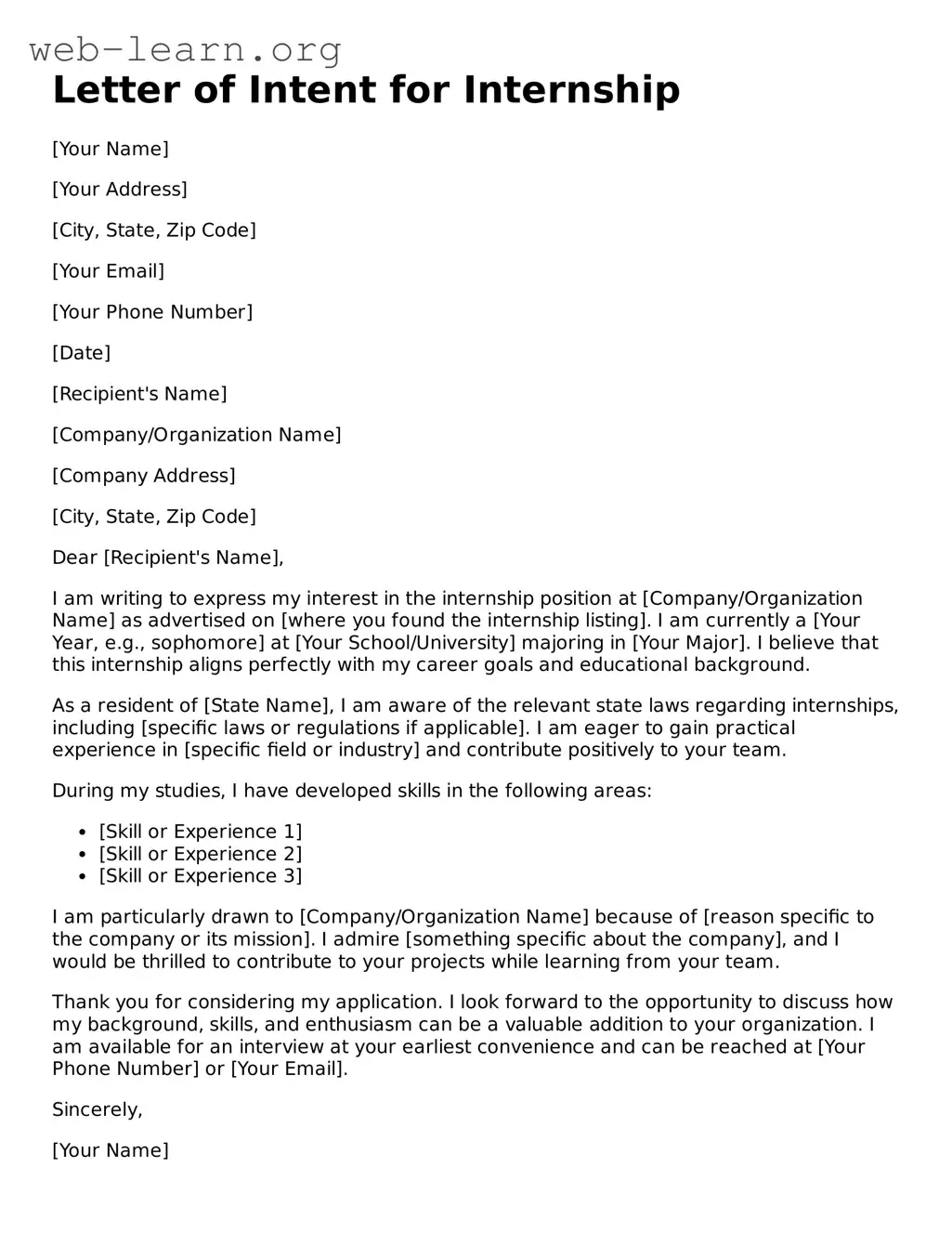
When embarking on an internship, one of the essential steps is often the completion of a Letter of Intent for Internship form. This document serves as a formal expression of interest in a specific internship position and outlines the applicant's goals, qualifications, and motivations. Typically, the form includes sections for personal information, educational background, and relevant skills or experiences. Additionally, it may require a brief statement on why the applicant is interested in the internship and how it aligns with their career aspirations. Employers use this form not only to assess the candidate's fit for the role but also to gauge their enthusiasm and commitment. A well-crafted Letter of Intent can set the tone for the entire internship application process, making it a crucial component for aspiring interns. Understanding the key elements of this form can greatly enhance one’s chances of securing a valuable internship opportunity.
Letter of Intent for Internship
[Your Name]
[Your Address]
[City, State, Zip Code]
[Your Email]
[Your Phone Number]
[Date]
[Recipient's Name]
[Company/Organization Name]
[Company Address]
[City, State, Zip Code]
Dear [Recipient's Name],
I am writing to express my interest in the internship position at [Company/Organization Name] as advertised on [where you found the internship listing]. I am currently a [Your Year, e.g., sophomore] at [Your School/University] majoring in [Your Major]. I believe that this internship aligns perfectly with my career goals and educational background.
As a resident of [State Name], I am aware of the relevant state laws regarding internships, including [specific laws or regulations if applicable]. I am eager to gain practical experience in [specific field or industry] and contribute positively to your team.
During my studies, I have developed skills in the following areas:
I am particularly drawn to [Company/Organization Name] because of [reason specific to the company or its mission]. I admire [something specific about the company], and I would be thrilled to contribute to your projects while learning from your team.
Thank you for considering my application. I look forward to the opportunity to discuss how my background, skills, and enthusiasm can be a valuable addition to your organization. I am available for an interview at your earliest convenience and can be reached at [Your Phone Number] or [Your Email].
Sincerely,
[Your Name]
| Fact Name | Description |
|---|---|
| Purpose | A Letter of Intent for Internship outlines the agreement between the intern and the organization regarding the internship's terms. |
| Components | Typically includes the intern's name, the organization’s name, duration of the internship, and specific duties. |
| Binding Nature | This letter is generally not legally binding but serves as a formal acknowledgment of the internship arrangement. |
| State-Specific Laws | In California, for instance, internships must comply with the California Labor Code regarding unpaid internships. |
| Signatures | Both the intern and a representative from the organization should sign the letter to confirm mutual agreement. |
| Submission | The completed letter is often submitted to the educational institution, if applicable, for academic credit consideration. |
Once you have your Letter of Intent for Internship form ready, it's time to fill it out carefully. This document is important for expressing your interest and outlining your goals for the internship. Follow these steps to complete the form accurately.
After completing the form, you will be ready to submit it along with any other required documents. Good luck with your internship application!
What is a Letter of Intent for Internship?
A Letter of Intent for Internship is a formal document that expresses a candidate's interest in a specific internship position. It outlines the applicant's qualifications, goals, and reasons for wanting to work with a particular organization. This letter serves as an introduction and sets the tone for the application process.
Why is the Letter of Intent important?
The Letter of Intent is crucial because it allows candidates to convey their enthusiasm and commitment to the internship opportunity. It provides a chance to highlight relevant skills and experiences that may not be fully captured in a resume. Additionally, it helps the employer gauge the candidate's motivation and fit for the organization.
What should be included in the Letter of Intent?
When writing a Letter of Intent, consider including the following elements:
How long should the Letter of Intent be?
The Letter of Intent should typically be one page long. Aim for a concise and focused approach. Use clear language and avoid overly complex sentences. This ensures that the reader can quickly grasp your intentions and qualifications.
Who should I address the Letter of Intent to?
Address the Letter of Intent to the specific person responsible for hiring interns, if possible. This may be the internship coordinator, a hiring manager, or the department head. If you cannot find a name, using a general greeting such as "Dear Hiring Manager" is acceptable.
Is it necessary to customize the Letter of Intent for each internship application?
Yes, it is highly recommended to customize the Letter of Intent for each internship application. Tailoring your letter shows that you have researched the organization and understand its values and goals. This personalized approach can significantly enhance your chances of standing out among other candidates.
Should I mention my availability in the Letter of Intent?
Absolutely. Including your availability in the Letter of Intent can help the employer understand your schedule and commitment level. Clearly state the start and end dates of your availability, as well as any flexibility you may have.
How should I conclude the Letter of Intent?
Conclude your Letter of Intent with a professional closing statement. Thank the reader for considering your application and express your eagerness to discuss your qualifications further. Use a formal closing, such as "Sincerely" or "Best regards," followed by your name.
What are common mistakes to avoid in a Letter of Intent?
When writing your Letter of Intent, steer clear of the following common mistakes:
Filling out a Letter of Intent for an internship can be a pivotal step in securing a position that can shape your career. However, many applicants make common mistakes that can hinder their chances of success. Understanding these pitfalls can help you present yourself in the best light possible.
One frequent mistake is failing to tailor the letter to the specific internship. Generic letters can come across as insincere. Instead, take the time to research the organization and mention specific aspects that attract you to the internship. This shows genuine interest and effort.
Another common error is neglecting to proofread. Spelling and grammatical errors can create a negative impression. Even minor mistakes can distract from the content of your letter. Always review your letter multiple times, and consider asking someone else to read it for clarity and correctness.
Many applicants also overlook the importance of a strong opening. The first few sentences should grab the reader’s attention. A bland introduction can make your letter blend in with others. Start with a compelling statement about your passion for the field or your excitement about the opportunity.
Additionally, some people fail to clearly state their goals and intentions. It’s important to articulate what you hope to gain from the internship and how it aligns with your career aspirations. This helps the reader understand your motivation and commitment.
Another mistake is being too vague about skills and experiences. While it’s great to express enthusiasm, backing it up with specific examples is crucial. Highlight relevant coursework, projects, or previous experiences that demonstrate your qualifications for the internship.
Some applicants also forget to address the letter to a specific person. Using a generic greeting, such as "To Whom It May Concern," can make your application feel impersonal. If possible, find out the name of the hiring manager or the person responsible for the internship program.
Failing to follow instructions is another common error. Each internship may have specific requirements for the letter. Ignoring these can lead to your application being dismissed. Pay close attention to any guidelines provided regarding length, format, or content.
Moreover, some individuals write too much or too little. Striking the right balance is essential. A concise letter that communicates your points clearly is more effective than a lengthy one that dilutes your message. Aim for clarity and brevity.
Lastly, many applicants forget to include a closing statement that expresses gratitude. A simple thank you for considering your application can leave a positive impression. It shows professionalism and respect for the reader’s time.
By avoiding these common mistakes, you can enhance your Letter of Intent for Internship and increase your chances of making a lasting impression. Focus on clarity, personalization, and professionalism to present your best self.
A Letter of Intent for Internship serves as a formal declaration of a candidate's interest in an internship position. Several other documents often accompany this letter to provide additional information and support the application. The following list outlines key forms and documents that may be required or beneficial in the internship application process.
These documents collectively strengthen an internship application by providing a comprehensive view of the candidate's qualifications and readiness for the position. Preparing these materials in advance can enhance the likelihood of securing the desired internship opportunity.
Cover Letter: A cover letter introduces a candidate to a potential employer. Like the Letter of Intent for Internship, it outlines the applicant's interest in a position and highlights relevant skills and experiences. Both documents serve as a first impression and aim to persuade the reader to consider the applicant for an opportunity.
Resume: A resume provides a detailed account of a candidate's education, work experience, and skills. Similar to the Letter of Intent for Internship, it is a crucial document in the application process. While the resume lists qualifications, the Letter of Intent offers a narrative that explains how those qualifications align with the internship role.
Statement of Purpose: A statement of purpose is often required for academic programs. Like the Letter of Intent, it articulates an individual's goals and motivations. Both documents allow the writer to express their aspirations and demonstrate how the opportunity will help them achieve their objectives.
Application Form: An application form collects essential information about a candidate. While it typically contains standard questions, the Letter of Intent for Internship adds a personal touch. It allows candidates to express their enthusiasm and provide context for their qualifications beyond the basic information requested in an application form.
Thank You Letter: A thank you letter is sent after an interview or meeting. Similar to the Letter of Intent, it reflects the candidate's appreciation and reinforces their interest in the opportunity. Both documents help maintain a connection with the employer and can influence the decision-making process.
When completing the Letter of Intent for Internship form, it is essential to follow certain guidelines to ensure clarity and professionalism. Here is a list of things to do and avoid.
The Letter of Intent for Internship form is often misunderstood. Here are nine common misconceptions:
Understanding these misconceptions can help individuals navigate the internship application process more effectively.
When it comes to filling out and using the Letter of Intent for Internship form, there are several important points to keep in mind. Here are some key takeaways that can help you navigate this process effectively:
By keeping these points in mind, you can create a compelling Letter of Intent that increases your chances of securing that internship.
Letter of Intent Template Medical School - A section to highlight your communication skills and their importance in medicine.
Sample Letter of Intent for Promotion Within Company - The letter may include any relevant training or certifications that support the promotion request.
Sue Letter of Intent to Take Legal Action Template - The letter can serve as a call to action for the recipient.