Creating a Last Will and Testament is an important step in planning for the future and ensuring that your wishes are honored after you pass away. This legal document outlines how your assets will be distributed, who will care for any minor children, and any specific instructions you may have regarding your funeral or burial. A well-drafted will can help prevent disputes among family members and provide clarity during a difficult time. It typically includes key elements such as the appointment of an executor, who is responsible for managing your estate, and the designation of beneficiaries, who will receive your property. Additionally, a will may include provisions for guardianship if you have dependents. Understanding these components can help you create a comprehensive document that reflects your intentions and provides peace of mind for you and your loved ones.
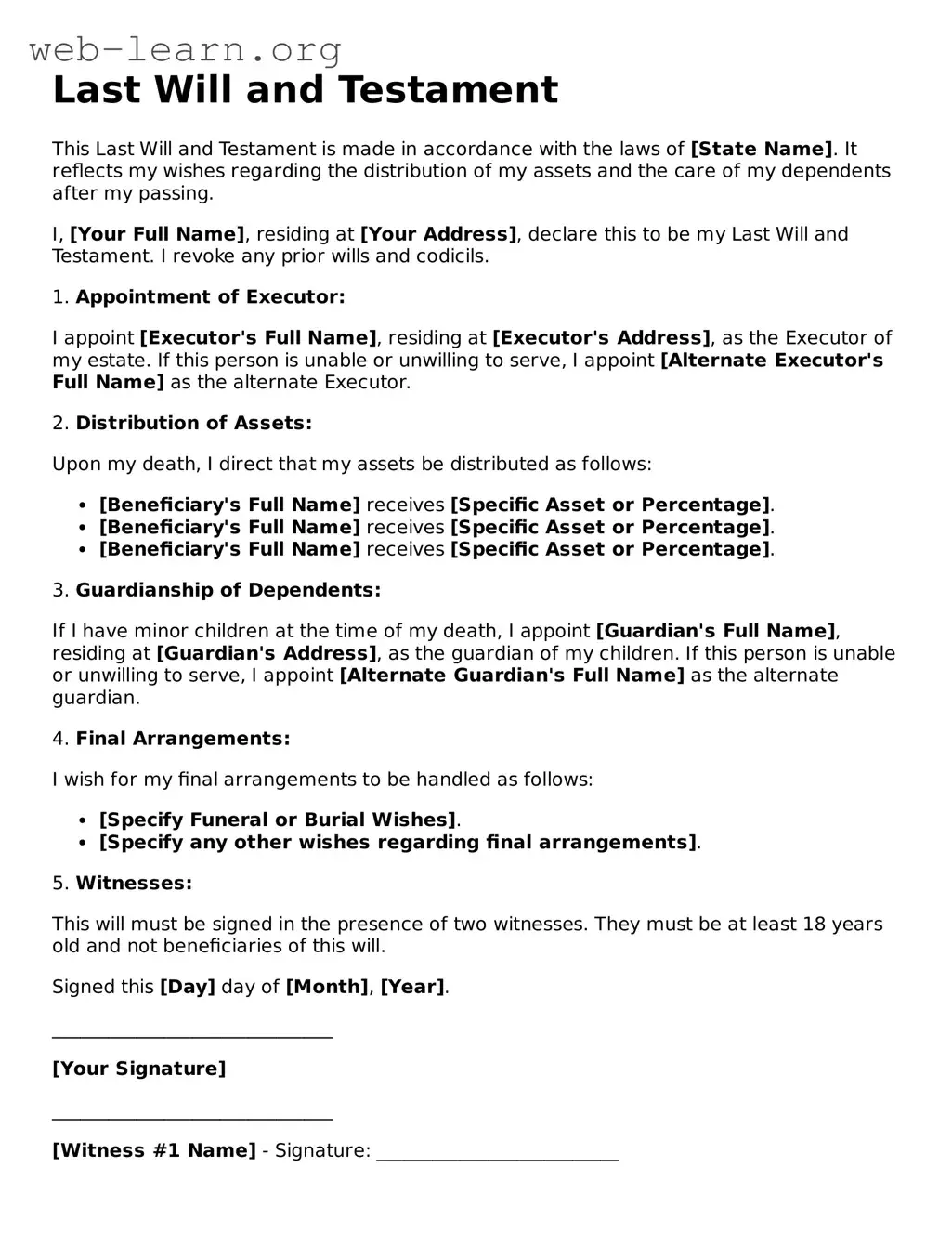
Last Will and Testament
This Last Will and Testament is made in accordance with the laws of [State Name]. It reflects my wishes regarding the distribution of my assets and the care of my dependents after my passing.
I, [Your Full Name], residing at [Your Address], declare this to be my Last Will and Testament. I revoke any prior wills and codicils.
1. Appointment of Executor:
I appoint [Executor's Full Name], residing at [Executor's Address], as the Executor of my estate. If this person is unable or unwilling to serve, I appoint [Alternate Executor's Full Name] as the alternate Executor.
2. Distribution of Assets:
Upon my death, I direct that my assets be distributed as follows:
3. Guardianship of Dependents:
If I have minor children at the time of my death, I appoint [Guardian's Full Name], residing at [Guardian's Address], as the guardian of my children. If this person is unable or unwilling to serve, I appoint [Alternate Guardian's Full Name] as the alternate guardian.
4. Final Arrangements:
I wish for my final arrangements to be handled as follows:
5. Witnesses:
This will must be signed in the presence of two witnesses. They must be at least 18 years old and not beneficiaries of this will.
Signed this [Day] day of [Month], [Year].
______________________________
[Your Signature]
______________________________
[Witness #1 Name] - Signature: __________________________
______________________________
[Witness #2 Name] - Signature: __________________________
| Fact Name | Details |
|---|---|
| Definition | A Last Will and Testament is a legal document that outlines how a person's assets will be distributed after their death. |
| State-Specific Forms | Each state has its own requirements and forms for a Last Will and Testament, which may vary significantly. |
| Governing Laws | The Uniform Probate Code (UPC) provides a framework, but individual states govern the specifics of wills. |
| Witness Requirements | Most states require at least two witnesses to sign the will for it to be valid. |
| Revocation | A Last Will can be revoked or modified at any time, as long as the person is mentally competent. |
Filling out a Last Will and Testament form is an important step in planning for the future. After completing the form, it will need to be signed and witnessed according to your state’s laws. This ensures that your wishes are respected and legally recognized.
A Last Will and Testament is a legal document that outlines how a person's assets and affairs should be handled after their death. It allows individuals to specify who will inherit their property, appoint guardians for minor children, and designate an executor to ensure that their wishes are carried out. Creating this document is an important step in planning for the future and can help avoid disputes among family members.
Anyone who has assets, dependents, or specific wishes regarding their estate should consider creating a Last Will and Testament. This includes parents with minor children, individuals with significant assets, or those who wish to leave specific items to certain people. Even if you believe your estate is small, having a will can provide clarity and peace of mind for your loved ones.
If an individual dies without a will, they are said to have died "intestate." In this situation, state laws will determine how their assets are distributed. This process can be lengthy and may not reflect the deceased's wishes, leading to potential disputes among family members. Having a will ensures that your preferences are honored and helps streamline the distribution process.
Yes, you can change your Last Will and Testament at any time while you are still alive and mentally competent. This is often done through a document called a codicil, which allows for modifications without creating a new will. However, if the changes are substantial, it may be advisable to draft a new will entirely to avoid confusion.
While it is not legally required to have a lawyer draft your will, consulting with one can be beneficial. A lawyer can help ensure that your will complies with state laws, accurately reflects your wishes, and addresses any complex situations, such as blended families or significant assets. If you choose to create a will without legal assistance, be sure to follow your state’s guidelines closely.
To ensure that your Last Will and Testament is valid, you must follow the legal requirements of your state. Generally, this includes being of sound mind, signing the document in the presence of witnesses, and having those witnesses sign as well. Some states also require notarization. It is essential to check your state’s specific laws to avoid any potential issues.
Creating a Last Will and Testament is an important step in ensuring your wishes are honored after your passing. However, many individuals make common mistakes when filling out this crucial document. One of the most frequent errors is failing to be specific about beneficiaries. Vague language can lead to confusion and disputes among family members. For instance, simply stating “my children” without naming them can cause issues if there are multiple children or if a child is estranged.
Another common mistake is neglecting to update the will after major life events. Changes such as marriage, divorce, or the birth of a child should prompt a review of your will. Failing to make these updates can result in unintended consequences, like leaving assets to an ex-spouse or omitting a new child from inheritance.
Many people also overlook the importance of having witnesses sign the will. In most states, a will must be signed in the presence of at least two witnesses who are not beneficiaries. Without proper witnessing, the document may be deemed invalid, leaving your wishes unfulfilled.
Some individuals mistakenly believe that a handwritten will is sufficient. While handwritten wills, known as holographic wills, can be valid in certain states, they often lack the formalities required for a traditional will. This can lead to complications during the probate process, making it essential to follow the legal requirements in your state.
Additionally, failing to include a residuary clause can create problems. This clause addresses what happens to any assets not specifically mentioned in the will. Without it, any leftover assets may be distributed according to state laws, which may not align with your wishes.
Lastly, people often forget to store their will in a safe yet accessible place. A will that cannot be found when needed can lead to delays and disputes. It’s wise to inform trusted family members or an attorney about its location to ensure it can be easily located when the time comes.
A Last Will and Testament is an essential document for outlining how an individual's assets should be distributed after their passing. However, there are several other forms and documents that often accompany a will to ensure a comprehensive estate plan. Each of these documents serves a unique purpose and can help clarify the individual's wishes, provide guidance to loved ones, or facilitate the probate process.
Incorporating these documents into an estate plan can provide clarity and peace of mind. Each plays a vital role in ensuring that an individual's wishes are honored and that their loved ones are supported during difficult times.
The Last Will and Testament form shares similarities with several other legal documents. Each of these documents serves a specific purpose related to estate planning and the distribution of assets. Below is a list of six documents that are similar to a Last Will and Testament:
When filling out a Last Will and Testament form, attention to detail is crucial. Here are five things to consider:
Following these guidelines can help ensure that your Last Will and Testament accurately reflects your wishes and provides clarity for your loved ones.
When it comes to creating a Last Will and Testament, there are several common misconceptions that can lead to confusion. Understanding the facts can help ensure that your wishes are honored and your loved ones are taken care of.
By clearing up these misconceptions, you can take the necessary steps to create a will that truly reflects your wishes and protects your loved ones.
When filling out and using a Last Will and Testament form, it is important to keep several key points in mind. These takeaways can help ensure that your wishes are clearly stated and legally valid.
By following these guidelines, you can create a Last Will and Testament that reflects your wishes and provides peace of mind for you and your loved ones.