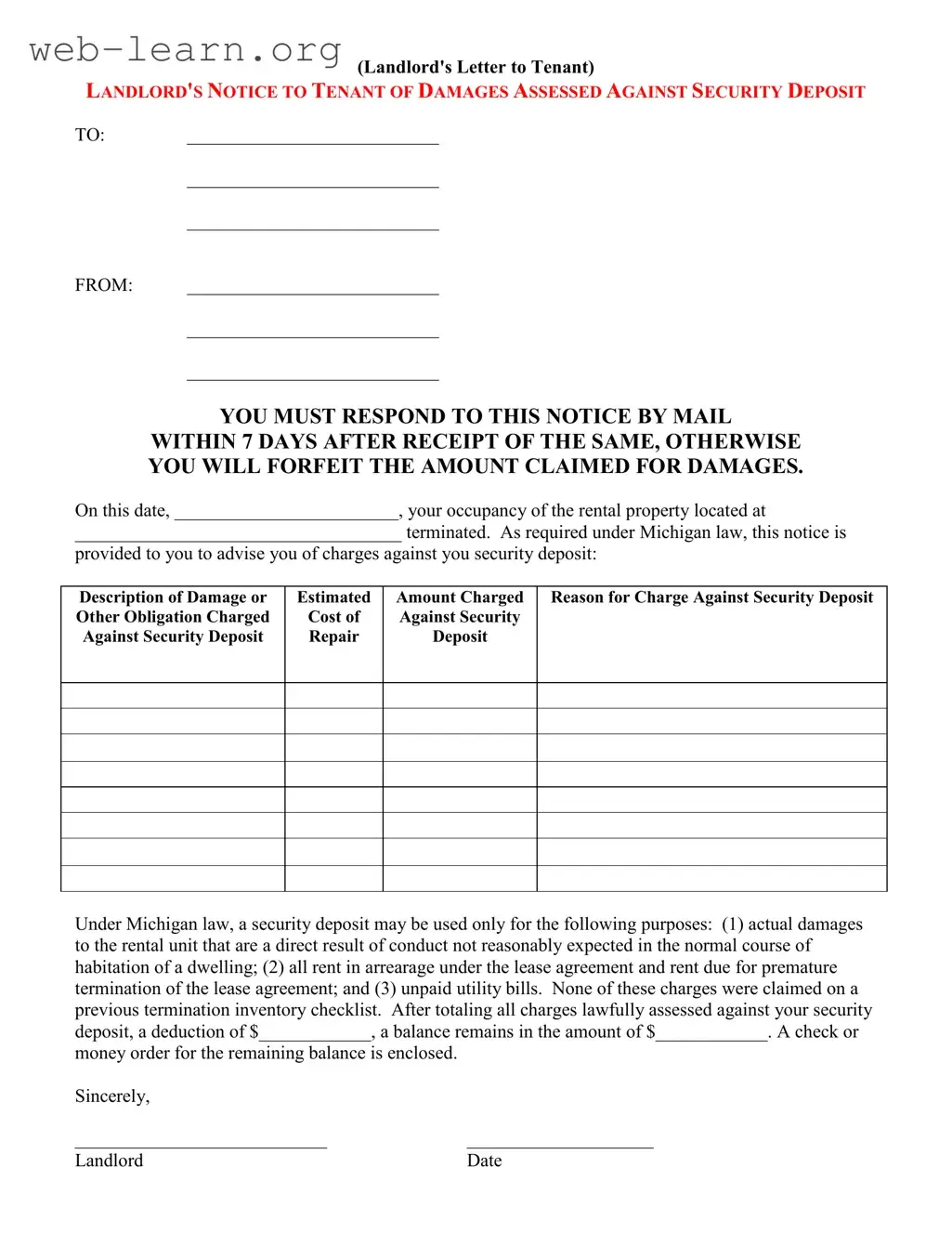
When a tenant moves out of a rental property, the landlord often needs to assess any damages that may have occurred during the tenancy. The Landlord Damages Letter form serves as an official notice to the tenant regarding deductions from their security deposit. This form outlines specific damages and the corresponding costs, making it clear what charges are being claimed. It is important for tenants to respond promptly—within seven days of receiving the notice—to avoid forfeiting their right to contest the charges. The letter details the reasons for the deductions, which can include actual damages, unpaid rent, or utility bills, all in accordance with Michigan law. The form also provides a summary of the remaining balance after deductions, ensuring transparency in the process. By using this form, landlords communicate their intentions clearly, while tenants are given the opportunity to understand and address any concerns regarding their security deposit.

(Landlord's Letter to Tenant)
LANDLORD'S NOTICE TO TENANT OF DAMAGES ASSESSED AGAINST SECURITY DEPOSIT
TO: ___________________________
___________________________
___________________________
FROM: ___________________________
___________________________
___________________________
YOU MUST RESPOND TO THIS NOTICE BY MAIL
WITHIN 7 DAYS AFTER RECEIPT OF THE SAME, OTHERWISE YOU WILL FORFEIT THE AMOUNT CLAIMED FOR DAMAGES.
On this date, ________________________, your occupancy of the rental property located at
___________________________________ terminated. As required under Michigan law, this notice is
provided to you to advise you of charges against you security deposit:
Description of Damage or |
Estimated |
Amount Charged |
Reason for Charge Against Security Deposit |
Other Obligation Charged |
Cost of |
Against Security |
|
Against Security Deposit |
Repair |
Deposit |
|
|
|
|
|
|
|
|
|
|
|
|
|
|
|
|
|
|
|
|
|
|
|
|
|
|
|
|
|
|
|
|
|
|
|
|
|
Under Michigan law, a security deposit may be used only for the following purposes: (1) actual damages to the rental unit that are a direct result of conduct not reasonably expected in the normal course of habitation of a dwelling; (2) all rent in arrearage under the lease agreement and rent due for premature termination of the lease agreement; and (3) unpaid utility bills. None of these charges were claimed on a previous termination inventory checklist. After totaling all charges lawfully assessed against your security deposit, a deduction of $____________, a balance remains in the amount of $____________. A check or
money order for the remaining balance is enclosed.
Sincerely, |
|
___________________________ |
____________________ |
Landlord |
Date |
| Fact Name | Description |
|---|---|
| Purpose of the Form | This letter informs the tenant about damages assessed against their security deposit. |
| Response Time | The tenant must respond by mail within 7 days of receiving the notice. |
| Governing Law | This form is governed by Michigan law regarding security deposits. |
| Damage Description | The form requires a description of the damage and the estimated amount charged. |
| Legal Uses of Security Deposit | A security deposit can cover actual damages, unpaid rent, and utility bills. |
| Previous Claims | No charges can be claimed that were listed on a previous termination inventory checklist. |
| Balance Calculation | The letter includes the total charges and the remaining balance after deductions. |
| Payment Method | A check or money order for the remaining balance is typically enclosed with the letter. |
| Landlord Signature | The letter must be signed and dated by the landlord to be valid. |
Completing the Landlord Damages Letter form requires careful attention to detail. This form is crucial for communicating any deductions from a tenant's security deposit. Follow these steps to ensure accuracy and compliance with Michigan law.
After completing the form, send it to the tenant by mail. Make sure to do this within the required time frame to avoid any complications. The tenant must respond within seven days to avoid forfeiting the claimed amount for damages.
What is the purpose of the Landlord Damages Letter form?
The Landlord Damages Letter form serves as an official notification to a tenant regarding any damages assessed against their security deposit. This letter outlines the specific charges, the reasons for those charges, and the remaining balance of the security deposit after deductions. It is a critical document that ensures transparency and compliance with Michigan law.
What should I do if I receive this letter?
Upon receiving the Landlord Damages Letter, you must respond by mail within 7 days. Failure to do so may result in forfeiting the amount claimed for damages. It is essential to review the charges carefully and determine whether you agree or disagree with them. If you have questions or disputes, address them promptly in your response.
What types of damages can be deducted from my security deposit?
According to Michigan law, deductions from a security deposit can be made for:
It is important to note that these charges must not have been previously claimed on a termination inventory checklist.
What if I disagree with the charges listed in the letter?
If you disagree with any of the charges, you should clearly outline your objections in your written response. Provide any supporting evidence you may have, such as photographs or witness statements. Open communication with your landlord can often resolve disputes amicably.
Will I receive any remaining balance from my security deposit?
Yes, after all lawful charges have been assessed against your security deposit, you will receive a check or money order for any remaining balance. The letter will specify the total deductions and the final amount that will be returned to you. Ensure that your contact information is up to date to facilitate this process.
When filling out the Landlord Damages Letter form, people often make several common mistakes that can lead to confusion or disputes. One frequent error is failing to provide accurate tenant information. It's crucial to ensure that the tenant's name and address are correct. Inaccuracies can delay communication and cause issues in the future.
Another mistake involves neglecting to specify the date of termination clearly. This date is essential as it marks the beginning of the timeline for the tenant's response. Without it, the tenant may not understand their deadline to respond, which could lead to forfeiting their security deposit.
Many landlords also overlook detailing the description of damages. Simply stating "damages" without specifics does not provide the tenant with enough information to understand the charges. Clear descriptions help tenants see why they are being charged and can facilitate a more productive discussion.
In addition, failing to include the estimated amounts charged for each damage can create misunderstandings. Tenants need to know how much they are being charged for each item to assess whether the charges are justified. Including these amounts helps maintain transparency.
Another common oversight is not referencing any previous termination inventory checklist. This checklist can serve as a crucial document in justifying the charges. Without mentioning it, tenants may feel blindsided by the claims made against their deposit.
Landlords sometimes forget to provide a total amount of deductions clearly. It’s important to show the total charges assessed and the remaining balance. This clarity helps tenants understand their financial situation regarding the security deposit.
Moreover, not enclosing the check or money order for the remaining balance can lead to further complications. Tenants expect to receive this payment promptly, and failing to include it can erode trust and lead to disputes.
Lastly, landlords might neglect to sign and date the letter. A signature adds a personal touch and confirms that the letter is official. Without it, the tenant may question the legitimacy of the notice.
By being aware of these common mistakes, landlords can ensure that the Landlord Damages Letter form is filled out correctly, promoting clear communication and reducing potential conflicts.
The Landlord Damages Letter form is a crucial document in the landlord-tenant relationship, particularly when it comes to addressing damages assessed against a security deposit. Along with this form, several other documents are often utilized to ensure clarity and legality in the process. Below is a list of related forms and documents that can play a significant role in this context.
These documents collectively contribute to a clear understanding of the financial obligations and rights of both landlords and tenants. Proper documentation can help prevent disputes and ensure compliance with applicable laws.
When filling out the Landlord Damages Letter form, it’s important to approach the task carefully. Here are ten tips to help you navigate the process effectively.
Understanding the Landlord Damages Letter form can help both landlords and tenants navigate the process more effectively. However, several misconceptions often arise. Below is a list of common misunderstandings:
Being aware of these misconceptions can lead to a smoother resolution process for both parties involved.
When filling out and using the Landlord Damages Letter form, it is important to follow specific guidelines to ensure compliance with the law and clarity in communication. Here are key takeaways to consider:
By adhering to these takeaways, landlords can effectively communicate with tenants regarding damages and ensure a smooth resolution process.