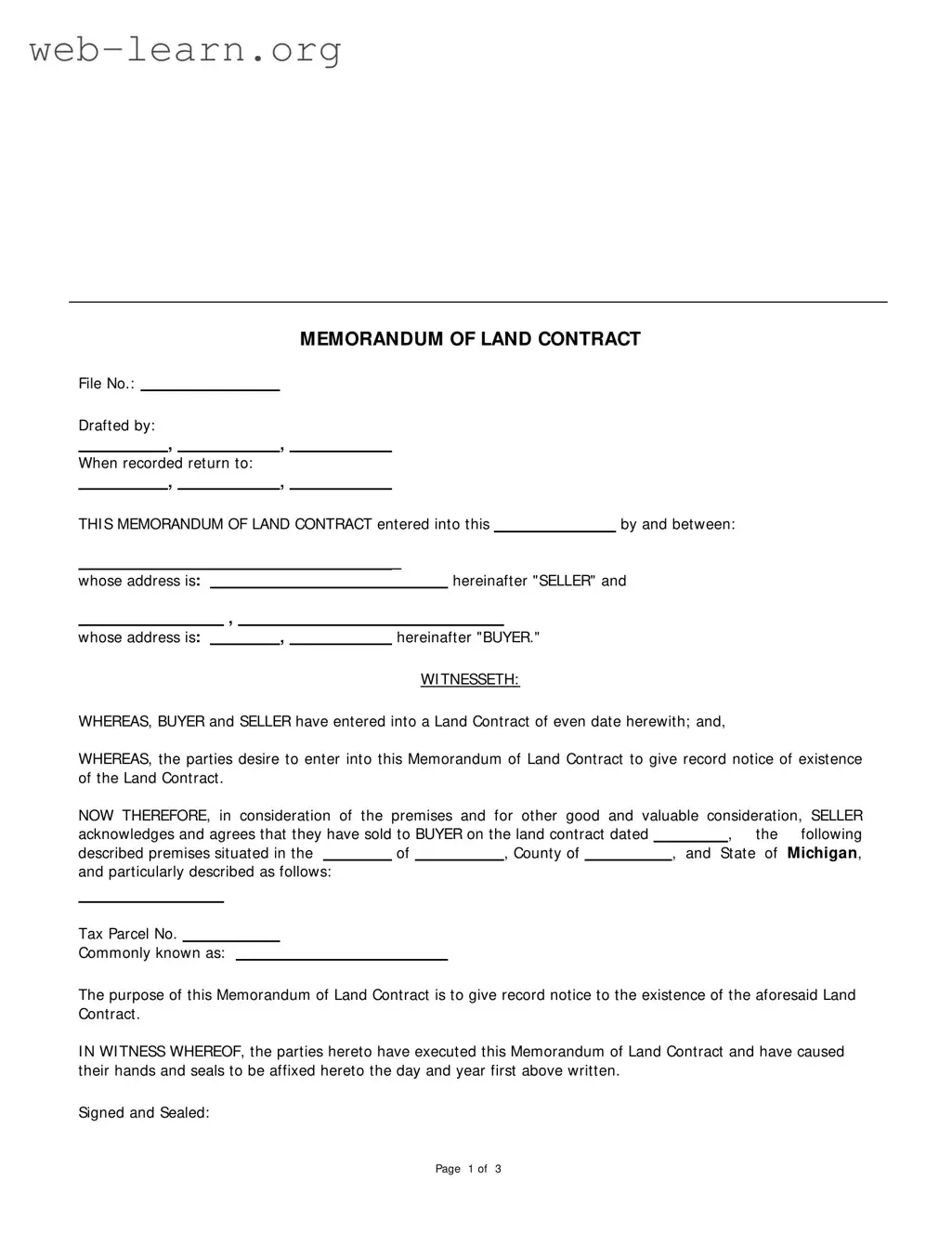
The Land Contract Michigan form is an essential document for buyers and sellers engaged in real estate transactions within the state. This form serves to outline the terms of the agreement between the seller and the buyer, providing a clear framework for the sale of property. Key components include the identification of both parties, the description of the property being sold, and the specific terms of the land contract. The form also includes a memorandum section, which is crucial for giving public notice of the existence of the land contract. This is important for protecting the buyer's interest in the property, as it establishes a legal claim that can be referenced in the future. Additionally, the document requires notarization, ensuring that the agreement is legally binding and recognized by the state. By understanding the major aspects of the Land Contract Michigan form, both parties can navigate the complexities of real estate transactions with confidence and clarity.

MEMORANDUM OF LAND CONTRACT
File No.:
Drafted by:
,,
When recorded return to:
,,
THI S MEMORANDUM OF LAND CONTRACT entered into this |
|
by and between: |
|||||||||
|
|
|
|
|
|
|
|
|
|
||
whose address is: |
|
|
|
|
|
|
|
hereinafter "SELLER" and |
|||
|
|
, |
|
|
|
|
|
|
|
|
|
whose address is: |
|
, |
|
hereinafter "BUYER." |
|
||||||
WI TNESSETH:
WHEREAS, BUYER and SELLER have entered into a Land Contract of even date herewith; and,
WHEREAS, the parties desire to enter into this Memorandum of Land Contract to give record notice of existence of the Land Contract .
NOW THEREFORE, in consideration of the premises and for other good and valuable consideration, SELLER
acknowledges and agrees that they have sold to BUYER on the land contract dated |
|
, |
the |
following |
|||||||
described premises situated in the |
|
of |
, County of |
|
, and State |
of |
Michigan, |
||||
|
|
|
|
|
|
|
|
|
|
|
|
and particularly described as follows: |
|
|
|
|
|
|
|
|
|
||
|
|
|
|
|
|
|
|
|
|
|
|
Tax Parcel No.
Commonly known as:
The purpose of this Memorandum of Land Contract is to give record notice to the existence of the aforesaid Land Contract .
I N WI TNESS WHEREOF, the parties hereto have executed this Memorandum of Land Contract and have caused their hands and seals to be affixed hereto the day and year first above written.
Signed and Sealed:
Page 1 of 3
File No.: |
Memorandum of Land Contract - continued |
____________________________________ |
____________________________________ |
____________________________________ |
|
= |
|
Page 2 of 3
File No.: dgsalemi () |
Memorandum of Land Contract - continued |
|
||||
= |
|
|
|
|
|
|
STATE OF |
Michigan |
} |
|
|
|
|
|
|
} ss |
|
|
|
|
COUNTY OF |
|
} |
|
|
|
|
The foregoing instrument was acknowledged before me on |
|
, by |
|
. |
||
|
|
|
Notary Public: _________________________________ |
|||
|
|
|
Printed Name: |
|
||
|
|
|
|
County, Michigan |
|
|
|
|
|
Acting in the County of |
|
||
|
|
|
My Commission Expires: |
|
||
STATE OF |
Michigan |
} |
|
|
|
|
|
|
} ss |
|
|
|
|
COUNTY OF |
|
} |
|
|
|
|
The foregoing instrument was acknowledged before me on XXX, by Pet er Piper, a single person .
Notary Public: ______________________________
Printed Name:
County, Michigan
Acting in the County of
My Commission Expires:
Page 3 of 3
| Fact Name | Description |
|---|---|
| Purpose | The Land Contract Memorandum serves to provide public notice of the existence of a Land Contract between the Seller and Buyer. |
| Governing Law | The Land Contract form is governed by Michigan state law, specifically the Michigan Land Contract Act. |
| Parties Involved | The form identifies two main parties: the Seller and the Buyer, each with specified addresses. |
| Property Description | The Memorandum requires a detailed description of the property involved, including the Tax Parcel Number. |
| Execution | The document must be signed and sealed by both parties to be valid and enforceable. |
| Notary Requirement | A notary public must acknowledge the signatures to ensure the authenticity of the document. |
| Record Keeping | The Memorandum must be recorded with the appropriate county office to provide notice to third parties. |
Filling out the Land Contract Michigan form requires careful attention to detail. Each section must be completed accurately to ensure that both the seller and buyer are properly identified and that the terms of the agreement are clearly stated. Follow the steps below to complete the form correctly.
Once the form is completed, it must be signed and notarized. This ensures that the document is legally binding and can be recorded with the appropriate county office. After recording, both parties should retain copies for their records.
A Land Contract is a legal agreement between a buyer and a seller for the purchase of real estate. In this arrangement, the buyer makes payments directly to the seller over a specified period, rather than obtaining a traditional mortgage from a bank. This type of contract can be particularly beneficial for individuals who may have difficulty securing financing through conventional means.
The Memorandum of Land Contract serves as a public notice of the existence of the Land Contract. By recording this memorandum, the seller acknowledges the sale of the property to the buyer, which protects the buyer's interest in the property. This is crucial in Michigan, as it ensures that other potential buyers or lenders are aware of the buyer's rights to the property, thereby reducing the risk of disputes.
The Land Contract typically includes several key pieces of information:
This information helps clarify the obligations and rights of both parties throughout the duration of the contract.
To execute a Land Contract in Michigan, both parties must agree to the terms and sign the document. It is advisable to have the contract notarized to ensure its validity. After signing, the Memorandum of Land Contract should be recorded with the county register of deeds. This recording protects the buyer’s interest in the property and provides public notice of the contract.
Filling out a Land Contract in Michigan can be a straightforward process, but many people make mistakes that can lead to complications down the line. One common error is failing to include complete names and addresses for both the seller and the buyer. Incomplete information can create confusion and may even invalidate the contract.
Another mistake often seen is neglecting to specify the date of the contract. Without a clear date, it can be difficult to determine when the agreement was made, which is crucial for legal purposes. This oversight can lead to disputes over timelines and obligations.
People frequently forget to include a detailed description of the property involved in the contract. A vague description can cause problems, especially if there are multiple properties involved. It’s essential to provide a clear and accurate description, including the tax parcel number and any commonly known names for the property.
Additionally, some individuals overlook the need for signatures from both parties. A contract is not valid without the proper signatures, and missing one can render the entire agreement unenforceable. Both parties should ensure they sign the document in the appropriate places.
Another common error is failing to have the document notarized. Notarization adds an important layer of authenticity to the contract. Without it, the contract may not hold up in court if disputes arise. Always ensure that a notary public acknowledges the signatures.
People also sometimes forget to review the terms of the contract carefully. Misunderstandings about payment terms, interest rates, or other obligations can lead to disputes later on. It’s vital to read and understand every clause before signing.
Moreover, some individuals neglect to keep copies of the signed contract. Having a personal copy is essential for both parties to refer back to the terms agreed upon. Without a copy, it can be challenging to resolve any future issues that may arise.
Lastly, a frequent mistake is not consulting with a legal professional before finalizing the contract. While it may seem unnecessary, having an expert review the document can help identify potential issues and ensure that everything is in order. Legal advice can save time and money in the long run.
When engaging in a land contract in Michigan, several additional documents may be necessary to ensure a smooth transaction. These forms help clarify the agreement, protect the interests of both parties, and provide legal backing. Below are five commonly used documents alongside the Land Contract Michigan form.
Utilizing these documents in conjunction with the Land Contract Michigan form can significantly enhance the security and clarity of the transaction. Always ensure that all parties understand their rights and obligations before proceeding.
When filling out the Land Contract Michigan form, it's crucial to approach the task with care. Here are four important do's and don'ts to keep in mind:
Many people believe that a land contract functions like a traditional mortgage. However, a land contract is an agreement where the seller finances the purchase for the buyer, who makes payments directly to the seller. The seller retains the title until the contract is fulfilled, unlike a mortgage where a bank holds the title until the loan is paid off.
Some assume that entering into a land contract immediately grants them ownership of the property. In reality, the buyer does not receive full ownership rights until all terms of the contract are satisfied, including payment in full.
It is a common belief that land contracts can be informal agreements. However, a legally binding land contract must be documented and signed by both parties. This documentation protects the rights of both the buyer and seller.
Some people think that buyers have no legal protections under a land contract. In fact, buyers have rights that can be enforced, including the right to receive a clear title upon completion of payments and the right to occupy the property.
Many believe that land contracts are exclusively for individuals who cannot obtain traditional financing due to poor credit. While they can be a solution for such buyers, they are also used by those who prefer the flexibility of seller financing.
Some assume that all land contracts follow a standard format. In reality, the terms can vary significantly based on the agreement between the buyer and seller. Each contract can include different payment schedules, interest rates, and conditions.
It is often thought that land contracts are set in stone once signed. However, both parties can agree to modify the terms of the contract, as long as any changes are documented in writing and signed by both parties.
When filling out and using the Land Contract Michigan form, consider the following key takeaways: