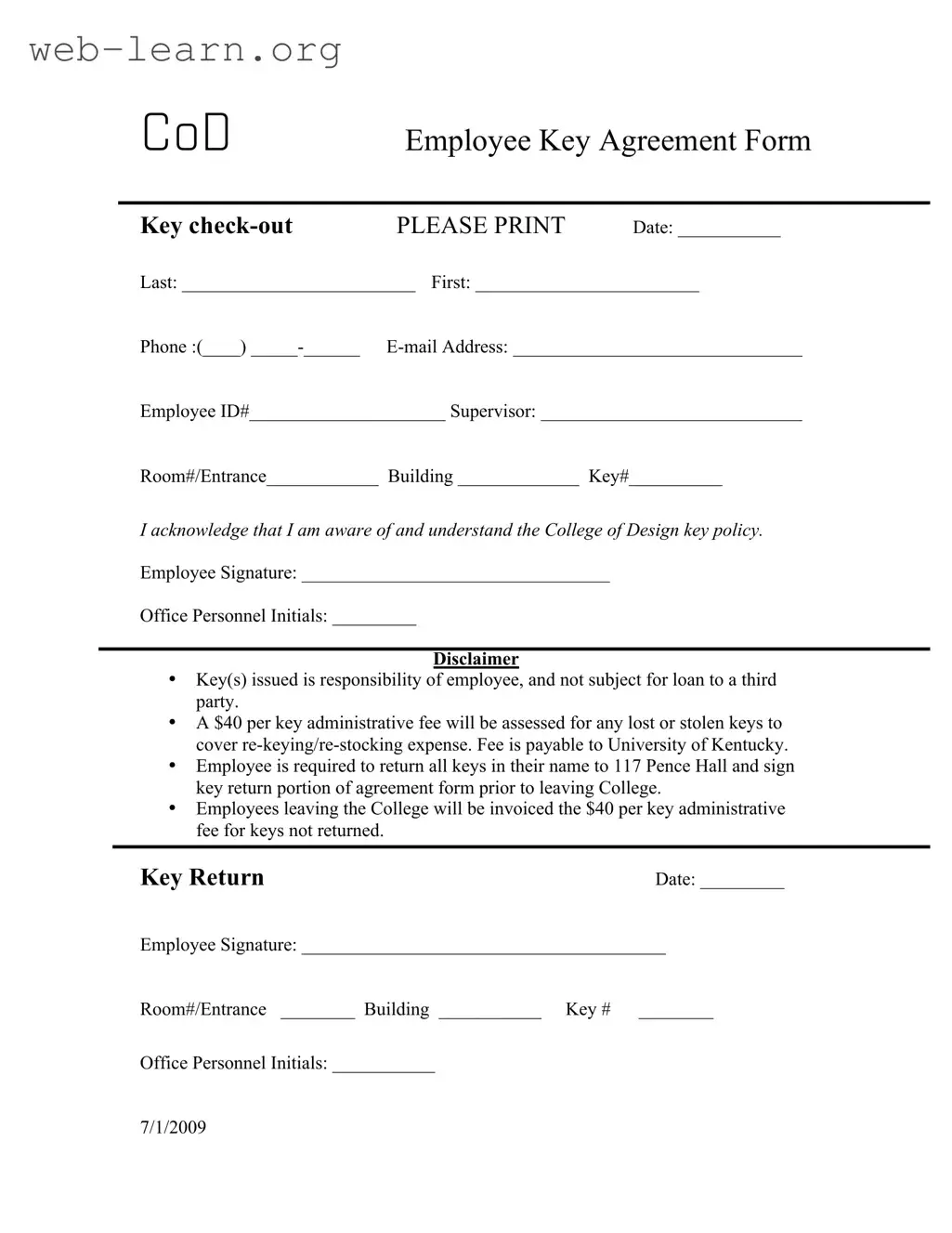
The Key Agreement form serves as a critical document for employees of the College of Design, facilitating the proper management and accountability of keys issued for access to various facilities. This form requires essential information such as the employee's name, contact details, and employee ID, ensuring accurate record-keeping. It also mandates acknowledgment of the college's key policy, emphasizing that the responsibility for the issued keys lies solely with the employee. A significant aspect of the form includes a disclaimer regarding lost or stolen keys, which incurs a $40 administrative fee to cover associated costs. Employees must also return all keys before departing from the College, with a specific return date noted on the form. Failure to return keys results in invoicing for the administrative fee, underscoring the importance of adhering to these protocols. The document concludes with space for signatures and initials, ensuring that both the employee and office personnel have formally recognized the agreement's terms.

COD
Employee Key Agreement Form
Key |
PLEASE PRINT |
Date: ___________ |
Last: _________________________ First: ________________________ |
||
Phone :(____) |
||
Employee ID#_____________________ Supervisor: ____________________________
Room#/Entrance____________ Building _____________ Key#__________
I acknowledge that I am aware of and understand the College of Design key policy.
Employee Signature: _________________________________
Office Personnel Initials: _________
Disclaimer
•Key(s) issued is responsibility of employee, and not subject for loan to a third party.
•A $40 per key administrative fee will be assessed for any lost or stolen keys to cover
•Employee is required to return all keys in their name to 117 Pence Hall and sign key return portion of agreement form prior to leaving College.
•Employees leaving the College will be invoiced the $40 per key administrative fee for keys not returned.
Key Return |
Date: _________ |
Employee Signature: _______________________________________ |
|
Room#/Entrance ________ Building ___________ Key # |
________ |
Office Personnel Initials: ___________ |
|
7/1/2009 |
|
| Fact Name | Description |
|---|---|
| Form Title | This is the COD Employee Key Agreement Form. |
| Key Check-out | Employees must print their information when checking out a key. |
| Key Policy Acknowledgment | Employees must acknowledge understanding of the College of Design key policy. |
| Administrative Fee | A $40 fee is charged for lost or stolen keys to cover re-keying costs. |
| Key Return Requirement | Employees must return all keys to 117 Pence Hall before leaving the College. |
| Invoicing for Unreturned Keys | Employees will be invoiced $40 for any keys not returned upon departure. |
| Governing Law | This form is governed by the laws of the University of Kentucky. |
Filling out the Key Agreement form is a straightforward process that ensures you receive the necessary keys while acknowledging your responsibilities regarding their use and return. Once completed, the form will be submitted to the appropriate office for processing, and you will receive your keys as per the established policies.
What is the purpose of the Key Agreement form?
The Key Agreement form is used by employees of the College of Design to officially acknowledge their responsibility for the keys issued to them. It ensures that employees understand the key policy and outlines the procedures for checking out and returning keys.
What information do I need to provide on the form?
When filling out the Key Agreement form, you need to provide your full name, phone number, email address, employee ID number, supervisor's name, room or entrance number, building name, and the key number you are checking out. This information helps maintain accurate records of key distribution.
What happens if I lose my key?
If you lose your key, you will be charged a $40 administrative fee. This fee covers the costs associated with re-keying and restocking the keys. It is important to report the loss immediately to your supervisor or the office responsible for key management.
Can I lend my key to someone else?
No, you cannot lend your key to a third party. The responsibility for the key remains with you as the employee. Sharing keys can lead to security issues and is against the key policy.
What should I do when I leave the College?
Before leaving the College, you must return all keys issued to you. You will need to visit 117 Pence Hall to return the keys and sign the key return portion of the agreement form. Failure to do so may result in an invoice for any unreturned keys.
What is the consequence of not returning my key?
If you do not return your key, you will be invoiced for the $40 administrative fee. This fee will be charged for each key that is not returned, which can accumulate if multiple keys are issued to you.
How can I contact someone if I have questions about the Key Agreement form?
If you have questions regarding the Key Agreement form or key policy, you should reach out to your supervisor or the office responsible for key management within the College of Design. They can provide you with the necessary guidance and support.
When was the Key Agreement form last updated?
The Key Agreement form was last updated on July 1, 2009. It is important to ensure you are using the most current version of the form to comply with the latest policies.
Filling out the Key Agreement form may seem straightforward, but many people make common mistakes that can lead to complications later. One frequent error is failing to provide complete contact information. When individuals neglect to fill in their phone number or email address, it becomes difficult for the office to reach them regarding key-related issues. Ensuring that all contact details are accurate and complete is essential for smooth communication.
Another mistake often seen is the omission of the Employee ID number. This number is crucial for identifying the individual associated with the keys being issued. Without it, the office may struggle to track which keys belong to which employees. Always double-check that this important detail is included before submitting the form.
People also frequently misunderstand the significance of the supervisor's name. Leaving this section blank can lead to confusion about who is responsible for the employee's key usage. Including the supervisor’s name not only clarifies responsibility but also helps in the event of any key-related incidents.
Many individuals overlook the acknowledgment of the College of Design key policy. This acknowledgment is a critical part of the agreement. By failing to sign or initial this section, employees may inadvertently indicate that they do not understand or accept the key policy, which can have consequences if issues arise later.
Another common oversight involves the return date for the keys. Employees often forget to fill in this date, which can create problems when it comes time to return the keys. Specifying a return date helps establish clear expectations and timelines for both the employee and the office.
Lastly, some individuals fail to sign the form in the designated areas. Both the initial signing when receiving the keys and the signature upon returning them are vital. Neglecting to sign can lead to disputes about key ownership and responsibility, so it’s crucial to ensure that all signatures are provided as required.
The Key Agreement form is an important document for employees who are issued keys to access certain areas within an organization. Along with this form, several other documents and forms may be used to ensure proper management and security of keys. Here’s a brief overview of these related documents.
Each of these documents plays a vital role in maintaining security and accountability within an organization. Properly managing keys and access helps ensure a safe working environment for everyone involved.
The Key Agreement form serves a specific purpose in managing keys issued to employees, ensuring accountability and compliance with institutional policies. Several other documents share similar characteristics and functions. Here are six documents that resemble the Key Agreement form:
Each of these documents emphasizes accountability, outlining the responsibilities of individuals and the consequences of failing to meet those responsibilities. Understanding these similarities can help individuals navigate their obligations in various contexts.
When filling out the Key Agreement form, attention to detail is crucial. Here are some important dos and don’ts to keep in mind:
Here are eight common misconceptions about the Key Agreement form:
The Key Agreement form is mandatory for all employees who check out keys. Failing to complete it can lead to complications regarding key responsibility.
Keys issued to an employee cannot be loaned to anyone else. Each employee is solely responsible for their assigned keys.
Employees will incur a $40 administrative fee for any lost or stolen keys. This fee covers the costs of re-keying and restocking.
All keys must be returned to 117 Pence Hall. A signature on the key return portion of the agreement form is also required.
The college keeps detailed records of key assignments. Employees must ensure their information is accurate on the form.
Understanding and acknowledging the key policy is crucial. Employees must be aware of their responsibilities regarding key management.
The Key Agreement form must be printed and filled out clearly. Handwritten forms should be legible to avoid processing issues.
Employees leaving the college will be invoiced for unreturned keys. It is essential to return all keys before departure to avoid charges.
Here are key takeaways regarding the Key Agreement form: