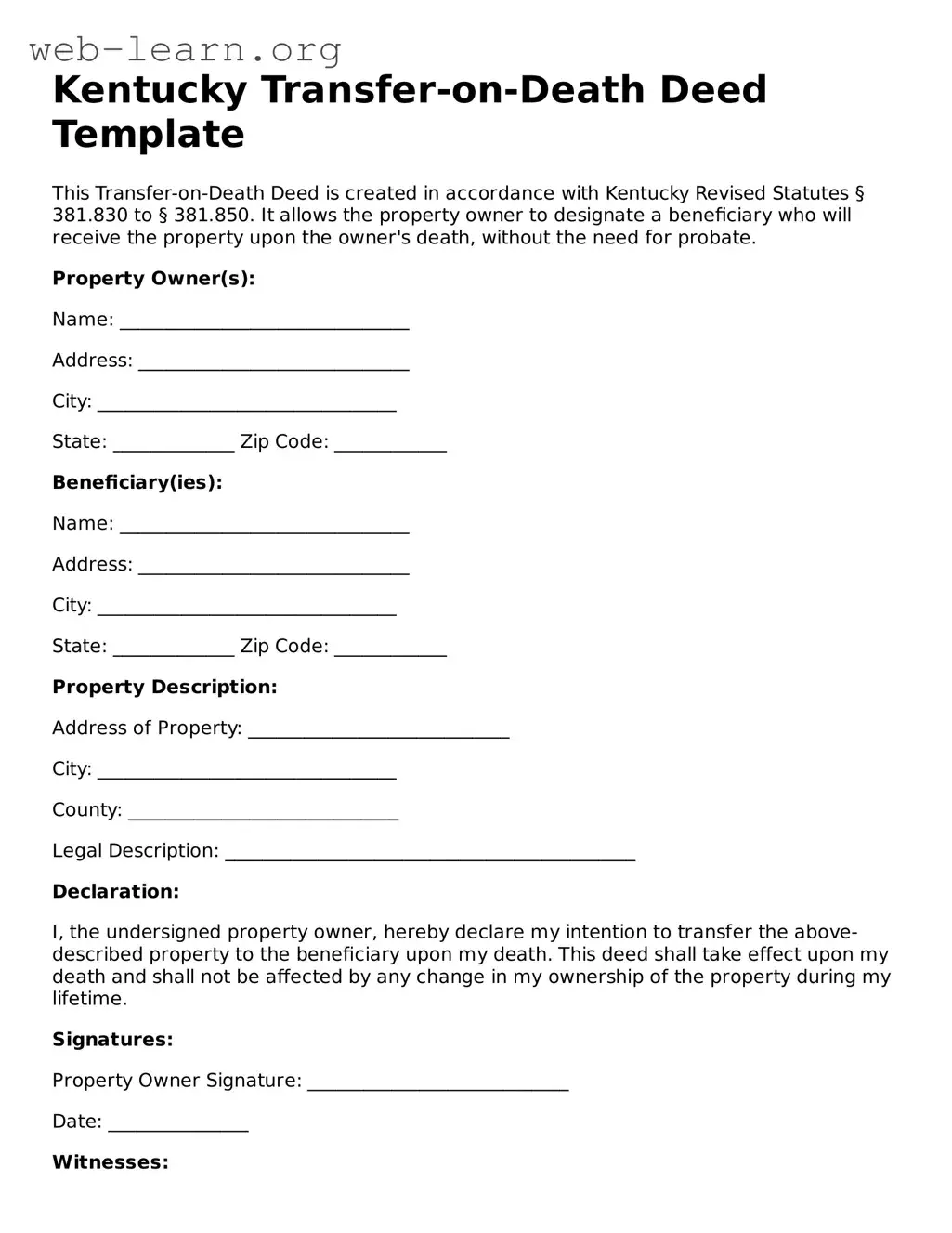
The Kentucky Transfer-on-Death Deed form serves as a valuable tool for property owners looking to simplify the transfer of their real estate upon their passing. This legal document allows individuals to designate a beneficiary who will automatically receive ownership of the property without the need for probate. By utilizing this form, property owners can maintain control over their assets during their lifetime while ensuring a seamless transition for their loved ones after death. The form requires specific information, including the names of the property owner and beneficiary, a legal description of the property, and the owner's signature. It is important to note that this deed can be revoked or modified at any time before the owner's death, providing flexibility in estate planning. Understanding the nuances of the Transfer-on-Death Deed can empower individuals to make informed decisions about their property and legacy, ultimately providing peace of mind for both themselves and their beneficiaries.
Kentucky Transfer-on-Death Deed Template
This Transfer-on-Death Deed is created in accordance with Kentucky Revised Statutes § 381.830 to § 381.850. It allows the property owner to designate a beneficiary who will receive the property upon the owner's death, without the need for probate.
Property Owner(s):
Name: _______________________________
Address: _____________________________
City: ________________________________
State: _____________ Zip Code: ____________
Beneficiary(ies):
Name: _______________________________
Address: _____________________________
City: ________________________________
State: _____________ Zip Code: ____________
Property Description:
Address of Property: ____________________________
City: ________________________________
County: _____________________________
Legal Description: ____________________________________________
Declaration:
I, the undersigned property owner, hereby declare my intention to transfer the above-described property to the beneficiary upon my death. This deed shall take effect upon my death and shall not be affected by any change in my ownership of the property during my lifetime.
Signatures:
Property Owner Signature: ____________________________
Date: _______________
Witnesses:
Witness 1 Name: ____________________________
Witness 1 Signature: ________________________ Date: _______________
Witness 2 Name: ____________________________
Witness 2 Signature: ________________________ Date: _______________
Notarization:
State of Kentucky
County of ____________________________
Subscribed and sworn before me on this ______ day of __________, 20___.
Notary Public Signature: ____________________________
My Commission Expires: _______________
This deed must be recorded in the county where the property is located to be effective. Ensure that all parties understand the implications of this deed and consider consulting a legal professional for guidance.
| Fact Name | Details |
|---|---|
| Definition | The Kentucky Transfer-on-Death Deed allows property owners to transfer real estate to beneficiaries upon their death without going through probate. |
| Governing Law | This deed is governed by Kentucky Revised Statutes, specifically KRS 381.830 to 381.850. |
| Requirements | The deed must be signed by the property owner and recorded with the county clerk to be effective. |
| Revocation | The property owner can revoke the deed at any time before their death by recording a new deed or a revocation form. |
After you complete the Kentucky Transfer-on-Death Deed form, you will need to ensure it is properly signed and notarized. Once finalized, the deed must be recorded with the appropriate county clerk's office to take effect.
What is a Transfer-on-Death Deed (TODD) in Kentucky?
A Transfer-on-Death Deed allows property owners in Kentucky to transfer their real estate to designated beneficiaries upon their death. This deed ensures that the property does not go through probate, simplifying the transfer process for loved ones.
Who can use a Transfer-on-Death Deed?
Any individual who owns real estate in Kentucky can use a Transfer-on-Death Deed. It is important that the property owner is of sound mind and acts voluntarily when creating the deed.
How do I create a Transfer-on-Death Deed?
To create a TODD, you must complete the appropriate form, which includes details such as the property description and the names of the beneficiaries. After filling out the form, you must sign it in front of a notary public and then record it with the county clerk’s office where the property is located.
Can I change or revoke a Transfer-on-Death Deed?
Yes, you can change or revoke a TODD at any time before your death. To do this, you must create a new deed that explicitly revokes the previous one or file a revocation form with the county clerk’s office.
What happens if I do not name a beneficiary?
If no beneficiary is named in the Transfer-on-Death Deed, the property will become part of your estate and will go through the probate process. It is crucial to designate at least one beneficiary to avoid this situation.
Are there any tax implications with a Transfer-on-Death Deed?
Generally, there are no immediate tax implications when creating a TODD. However, beneficiaries may be responsible for property taxes and any potential capital gains taxes when they sell the property. Consulting a tax professional is advisable for specific situations.
Can a Transfer-on-Death Deed be contested?
Yes, a TODD can be contested in court, similar to a will. Contesting may occur if there are claims of undue influence, lack of capacity, or improper execution of the deed. It is essential to ensure that the deed is completed correctly to minimize disputes.
Is a Transfer-on-Death Deed the same as a will?
No, a Transfer-on-Death Deed is not the same as a will. While both documents deal with the transfer of property, a TODD transfers property directly to beneficiaries upon the owner’s death, bypassing probate. A will, however, requires probate to distribute assets according to the deceased’s wishes.
Where can I obtain a Transfer-on-Death Deed form?
You can obtain a Transfer-on-Death Deed form from various sources, including the Kentucky Secretary of State’s website, local county clerk offices, or legal stationery stores. It is advisable to ensure that the form is up-to-date and compliant with current Kentucky laws.
Filling out the Kentucky Transfer-on-Death Deed form can be straightforward, but many people make common mistakes that can lead to complications down the line. One frequent error is not including all required information. Each section of the form must be completed accurately. Omitting even a small detail can result in the deed being considered invalid.
Another mistake is failing to properly identify the beneficiaries. It’s essential to provide full names and, if possible, their addresses. Incomplete or incorrect names can create confusion or disputes among heirs. Additionally, people often forget to include a description of the property. A clear description helps ensure that there are no misunderstandings about what is being transferred.
Some individuals overlook the importance of signatures. Both the grantor and the witnesses must sign the document. Without these signatures, the deed may not hold up in court. Moreover, not having the deed notarized is another common pitfall. A notary public's acknowledgment adds a layer of authenticity that is crucial for the deed's acceptance.
Timing can also be an issue. Many people wait too long to file the deed after completing it. In Kentucky, the deed must be recorded in the county where the property is located. Delays can lead to complications, especially if the grantor passes away before the deed is recorded.
Sometimes, individuals fail to keep a copy of the completed deed. Having a personal copy is important for future reference and can help prevent disputes among family members. Additionally, not informing beneficiaries about the deed can lead to confusion later. Clear communication ensures that everyone involved understands the arrangement.
Finally, some people do not seek legal advice when filling out the form. While it may seem simple, consulting with a legal professional can help avoid mistakes. They can provide guidance tailored to individual circumstances, ensuring that the deed meets all legal requirements.
The Kentucky Transfer-on-Death Deed form allows individuals to transfer real estate to beneficiaries upon their death without going through probate. This deed simplifies the transfer process and ensures that the property goes directly to the intended heirs. Along with this form, several other documents may be necessary to complete the estate planning process effectively. Here are five commonly used documents that often accompany the Transfer-on-Death Deed.
Understanding these documents can enhance the effectiveness of estate planning. Each plays a unique role in ensuring that an individual's wishes are honored and that their loved ones are taken care of after their passing.
The Transfer-on-Death Deed (TOD Deed) is a unique legal instrument that allows property owners to designate beneficiaries who will receive their property upon their death, bypassing the probate process. Several other documents share similar functions or features. Here’s a list of nine such documents:
Filling out a Transfer-on-Death (TOD) Deed form in Kentucky can be a straightforward process, but there are important considerations to keep in mind. Here are five essential dos and don'ts to ensure that the deed is completed correctly.
By following these guidelines, you can help ensure that your Transfer-on-Death Deed is valid and meets your intentions for transferring property upon your passing.
This is incorrect. The deed only transfers ownership when the owner passes away, but it must be recorded properly before the owner's death to be valid.
This is not true. The deed is typically applicable only to real estate and does not apply to personal property, such as vehicles or bank accounts.
This is false. The owner retains the right to revoke or change the deed at any time before their death, as long as they follow the proper procedures.
This is misleading. While it can help avoid probate for the property listed in the deed, other assets may still go through probate.
This is not accurate. Beneficiaries do not inherit debts unless they are co-signers or otherwise legally responsible for them.
This is incorrect. Any individual can use a Transfer-on-Death Deed to designate beneficiaries, regardless of marital status.
While it is possible to complete the deed without an attorney, consulting with one is advisable to ensure that all legal requirements are met and to avoid potential issues.
When considering the Kentucky Transfer-on-Death Deed form, there are several important points to keep in mind. Below are key takeaways that can help guide you through the process.
By understanding these key points, individuals can effectively utilize the Kentucky Transfer-on-Death Deed to plan for the future of their property.
How to Avoid Probate in Illinois - This deed is revocable, meaning the property owner can change or cancel it at any time before death.
Does a Beneficiary Deed Avoid Probate - This deed can be a valuable part of an overall estate planning strategy.