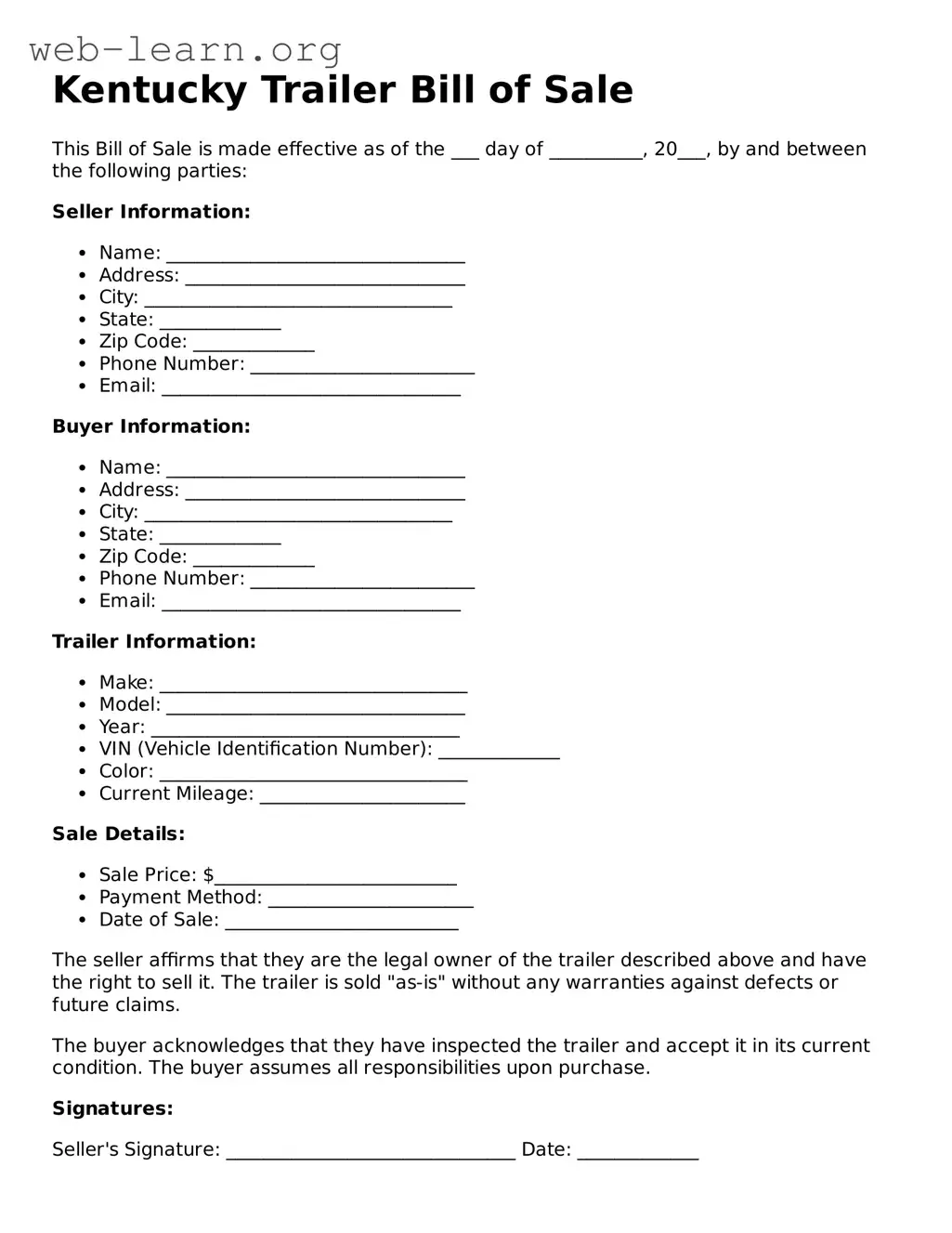
The Kentucky Trailer Bill of Sale form is an essential document for anyone involved in the buying or selling of a trailer in the state of Kentucky. This form serves as a legal record of the transaction, providing proof of ownership and details about the trailer itself. It typically includes important information such as the names and addresses of both the buyer and the seller, a description of the trailer including its make, model, year, and Vehicle Identification Number (VIN), as well as the sale price. Additionally, the form may contain space for signatures and the date of the sale, which are crucial for validating the agreement. Understanding the components of this form can help ensure a smooth transaction, protecting the interests of both parties involved. Properly completing the Kentucky Trailer Bill of Sale not only facilitates the transfer of ownership but also aids in future registrations and title transfers, making it a vital document for trailer owners in the state.
Kentucky Trailer Bill of Sale
This Bill of Sale is made effective as of the ___ day of __________, 20___, by and between the following parties:
Seller Information:
Buyer Information:
Trailer Information:
Sale Details:
The seller affirms that they are the legal owner of the trailer described above and have the right to sell it. The trailer is sold "as-is" without any warranties against defects or future claims.
The buyer acknowledges that they have inspected the trailer and accept it in its current condition. The buyer assumes all responsibilities upon purchase.
Signatures:
Seller's Signature: _______________________________ Date: _____________
Buyer's Signature: _______________________________ Date: _____________
This Bill of Sale is governed by the laws of the State of Kentucky.
| Fact Name | Description |
|---|---|
| Purpose | The Kentucky Trailer Bill of Sale is used to document the sale or transfer of ownership of a trailer in Kentucky. |
| Governing Law | This form is governed by Kentucky state law, specifically KRS 186A.190 regarding vehicle transfers. |
| Required Information | The form requires details such as the seller's and buyer's names, addresses, and the trailer's identification information. |
| Signatures | Both the seller and the buyer must sign the form to validate the transaction. |
| Notarization | While notarization is not mandatory, it is recommended to enhance the document's credibility. |
| Transfer of Title | The bill of sale serves as a receipt and may be required to transfer the trailer title at the local DMV. |
| Record Keeping | It is advisable for both parties to keep a copy of the bill of sale for their records. |
| Fees | There may be fees associated with the title transfer process at the DMV after completing the bill of sale. |
Completing the Kentucky Trailer Bill of Sale form is an important step in the process of transferring ownership of a trailer. After filling out the form, you will be ready to finalize the sale and ensure that all necessary details are documented for both parties involved.
What is a Kentucky Trailer Bill of Sale?
A Kentucky Trailer Bill of Sale is a legal document that serves as proof of the sale and transfer of ownership of a trailer in the state of Kentucky. This form includes essential details about the trailer, the buyer, and the seller, ensuring that both parties have a record of the transaction.
Why do I need a Bill of Sale for my trailer?
A Bill of Sale is crucial for several reasons. It protects both the buyer and the seller by providing a written record of the transaction. It can also be necessary for registering the trailer with the state, obtaining a title, or for tax purposes. Having this document helps clarify the terms of the sale and can prevent disputes in the future.
What information is included in the Kentucky Trailer Bill of Sale?
The form typically includes the following information:
Do I need to have the Bill of Sale notarized?
In Kentucky, notarization is not a strict requirement for a Bill of Sale. However, having the document notarized can provide an additional layer of authenticity and may be beneficial for both parties. It can also help in cases where proof of the transaction is needed later.
How do I complete a Kentucky Trailer Bill of Sale?
To complete the Bill of Sale, both the buyer and seller should fill in the required information accurately. Ensure that all details, such as the trailer description and sale price, are correct. After filling out the form, both parties should sign and date it. Retain copies for your records.
What should I do after completing the Bill of Sale?
Once the Bill of Sale is completed and signed, the buyer should keep it for their records. The buyer may also need to present this document when registering the trailer with the Kentucky Department of Motor Vehicles (DMV) or when applying for a title. The seller should keep a copy as proof of the sale.
Can I use a generic Bill of Sale form for my trailer sale?
While you can use a generic Bill of Sale form, it is advisable to use a specific Kentucky Trailer Bill of Sale to ensure compliance with state laws. A state-specific form will include all necessary information and clauses that are relevant to trailer sales in Kentucky, reducing the risk of errors or omissions.
Filling out the Kentucky Trailer Bill of Sale form can seem straightforward, but many individuals make common mistakes that can lead to complications. One frequent error is failing to provide accurate information about the trailer. This includes the Vehicle Identification Number (VIN), make, model, and year. If any of these details are incorrect or incomplete, it can create problems when registering the trailer.
Another mistake occurs when the seller does not sign the form. The signature of the seller is crucial, as it signifies the transfer of ownership. Without this signature, the bill of sale is not valid. Similarly, buyers sometimes overlook the need for their own signature, which is equally important for the transaction to be legally recognized.
People often forget to include the sale price of the trailer. This amount is necessary for tax purposes and helps establish the value of the transaction. Leaving it blank can lead to confusion during the registration process. Additionally, failing to date the bill of sale can complicate matters. A date provides a clear record of when the transaction took place, which can be essential in case of disputes.
Another common error is neglecting to provide the buyer's and seller's contact information. Including full names, addresses, and phone numbers ensures that both parties can be reached if any issues arise after the sale. Incomplete or incorrect contact details can lead to difficulties in communication.
Some individuals also mistakenly assume that a bill of sale is not necessary for a trailer. However, having this document is important for legal protection and proof of ownership. Without it, a buyer may face challenges in proving they own the trailer, especially if disputes arise in the future.
Additionally, people may fail to check for any liens or outstanding loans on the trailer. If the trailer has a lien, the seller must resolve this before completing the sale. Otherwise, the buyer may find themselves responsible for debts associated with the trailer.
Another oversight is not making copies of the completed bill of sale. Both the buyer and seller should retain a copy for their records. This documentation can be crucial if any issues arise later on regarding ownership or the terms of the sale.
Some sellers do not provide a clear description of the trailer's condition. Being honest about any damages or repairs can prevent misunderstandings and disputes later. Buyers appreciate transparency and are more likely to trust the seller when they provide accurate information.
Finally, neglecting to consult local regulations can lead to problems. Each state may have specific requirements regarding the sale and registration of trailers. Familiarizing oneself with these regulations can help ensure compliance and a smoother transaction.
When buying or selling a trailer in Kentucky, several forms and documents may be necessary in addition to the Trailer Bill of Sale. These documents help ensure a smooth transaction and provide legal protection for both parties involved. Below is a list of commonly used forms and documents.
Having these documents ready can streamline the buying or selling process and help avoid potential legal issues. Always ensure that all paperwork is completed accurately to protect your interests in the transaction.
When filling out the Kentucky Trailer Bill of Sale form, it's important to follow certain guidelines to ensure the document is valid and complete. Here are six things to consider:
When dealing with the Kentucky Trailer Bill of Sale form, several misconceptions can lead to confusion. Understanding these misconceptions can help ensure a smoother transaction process. Here are five common misunderstandings:
Misconception 1: A bill of sale is not necessary for trailer sales.
Many people believe that a bill of sale is optional when buying or selling a trailer. However, having a bill of sale provides legal proof of the transaction and protects both the buyer and seller.
Misconception 2: The bill of sale must be notarized.
Some individuals think that a notary public must witness the signing of the bill of sale. In Kentucky, notarization is not required for the bill of sale to be valid, though it can add an extra layer of security.
Misconception 3: The bill of sale needs to be filed with the state.
There is a belief that the bill of sale must be submitted to a government office. In reality, the bill of sale is a private document between the buyer and seller and does not need to be filed with the state.
Misconception 4: The bill of sale can be handwritten.
While a handwritten bill of sale can be legally binding, using a standardized form is often recommended. A formalized document can help ensure that all necessary information is included and reduce the risk of disputes.
Misconception 5: The bill of sale is only for used trailers.
Some people think that a bill of sale is only required for used trailers. However, whether new or used, a bill of sale serves as an important record of the transaction, protecting both parties involved.
By addressing these misconceptions, individuals can navigate the process of buying or selling a trailer in Kentucky more confidently and effectively.
When filling out and using the Kentucky Trailer Bill of Sale form, keep these key takeaways in mind:
Dealership Bill of Sale Template - Records the sale of a trailer between a buyer and seller.
Indiana Vehicle Bill of Sale - Useful for both individuals and businesses involved in trailer sales.
Nys Dmv Bill of Sale Form - Offers a simple way to document a private sale.
Does a Bill of Sale Have to Be Notarized in Georgia - Can be utilized in various types of trailer transactions.