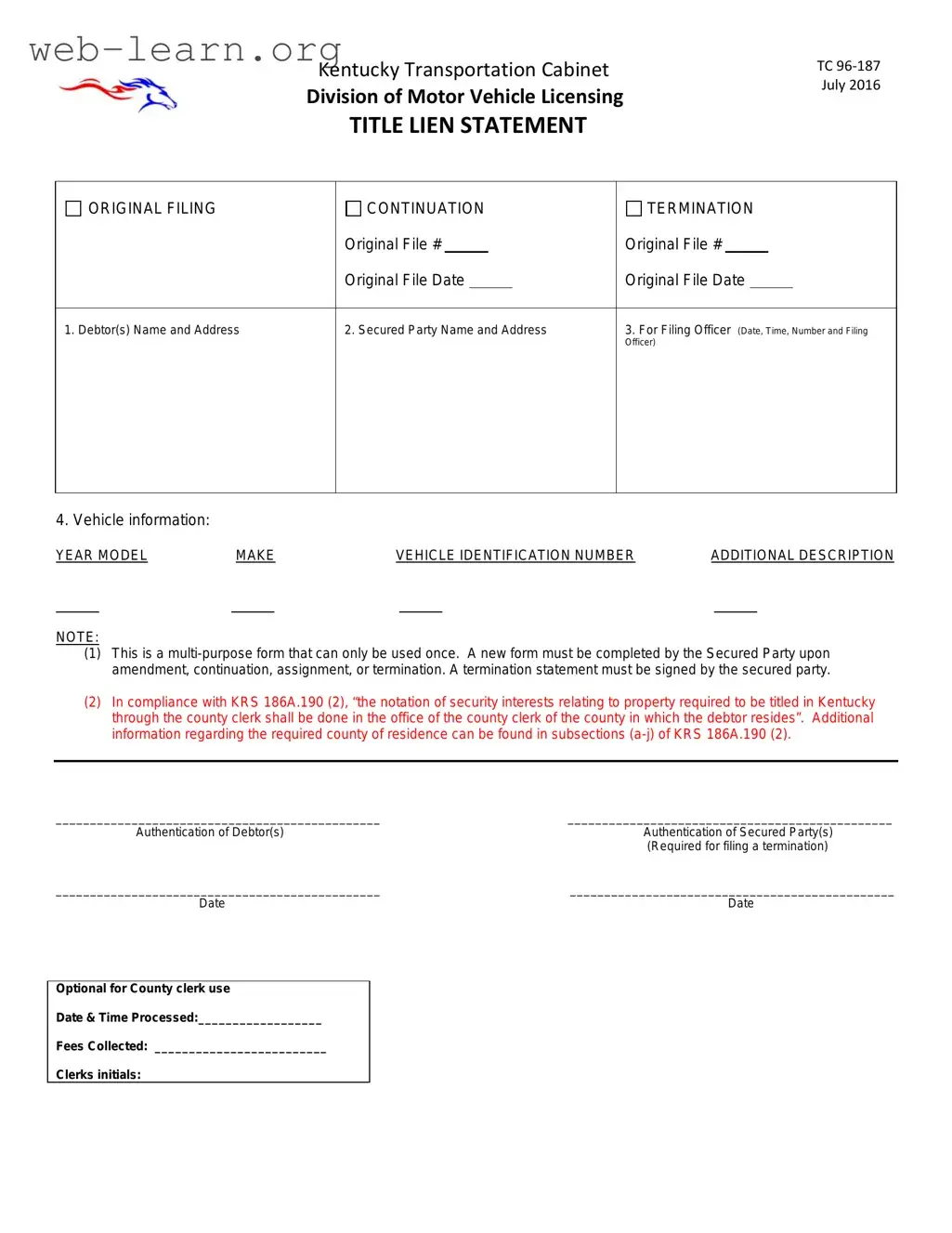
The Kentucky TC 96-187 form serves an important function in the realm of vehicle ownership and financing. This multi-purpose document is primarily used for filing a title lien statement, which establishes a secured party's interest in a vehicle. The form captures essential details, including the names and addresses of both the debtor and the secured party, as well as specific vehicle information such as the year, model, make, and vehicle identification number. It is crucial to note that this form can only be utilized once; any amendments, continuations, assignments, or terminations require the completion of a new form. Furthermore, a termination statement necessitates the signature of the secured party. Compliance with Kentucky law is also emphasized in this form, particularly KRS 186A.190, which mandates that security interests related to titled property must be filed in the county clerk's office where the debtor resides. This requirement helps ensure that all parties involved are aware of any liens on the vehicle, promoting transparency in ownership and financing arrangements.

Kentucky Transportation Cabinet |
TC 96‐187 |
Division of Motor Vehicle Licensing |
July 2016 |
|
TITLE LIEN STATEMENT
ORIGINAL FILING |
CONTINUATION |
TERMINATION |
||||||||
|
Original File # |
|
|
Original File # |
|
|
||||
|
Original File Date |
|
|
Original File Date |
|
|
||||
|
|
|
||||||||
1. Debtor(s) Name and Address |
2. Secured Party Name and Address |
3. For Filing Officer (Date, Time, Number and Filing |
||||||||
|
|
|
|
|
|
Officer) |
||||
|
|
|
|
|
|
|
|
|
|
|
4. Vehicle information:
YEAR MODEL |
MAKE |
VEHICLE IDENTIFICATION NUMBER |
ADDITIONAL DESCRIPTION |
NOTE:
(1)This is a
(2)In compliance with KRS 186A.190 (2), “the notation of security interests relating to property required to be titled in Kentucky through the county clerk shall be done in the office of the county clerk of the county in which the debtor resides”. Additional information regarding the required county of residence can be found in subsections
_______________________________________________ |
_______________________________________________ |
Authentication of Debtor(s) |
Authentication of Secured Party(s) |
|
(Required for filing a termination) |
_______________________________________________ |
_______________________________________________ |
Date |
Date |
Optional for County clerk use
Date & Time Processed:__________________
Fees Collected: _________________________
Clerks initials:
| Fact Name | Details |
|---|---|
| Form Purpose | This form is used to file a title lien statement in Kentucky. |
| Governing Law | KRS 186A.190 governs the filing of security interests for titled property in Kentucky. |
| Filing Requirements | The form must be completed by the secured party for amendments, continuations, assignments, or terminations. |
| Signature Requirement | A termination statement must be signed by the secured party to be valid. |
| Multi-Purpose Use | This is a multi-purpose form and can only be used once for each filing. |
| Debtor's Residence | The filing must occur in the county where the debtor resides, as per KRS 186A.190 (2). |
| Vehicle Information | The form requires details such as year, model, make, and vehicle identification number (VIN). |
| Clerk's Processing | The form includes a section for the county clerk to record processing details and fees collected. |
Filling out the Kentucky TC 96-187 form requires careful attention to detail. This form must be completed accurately to ensure that your filing is processed correctly. After you fill out the form, you will submit it to the appropriate county clerk's office, where the information will be recorded.
What is the Kentucky TC 96-187 form?
The Kentucky TC 96-187 form is a Title Lien Statement used in Kentucky to record a lien on a vehicle. This form is essential for securing a financial interest in a vehicle, ensuring that the lender's rights are protected in case the borrower defaults on their loan. It is a multi-purpose form that can be used for original filings, continuations, and terminations of liens.
Who needs to file the TC 96-187 form?
This form must be filed by the secured party, which is typically a lender or financial institution that has provided a loan for the purchase of the vehicle. The secured party needs to file this form to establish their legal claim to the vehicle until the loan is fully repaid. Additionally, debtors (the individuals or entities borrowing the money) may also need to provide information for the filing.
What information is required on the TC 96-187 form?
The form requires several key pieces of information:
Each section must be filled out accurately to ensure proper filing and to avoid any potential issues with the lien.
How do I file the TC 96-187 form?
The TC 96-187 form must be filed with the county clerk in the county where the debtor resides. This process involves submitting the completed form along with any required fees. It is important to ensure that all information is correct before submission, as the form can only be used once for each filing. If any changes are needed, a new form must be completed.
What happens if I need to amend or terminate a lien?
If you need to amend, continue, assign, or terminate a lien, a new TC 96-187 form must be completed. Each of these actions requires a new filing. Specifically, a termination statement must be signed by the secured party, indicating that the lien is no longer in effect. This ensures that the vehicle's title is clear of any claims once the loan has been paid off.
Are there any fees associated with filing the TC 96-187 form?
Yes, there are fees associated with filing the TC 96-187 form. The exact amount can vary depending on the county and the specific circumstances of the filing. When submitting the form, it is important to check with the county clerk's office for the current fee schedule. Make sure to include the required payment along with your filing to avoid any delays.
Filling out the Kentucky TC 96-187 form can be straightforward, but many individuals make common mistakes that can lead to delays or complications. One of the most frequent errors is failing to provide accurate debtor and secured party information. It’s essential that the names and addresses are correct and match official documents. Inaccuracies can result in the rejection of the filing.
Another common mistake involves the vehicle identification number (VIN). This number must be entered precisely as it appears on the vehicle. Even a single digit error can cause significant issues in processing the lien. Always double-check this information to ensure it is accurate.
People often overlook the requirement for signatures. The form requires authentication from both the debtor and the secured party, especially for termination statements. Missing signatures can lead to delays in processing or even the rejection of the entire filing.
Additionally, many individuals do not realize that the TC 96-187 form is a one-time use document. If there are any amendments, continuations, or assignments, a new form must be completed. This misunderstanding can lead to unnecessary complications and additional paperwork.
Another mistake is not adhering to the county of residence requirements. According to KRS 186A.190 (2), the filing must occur in the county where the debtor resides. Failing to comply with this regulation can result in invalid filings.
Some filers neglect to include the vehicle information section completely. This includes the year, model, make, and any additional descriptions of the vehicle. Omitting this information can lead to confusion and potential legal issues down the line.
People sometimes forget to check the date and time of filing. This information is crucial for record-keeping and can affect the priority of the lien. Ensure that this section is filled out accurately to avoid any future disputes.
Another frequent oversight is not verifying the fees collected section. It’s important to ensure that the correct fees are paid and documented. Inaccurate fee information can lead to processing delays or additional charges.
Lastly, many filers do not pay attention to the clerk's initials section. This part is essential for confirming that the filing has been processed. Without the clerk’s initials, there may be uncertainty regarding the status of the lien.
When dealing with vehicle titles and liens in Kentucky, several forms and documents are often used alongside the Kentucky TC 96 187 form. Each of these documents serves a specific purpose and helps ensure that all necessary information is properly recorded. Here are some important forms to be aware of:
Understanding these forms can simplify the process of managing vehicle titles and liens. Each document plays a crucial role in ensuring that ownership and lien information is accurate and up to date. If you have any questions about these forms, it’s important to seek guidance to ensure compliance with Kentucky regulations.
The Kentucky TC 96 187 form serves as a title lien statement, which is essential for documenting secured interests in vehicles. Several other documents serve similar purposes in various contexts. Below is a list of these documents, highlighting their similarities to the TC 96 187 form.
When filling out the Kentucky TC 96-187 form, it's important to follow specific guidelines to ensure your submission is accurate and complete. Here’s a list of what to do and what to avoid:
Following these guidelines will help ensure your form is processed smoothly and efficiently.
The Kentucky TC 96 187 form is a vital document used in the context of vehicle title liens, but it is often misunderstood. Here are nine common misconceptions about this form, along with clarifications to help demystify its purpose and requirements.
This form is designed for a single use only. Each time a secured party needs to amend, continue, assign, or terminate a lien, a new form must be completed.
In fact, a termination statement must be signed by the secured party. This signature is crucial for the validity of the termination process.
According to Kentucky law, the form must be filed in the office of the county clerk where the debtor resides. This requirement is essential for ensuring proper jurisdiction.
The TC 96 187 form has specific fields that must be filled out, including the names and addresses of the debtor and secured party, as well as vehicle details like the make and model.
The TC 96 187 form is not limited to new vehicles. It applies to any situation where a lien is placed on a vehicle, regardless of its age.
Filing fees can vary by county, and it is important to check with the local county clerk’s office for the specific fees associated with filing the TC 96 187.
This is incorrect. Filing the TC 96 187 is a legal requirement for establishing a lien on a vehicle, and failure to do so can result in complications regarding the enforceability of the lien.
While financial institutions frequently use this form, any secured party, including individuals and businesses, can utilize it to establish a lien on a vehicle.
Although the form itself can only be used once, changes can be made through the completion of a new form for amendments or continuations, ensuring that records remain accurate and up to date.
Here are key takeaways about filling out and using the Kentucky TC 96 187 form: