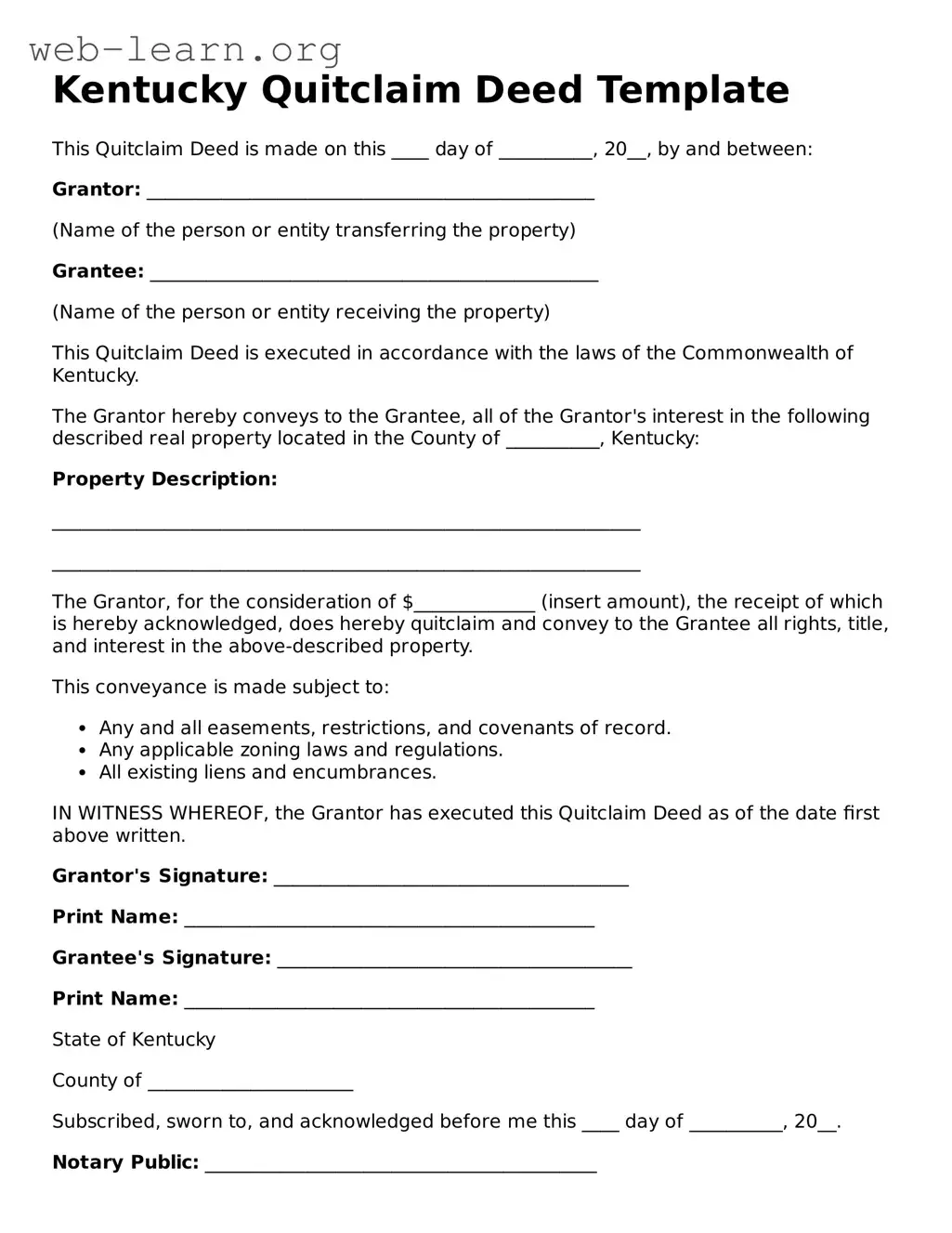
In the realm of property transactions, the Kentucky Quitclaim Deed form serves as a vital tool for transferring ownership rights from one party to another. This legal document is particularly useful when the grantor, or seller, wishes to convey their interest in a property without making any warranties about the title's validity. It is commonly used among family members, friends, or in situations where the parties are familiar with the property's history. The quitclaim deed allows for a straightforward transfer, often requiring minimal information about the property and the parties involved. It is important to note that while the quitclaim deed can facilitate quick transfers, it does not protect the grantee, or buyer, from potential claims against the property. Therefore, understanding the implications of using this form is essential for anyone considering a property transfer in Kentucky. This article will explore the key components of the Kentucky Quitclaim Deed, the process of completing it, and the potential benefits and drawbacks associated with its use.
Kentucky Quitclaim Deed Template
This Quitclaim Deed is made on this ____ day of __________, 20__, by and between:
Grantor: ________________________________________________
(Name of the person or entity transferring the property)
Grantee: ________________________________________________
(Name of the person or entity receiving the property)
This Quitclaim Deed is executed in accordance with the laws of the Commonwealth of Kentucky.
The Grantor hereby conveys to the Grantee, all of the Grantor's interest in the following described real property located in the County of __________, Kentucky:
Property Description:
_______________________________________________________________
_______________________________________________________________
The Grantor, for the consideration of $_____________ (insert amount), the receipt of which is hereby acknowledged, does hereby quitclaim and convey to the Grantee all rights, title, and interest in the above-described property.
This conveyance is made subject to:
IN WITNESS WHEREOF, the Grantor has executed this Quitclaim Deed as of the date first above written.
Grantor's Signature: ______________________________________
Print Name: ____________________________________________
Grantee's Signature: ______________________________________
Print Name: ____________________________________________
State of Kentucky
County of ______________________
Subscribed, sworn to, and acknowledged before me this ____ day of __________, 20__.
Notary Public: __________________________________________
My Commission Expires: ______________________________________
| Fact Name | Details |
|---|---|
| Definition | A quitclaim deed is a legal document that transfers ownership interest in a property from one party to another without any warranties. |
| Governing Law | The Kentucky Quitclaim Deed is governed by Kentucky Revised Statutes, Chapter 381. |
| Usage | This type of deed is often used among family members or in situations where the property title is clear. |
| Requirements | The form must be signed by the grantor and notarized to be valid. |
| Recording | To protect the new owner's rights, the deed should be recorded in the county where the property is located. |
Once you have the Kentucky Quitclaim Deed form in hand, you’re ready to begin the process of filling it out. This form is essential for transferring property ownership, and it’s important to ensure all details are accurately completed. After you fill out the form, you will need to have it signed and notarized before filing it with the appropriate county office.
What is a Kentucky Quitclaim Deed?
A Kentucky Quitclaim Deed is a legal document used to transfer ownership of real estate from one party to another. This type of deed does not guarantee that the property is free of liens or other claims; instead, it simply conveys whatever interest the grantor has in the property at the time of the transfer.
When should I use a Quitclaim Deed?
This deed is often used in situations where the parties know each other well, such as transferring property between family members, divorcing spouses, or business partners. It is also commonly used to clear up title issues or to add or remove someone from the title.
What are the requirements for a Quitclaim Deed in Kentucky?
In Kentucky, a Quitclaim Deed must include the following elements:
Do I need an attorney to prepare a Quitclaim Deed?
While it is not legally required to have an attorney prepare a Quitclaim Deed, it is often advisable. An attorney can ensure that the document is correctly drafted and complies with all legal requirements, helping to prevent potential disputes or issues in the future.
How do I record a Quitclaim Deed in Kentucky?
To record a Quitclaim Deed in Kentucky, you must take the completed and notarized document to the county clerk's office in the county where the property is located. There may be a small fee for recording the deed, and it is important to keep a copy for your records.
What are the tax implications of using a Quitclaim Deed?
Generally, transferring property through a Quitclaim Deed may trigger certain tax implications, such as transfer taxes or gift taxes. It is wise to consult with a tax professional to understand how the transfer may affect your tax situation.
Can a Quitclaim Deed be revoked?
Once a Quitclaim Deed is executed and recorded, it cannot be unilaterally revoked by the grantor. If the grantor wishes to regain ownership, a new deed must be created to transfer the property back. This process may require the consent of the grantee.
What are the risks of using a Quitclaim Deed?
One of the primary risks associated with a Quitclaim Deed is that it offers no warranties regarding the title. This means that if there are existing liens or claims against the property, the grantee may be responsible for addressing those issues. It is crucial to conduct a title search before proceeding with a Quitclaim Deed to understand any potential risks.
Filling out a Kentucky Quitclaim Deed form can be straightforward, but many people make common mistakes that can lead to complications down the road. One frequent error is failing to include the correct names of the parties involved. It’s essential to ensure that the grantor (the person transferring the property) and the grantee (the person receiving the property) are accurately named. Any discrepancies in names can lead to legal issues later.
Another common mistake is neglecting to provide a complete legal description of the property. This description should include details like the parcel number and any relevant boundaries. A vague or incomplete description can create confusion and may even invalidate the deed. Always double-check that the legal description matches the information on the property’s title or tax documents.
Many people also overlook the importance of having the deed notarized. In Kentucky, a Quitclaim Deed must be signed in the presence of a notary public to be legally binding. Without this notarization, the deed may not hold up in court. Ensure that both parties sign the document in front of a notary to avoid this pitfall.
Additionally, failing to record the Quitclaim Deed with the county clerk’s office is a mistake that can have serious consequences. Recording the deed is crucial for making the transfer official and protecting the grantee’s ownership rights. Without recording, future buyers or lenders may not recognize the transfer, which could lead to disputes.
Another error involves not including the necessary consideration for the transfer. While Quitclaim Deeds can be used to transfer property for little or no money, it’s still important to state the consideration, even if it’s nominal. This helps clarify the intent of the transaction and can prevent misunderstandings.
People often forget to check for any outstanding liens or encumbrances on the property before completing the deed. If there are existing debts tied to the property, the grantee could become responsible for them after the transfer. It’s wise to conduct a title search to uncover any potential issues before signing the Quitclaim Deed.
Lastly, many individuals fail to keep copies of the completed Quitclaim Deed. After filling out and signing the document, it’s important to retain a copy for personal records. This ensures that both parties have proof of the transaction, which can be crucial for future reference or if disputes arise.
A Kentucky Quitclaim Deed is a legal document used to transfer ownership of real estate from one party to another without any guarantees about the title. When completing a real estate transaction, several other forms and documents may be necessary to ensure a smooth transfer of property. Below is a list of common documents often used alongside the Quitclaim Deed in Kentucky.
Each of these documents plays a crucial role in the property transfer process. It is important to ensure that all necessary forms are completed accurately to avoid potential legal issues in the future.
A Quitclaim Deed is a legal document that transfers ownership interest in a property from one party to another. While it serves a specific purpose, several other documents share similarities in function and intent. Here are four documents that are comparable to a Quitclaim Deed:
When filling out the Kentucky Quitclaim Deed form, it's important to be careful and thorough. Here’s a list of things you should and shouldn't do:
The Kentucky Quitclaim Deed is often misunderstood. Here are ten common misconceptions surrounding this legal document:
Many believe that a quitclaim deed transfers full ownership of a property. While it does transfer whatever interest the grantor has, it does not guarantee that the grantor owns the property outright.
Some think quitclaim deeds are exclusively used for transferring property between family members. In reality, they can be used in various situations, including sales and transfers between unrelated parties.
While the process may be simpler than other deeds, it still requires careful attention to detail. Mistakes can lead to complications or disputes in the future.
Many assume that executing a quitclaim deed automatically includes title insurance. However, title insurance must be purchased separately and is not included with the deed.
It is a common belief that once a quitclaim deed is executed, it cannot be changed. In fact, a grantor can revoke the deed if they retain certain rights or if both parties agree to do so.
Some people think quitclaim deeds can only be used for real estate transactions. They can also be used to transfer interests in other types of property, such as vehicles or personal belongings.
Just because a quitclaim deed is signed does not mean it is valid. It must meet specific legal requirements and be properly recorded to be enforceable.
There is a misconception that quitclaim deeds remove any existing liens on the property. In reality, the new owner may still be responsible for any liens or debts associated with the property.
Not every property transfer is appropriate for a quitclaim deed. In situations where a clear title is needed, a warranty deed may be a better choice.
While notarization is recommended for validity, it is not strictly required in Kentucky. However, having the deed notarized can help prevent disputes later on.
Understanding these misconceptions can help individuals make informed decisions when dealing with quitclaim deeds in Kentucky.
When filling out and using the Kentucky Quitclaim Deed form, there are several important considerations to keep in mind. Here are five key takeaways:
By following these guidelines, individuals can effectively use the Kentucky Quitclaim Deed form to transfer property ownership. Careful attention to detail is essential to avoid potential legal issues in the future.
Quitclaim Deed Illinois - A Quitclaim Deed may be used to correct errors in previous property deeds.
Quick Claim Deeds Alabama - Quitclaim Deeds can be useful for correcting errors in property titles or legal descriptions.
Quick Claim Deed Kansas - They are a popular choice for transferring property between family members, especially in informal situations.