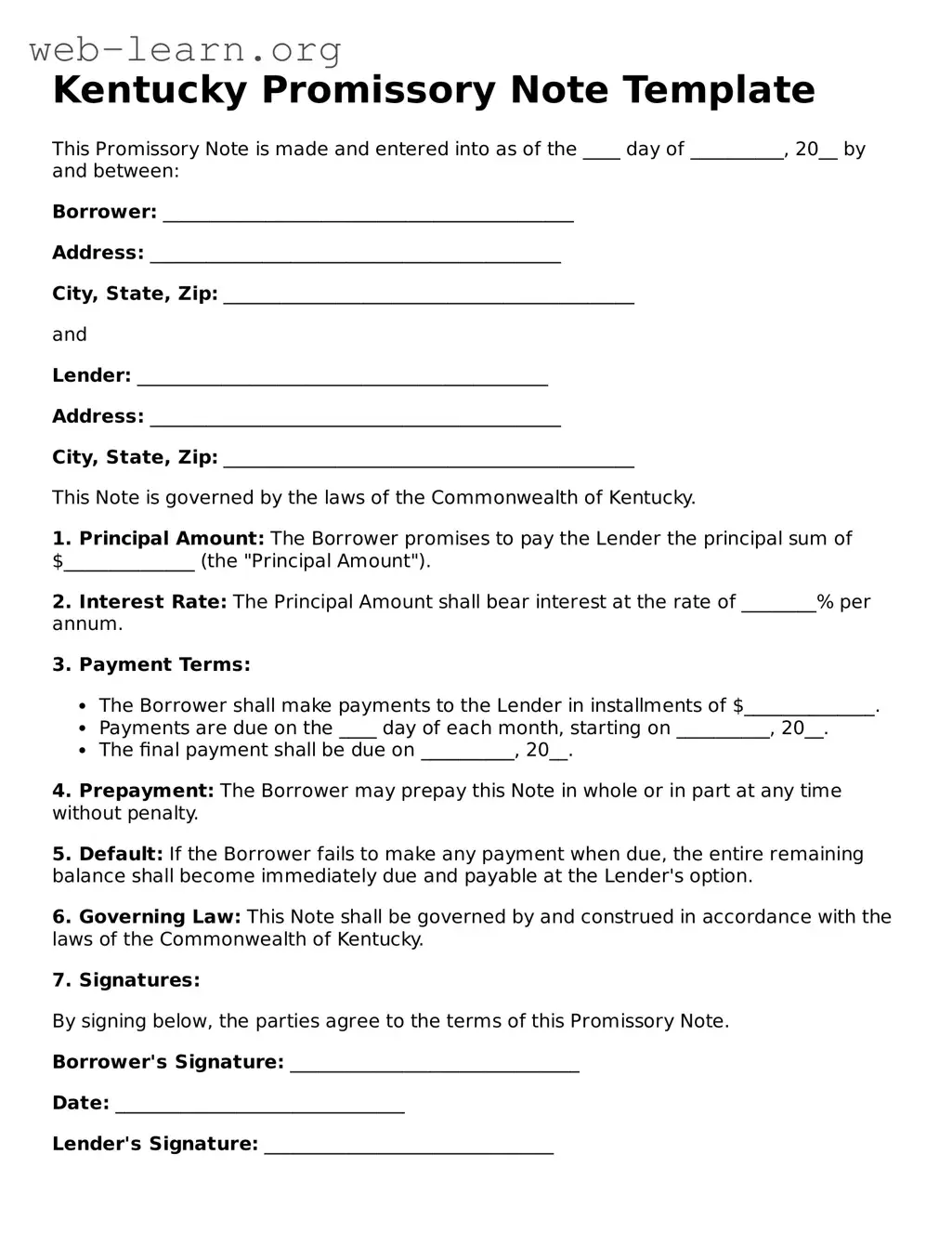
The Kentucky Promissory Note form serves as a crucial financial document for individuals and businesses engaging in lending and borrowing transactions. This legally binding agreement outlines the borrower's commitment to repay a specified amount of money to the lender, detailing key elements such as the principal amount, interest rate, repayment schedule, and any applicable late fees. It also specifies the consequences of default, ensuring that both parties understand their rights and obligations. The form can be customized to fit the needs of the transaction, whether it involves personal loans, business financing, or real estate transactions. Clarity and accuracy in the terms are essential, as they help prevent disputes and misunderstandings in the future. Understanding the Kentucky Promissory Note is vital for anyone involved in a lending arrangement, as it provides a clear framework for the financial relationship between the parties involved.
Kentucky Promissory Note Template
This Promissory Note is made and entered into as of the ____ day of __________, 20__ by and between:
Borrower: ____________________________________________
Address: ____________________________________________
City, State, Zip: ____________________________________________
and
Lender: ____________________________________________
Address: ____________________________________________
City, State, Zip: ____________________________________________
This Note is governed by the laws of the Commonwealth of Kentucky.
1. Principal Amount: The Borrower promises to pay the Lender the principal sum of $______________ (the "Principal Amount").
2. Interest Rate: The Principal Amount shall bear interest at the rate of ________% per annum.
3. Payment Terms:
4. Prepayment: The Borrower may prepay this Note in whole or in part at any time without penalty.
5. Default: If the Borrower fails to make any payment when due, the entire remaining balance shall become immediately due and payable at the Lender's option.
6. Governing Law: This Note shall be governed by and construed in accordance with the laws of the Commonwealth of Kentucky.
7. Signatures:
By signing below, the parties agree to the terms of this Promissory Note.
Borrower's Signature: _______________________________
Date: _______________________________
Lender's Signature: _______________________________
Date: _______________________________
| Fact Name | Description |
|---|---|
| Definition | A Kentucky Promissory Note is a written promise to pay a specific amount of money to a designated person at a specified time. |
| Governing Law | The laws governing promissory notes in Kentucky are found in KRS Chapter 355, which covers the Uniform Commercial Code. |
| Parties Involved | Typically, there are two parties: the borrower (maker) and the lender (payee). |
| Interest Rate | The note can specify an interest rate, which must comply with Kentucky usury laws. |
| Payment Terms | Payment terms should be clearly outlined, including the due date and any installment details. |
| Enforceability | A properly executed promissory note is legally enforceable in Kentucky, provided it meets all necessary requirements. |
After obtaining the Kentucky Promissory Note form, you will be ready to fill it out with the necessary information. This document will require specific details about the loan, the parties involved, and the terms of repayment. Ensure that all information is accurate and complete before submitting the form.
Once the form is filled out, make copies for both the borrower and the lender. Keeping a record of the signed Promissory Note is essential for future reference and to ensure that both parties understand their obligations under the agreement.
What is a Kentucky Promissory Note?
A Kentucky Promissory Note is a legal document that outlines a promise to pay a specific amount of money to a lender or creditor at a designated time. This note serves as a written record of the agreement between the borrower and the lender, detailing the terms of the loan, including interest rates, payment schedules, and any penalties for late payments.
What are the key components of a Kentucky Promissory Note?
Typically, a Kentucky Promissory Note includes the following elements:
Is a Kentucky Promissory Note legally binding?
Yes, once both parties sign the note, it becomes a legally binding contract. This means that if the borrower fails to repay the loan according to the agreed terms, the lender can take legal action to recover the owed amount. It’s important for both parties to fully understand the terms before signing.
Can a Kentucky Promissory Note be modified after it is signed?
Yes, a Promissory Note can be modified, but both parties must agree to the changes. It’s advisable to document any modifications in writing and have both parties sign the amended note. This helps avoid confusion and ensures that all terms are clear moving forward.
What happens if the borrower defaults on the Promissory Note?
If the borrower defaults, meaning they fail to make payments as agreed, the lender has several options. They may choose to pursue legal action to collect the debt, which could involve filing a lawsuit. Additionally, the lender may be able to report the default to credit bureaus, which could impact the borrower’s credit score.
Do I need a lawyer to create a Kentucky Promissory Note?
While it’s not legally required to have a lawyer draft a Promissory Note, it is often a good idea. A legal professional can ensure that the document complies with Kentucky laws and adequately protects your interests. If you choose to create the note on your own, make sure to include all necessary details and be clear about the terms.
Filling out the Kentucky Promissory Note form requires attention to detail. One common mistake is failing to include all necessary parties' names. Both the borrower and lender must be clearly identified. Omitting a name can lead to confusion and disputes in the future.
Another frequent error is not specifying the loan amount. The amount should be written in both numerical and written form. This redundancy helps prevent misunderstandings regarding the total amount owed.
People often neglect to state the interest rate. If the loan is to accrue interest, it must be explicitly mentioned. Without this detail, the terms of repayment may become unclear.
Additionally, many individuals overlook the importance of defining the repayment schedule. The form should clearly outline when payments are due and the total duration of the loan. A vague repayment schedule can lead to missed payments and potential legal issues.
Another mistake is not including a default clause. This clause outlines the consequences if the borrower fails to make payments as agreed. Without it, the lender may have limited options if the borrower defaults.
People sometimes forget to sign and date the document. Both signatures are crucial for the note to be legally binding. A missing signature can render the agreement invalid.
Failing to provide a witness or notary signature is also a common oversight. Depending on the circumstances, having a witness or notary can add an extra layer of legitimacy to the document.
Lastly, individuals may not keep copies of the signed Promissory Note. Retaining a copy is essential for both parties to have a record of the agreement. This can be invaluable in case of disputes or misunderstandings in the future.
A Kentucky Promissory Note is often accompanied by several other documents to ensure clarity and legal protection for both parties involved. Below are five common forms and documents that may be used in conjunction with a Promissory Note.
Utilizing these documents alongside the Kentucky Promissory Note can help protect the interests of both lenders and borrowers. Clear agreements and proper documentation are essential for a smooth transaction.
A Promissory Note is a financial document that establishes a promise to pay a specific amount of money to a designated person or entity under agreed-upon terms. Several other documents share similarities with a Promissory Note. Here’s a list of eight such documents:
Understanding these documents can help clarify financial obligations and the responsibilities involved in borrowing and lending money.
When filling out the Kentucky Promissory Note form, it is essential to follow certain guidelines to ensure accuracy and legality. Here are nine important dos and don'ts to consider:
By adhering to these guidelines, you can help ensure that the promissory note is valid and enforceable under Kentucky law.
When it comes to the Kentucky Promissory Note form, there are several misconceptions that can lead to confusion. Understanding these can help ensure that individuals are better informed when entering into agreements. Here’s a look at some common misunderstandings:
By addressing these misconceptions, individuals can approach the use of a Kentucky Promissory Note with greater confidence and clarity. Understanding the nuances can help avoid potential pitfalls and ensure that agreements are honored.
When dealing with a Kentucky Promissory Note, it’s essential to understand its components and implications. Here are some key takeaways to keep in mind:
Free Promissory Note Template Georgia - They can help lenders assess the risk of lending money based on the borrower's history.
Sample Promissory Note California - It is often used in small business financing arrangements.
Promissory Note Template Louisiana - Promissory notes can help build credit history if reported to credit bureaus.