Entering into a marriage is a significant milestone, often accompanied by a mix of excitement and planning for the future. For couples in Kentucky, one essential aspect of this planning may involve a prenuptial agreement, commonly known as a prenup. This legal document outlines the financial rights and responsibilities of each spouse in the event of a divorce or separation. It can cover various topics, including the division of property, spousal support, and debt allocation. By addressing these matters before tying the knot, couples can foster open communication and set clear expectations. A well-crafted prenup can protect individual assets, clarify financial responsibilities, and help avoid potential disputes down the line. Understanding the Kentucky Prenuptial Agreement form is crucial for anyone considering this proactive approach to marriage, as it ensures that both partners have a clear understanding of their rights and obligations, ultimately contributing to a healthier relationship.
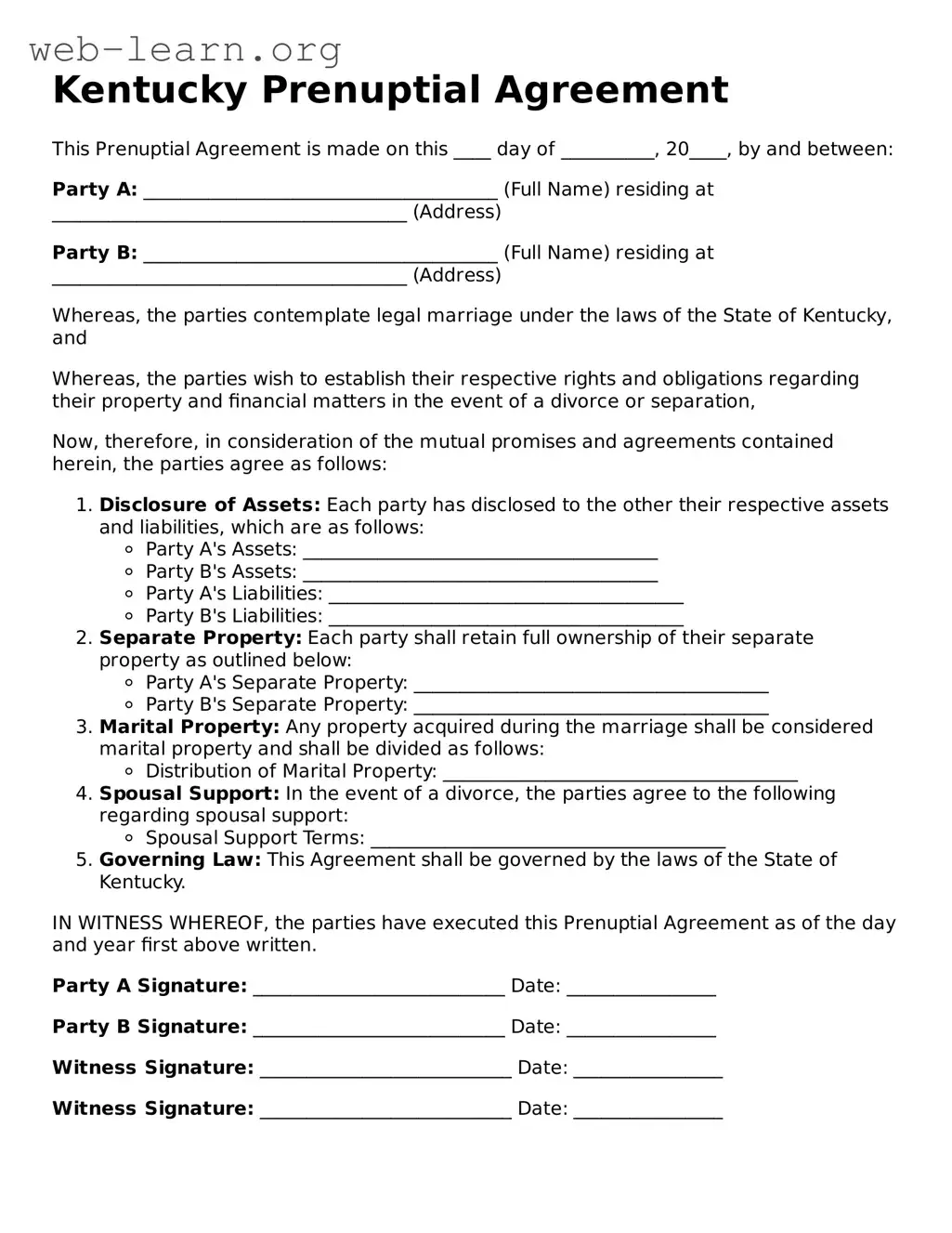
Kentucky Prenuptial Agreement
This Prenuptial Agreement is made on this ____ day of __________, 20____, by and between:
Party A: ______________________________________ (Full Name) residing at ______________________________________ (Address)
Party B: ______________________________________ (Full Name) residing at ______________________________________ (Address)
Whereas, the parties contemplate legal marriage under the laws of the State of Kentucky, and
Whereas, the parties wish to establish their respective rights and obligations regarding their property and financial matters in the event of a divorce or separation,
Now, therefore, in consideration of the mutual promises and agreements contained herein, the parties agree as follows:
IN WITNESS WHEREOF, the parties have executed this Prenuptial Agreement as of the day and year first above written.
Party A Signature: ___________________________ Date: ________________
Party B Signature: ___________________________ Date: ________________
Witness Signature: ___________________________ Date: ________________
Witness Signature: ___________________________ Date: ________________
| Fact Name | Description |
|---|---|
| Definition | A prenuptial agreement is a contract made before marriage outlining the division of assets and responsibilities in case of divorce. |
| Governing Law | Kentucky law governs prenuptial agreements, specifically under KRS 403.120. |
| Enforceability | For a prenuptial agreement to be enforceable in Kentucky, it must be in writing and signed by both parties. |
| Full Disclosure | Both parties are required to fully disclose their assets and liabilities to ensure fairness in the agreement. |
| Voluntary Agreement | The agreement must be entered into voluntarily, without coercion or undue pressure from either party. |
| Legal Representation | While not mandatory, it is highly recommended that both parties seek independent legal counsel before signing. |
| Modification | A prenuptial agreement can be modified or revoked after marriage, but this must be done in writing. |
| Judicial Review | If disputes arise, a court can review the agreement to determine its fairness and enforceability at the time of divorce. |
| Children's Rights | Any provisions regarding child support or custody must comply with Kentucky's child welfare laws and cannot be predetermined. |
| Common Misconceptions | Many believe prenuptial agreements are only for the wealthy, but they can benefit anyone looking to clarify financial matters before marriage. |
Filling out the Kentucky Prenuptial Agreement form is an important step for couples looking to clarify their financial rights and responsibilities before marriage. Completing this form can help ensure that both parties are on the same page regarding their assets and obligations. Here’s how to navigate the process smoothly.
What is a prenuptial agreement?
A prenuptial agreement, commonly referred to as a prenup, is a legal document that couples create before getting married. It outlines how assets and debts will be divided in the event of a divorce or separation. This agreement can help clarify financial responsibilities and protect individual interests.
Why should I consider a prenuptial agreement in Kentucky?
In Kentucky, a prenup can provide peace of mind by clearly defining the financial landscape of your marriage. It can protect personal assets, clarify spousal support obligations, and minimize conflicts in case of a divorce. This proactive approach can save time, money, and emotional stress later on.
What should be included in a Kentucky prenuptial agreement?
While each prenup can be tailored to the couple's needs, common elements include:
Is a prenuptial agreement enforceable in Kentucky?
Yes, a prenuptial agreement can be enforceable in Kentucky as long as it meets certain legal requirements. The agreement must be in writing and signed by both parties. Additionally, it should be entered into voluntarily, without any duress or coercion, and both parties should fully disclose their financial situations.
Can a prenuptial agreement be modified after marriage?
Yes, couples can modify a prenuptial agreement after marriage. Both parties must agree to the changes, and the modifications should be documented in writing and signed by both individuals. It’s advisable to consult with a legal professional to ensure that the updated agreement complies with Kentucky law.
How do I create a prenuptial agreement in Kentucky?
To create a prenuptial agreement, couples typically follow these steps:
What happens if we don’t have a prenuptial agreement?
If a couple does not have a prenuptial agreement, Kentucky law will dictate how assets and debts are divided in the event of a divorce. This could lead to outcomes that neither party anticipated or desired, potentially resulting in lengthy legal disputes.
Are there any limitations to what a prenuptial agreement can cover?
Yes, there are certain limitations. A prenuptial agreement cannot include provisions that are illegal or against public policy, such as waiving child support obligations. Additionally, agreements that are deemed unfair or signed under duress may not be enforceable in court.
Can I use a template for my prenuptial agreement?
While templates can provide a starting point, it is essential to customize the agreement to reflect the unique circumstances of your relationship. Consulting with a legal professional is highly recommended to ensure that the document complies with Kentucky laws and adequately protects both parties' interests.
How much does it cost to create a prenuptial agreement in Kentucky?
The cost of creating a prenuptial agreement can vary widely depending on several factors, including the complexity of the agreement and the attorney’s fees. Generally, couples can expect to pay anywhere from a few hundred to several thousand dollars. Investing in a well-drafted prenup can prevent costly disputes in the future.
Filling out a prenuptial agreement form in Kentucky can be a straightforward process, but there are common mistakes that individuals often make. One of the most significant errors is failing to disclose all assets and debts. Transparency is crucial in creating a valid prenuptial agreement. If one party does not fully disclose their financial situation, it can lead to the agreement being contested later. Both parties must be honest about their financial status to ensure the agreement holds up in court.
Another frequent mistake is using vague language. The terms of a prenuptial agreement should be clear and specific. Ambiguities can lead to misunderstandings and disputes in the future. For instance, if one party states they will receive “a fair share” of certain assets without defining what that entails, it can create confusion. Precise language helps avoid potential conflicts and ensures both parties understand their rights and responsibilities.
Individuals sometimes overlook the importance of legal counsel. While it is possible to fill out the form without an attorney, having legal representation can help ensure that the agreement complies with Kentucky law. An attorney can provide guidance on how to structure the agreement effectively and ensure that both parties’ interests are protected. Without this professional insight, individuals may inadvertently include terms that could render the agreement unenforceable.
Lastly, a common oversight is neglecting to update the agreement after significant life changes. A prenuptial agreement should be a living document that reflects the current financial circumstances of both parties. Changes such as the birth of a child, significant income changes, or the acquisition of new assets should prompt a review and potential revision of the agreement. Failing to make these updates can lead to complications if the agreement is ever enforced.
When preparing a prenuptial agreement in Kentucky, several other forms and documents may also be relevant. These documents help clarify financial responsibilities, property rights, and other important aspects of a marriage. Below is a list of commonly used forms that can complement a prenuptial agreement.
Each of these documents serves a unique purpose and can provide additional clarity and security for both parties in a marriage. By considering these forms alongside a prenuptial agreement, couples can better prepare for their financial futures and potential challenges that may arise.
When filling out the Kentucky Prenuptial Agreement form, there are several important considerations to keep in mind. Here’s a helpful list of things you should and shouldn’t do:
Following these guidelines can help create a solid foundation for your prenuptial agreement. Taking the time to prepare properly can lead to a smoother process for both parties involved.
Misconception 1: Prenuptial agreements are only for wealthy individuals.
Many people believe that prenuptial agreements are only necessary for those with significant assets. In reality, anyone can benefit from a prenup, regardless of their financial situation. A prenup can clarify financial responsibilities and protect both partners, making it a useful tool for all couples.
Misconception 2: Prenuptial agreements are only enforceable if both parties are represented by lawyers.
While it is highly recommended for both parties to have legal representation when drafting a prenuptial agreement, it is not a strict requirement for the agreement to be enforceable. However, having independent legal advice can help ensure that both parties fully understand the terms and implications of the agreement.
Misconception 3: Prenuptial agreements are only valid if signed months before the wedding.
Some believe that prenuptial agreements must be signed well in advance of the wedding day. In Kentucky, as long as both parties voluntarily agree to the terms and sign the document before the marriage takes place, the timing is flexible. However, signing too close to the wedding date may raise questions about coercion or lack of understanding.
Misconception 4: A prenuptial agreement can cover any and all future issues.
Many people think that prenuptial agreements can address any potential future disputes. However, certain topics, such as child custody and child support, cannot be predetermined in a prenup. Courts will ultimately decide these matters based on the best interests of the child at the time of divorce.
Misconception 5: Prenuptial agreements are only for couples who expect to divorce.
This belief suggests that entering into a prenup implies a lack of commitment. In truth, a prenuptial agreement can serve as a proactive measure to promote transparency and open communication about finances. It can help couples build a solid foundation for their marriage by addressing potential issues before they arise.
When considering a prenuptial agreement in Kentucky, understanding the process and implications is essential. Below are key takeaways to keep in mind:
These takeaways provide a foundational understanding of the Kentucky Prenuptial Agreement form, ensuring that both parties can enter into the agreement with clarity and confidence.
Georgia Prenup - A prenuptial agreement can be an important tool for financial planning in a marriage.
Illinois Prenup - A Prenuptial Agreement can clarify expectations regarding financial contributions.
Alabama Prenup - This agreement outlines the division of assets and responsibilities in the event of divorce.