The Kentucky Operating Agreement form is a vital document for individuals and groups looking to establish a limited liability company (LLC) in the state. This form outlines the internal workings of the LLC, detailing the rights and responsibilities of its members. It serves as a blueprint for how the business will be managed and operated, covering aspects such as profit distribution, decision-making processes, and member roles. By clearly defining these elements, the Operating Agreement helps to prevent disputes among members and provides a framework for resolving any issues that may arise. Additionally, while Kentucky law does not require an Operating Agreement for LLCs, having one in place is highly recommended. This document not only enhances the credibility of the business but also protects the limited liability status of its members by demonstrating that the LLC is being operated as a separate entity. In essence, the Kentucky Operating Agreement form is an essential tool for ensuring smooth operations and fostering a clear understanding among all parties involved in the business.
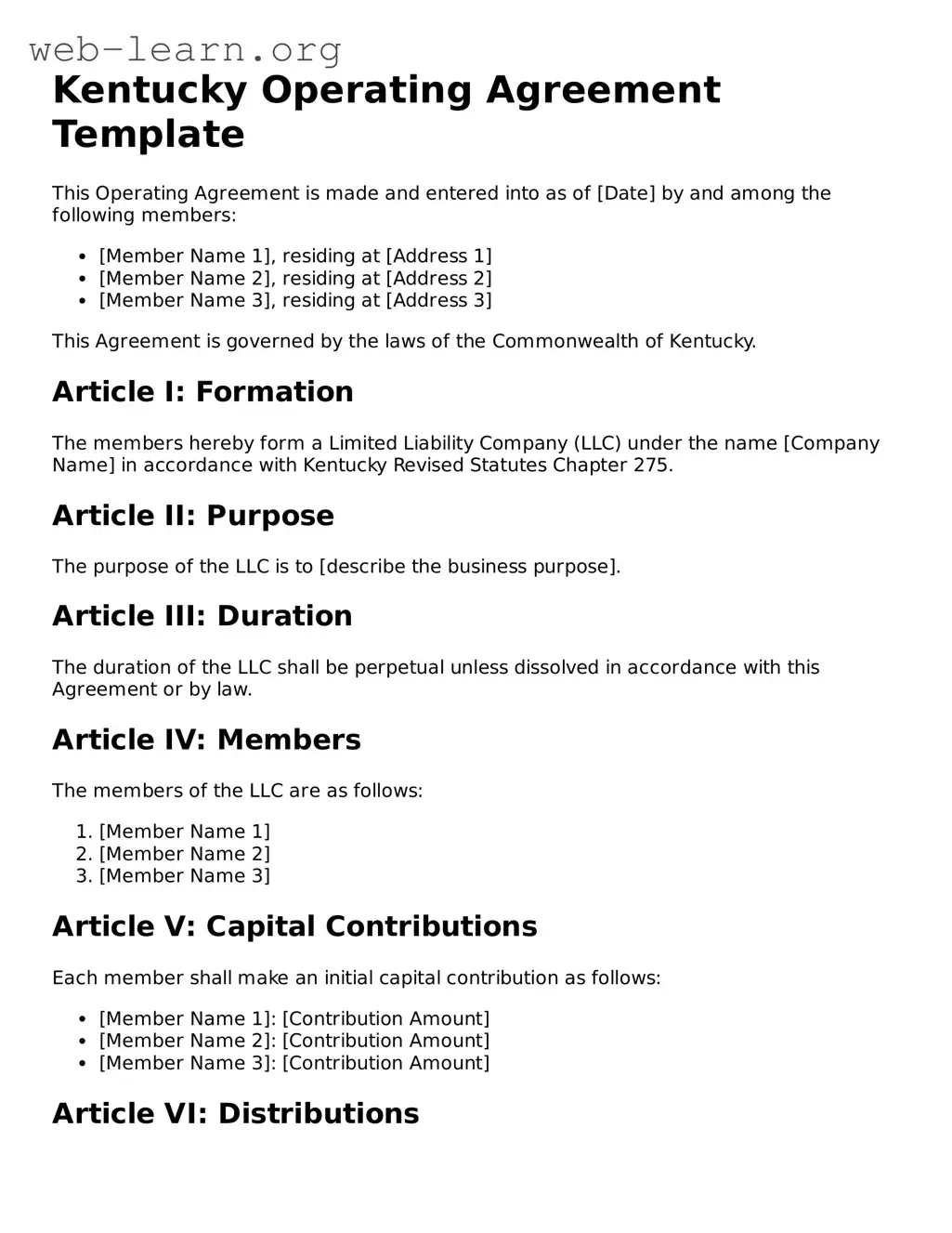
Kentucky Operating Agreement Template
This Operating Agreement is made and entered into as of [Date] by and among the following members:
This Agreement is governed by the laws of the Commonwealth of Kentucky.
Article I: Formation
The members hereby form a Limited Liability Company (LLC) under the name [Company Name] in accordance with Kentucky Revised Statutes Chapter 275.
Article II: Purpose
The purpose of the LLC is to [describe the business purpose].
Article III: Duration
The duration of the LLC shall be perpetual unless dissolved in accordance with this Agreement or by law.
Article IV: Members
The members of the LLC are as follows:
Article V: Capital Contributions
Each member shall make an initial capital contribution as follows:
Article VI: Distributions
Distributions of profits and losses shall be allocated to the members in proportion to their respective capital contributions.
Article VII: Management
The LLC shall be managed by its members. Decisions shall be made by a majority vote of the members.
Article VIII: Indemnification
The LLC shall indemnify each member against any and all expenses and liabilities incurred in connection with the LLC to the fullest extent permitted by law.
Article IX: Amendments
This Agreement may be amended only by a written agreement signed by all members.
Article X: Miscellaneous
This Agreement constitutes the entire understanding among the members and supersedes all prior agreements. If any provision is found to be invalid, the remaining provisions shall remain in effect.
IN WITNESS WHEREOF, the undersigned members have executed this Operating Agreement as of the date first above written.
_________________________ [Member Name 1]
_________________________ [Member Name 2]
_________________________ [Member Name 3]
| Fact Name | Details |
|---|---|
| Purpose | The Kentucky Operating Agreement outlines the management structure and operational procedures of a limited liability company (LLC). |
| Governing Law | The agreement is governed by the Kentucky Revised Statutes, specifically KRS Chapter 275. |
| Member Rights | It defines the rights and responsibilities of each member, ensuring clarity in ownership and decision-making. |
| Flexibility | The agreement allows for customization, enabling members to tailor terms to fit their specific business needs. |
| Dispute Resolution | It often includes provisions for resolving disputes among members, which can help prevent litigation. |
| Tax Treatment | The agreement can outline how the LLC will be taxed, including options for pass-through taxation. |
| Amendments | Members can specify procedures for amending the agreement, ensuring it remains relevant as the business evolves. |
| Duration | The agreement may state the duration of the LLC, whether it is perpetual or for a specified term. |
After obtaining the Kentucky Operating Agreement form, you will need to complete it accurately to ensure your business operates smoothly. This process involves providing essential information about your business structure and the roles of each member. Following these steps will help you fill out the form correctly.
Once you have completed the form, review it carefully for any errors or omissions. This ensures that all information is accurate and reflects the intentions of all members involved.
A Kentucky Operating Agreement is a legal document that outlines the management structure and operational procedures of a limited liability company (LLC) in Kentucky. It serves as an internal guideline for the members of the LLC, detailing their rights, responsibilities, and the distribution of profits and losses.
While Kentucky law does not mandate that LLCs have an Operating Agreement, it is highly recommended. Having this document can help prevent misunderstandings among members and provide clarity on how the business should be run.
The Operating Agreement can be drafted by any member of the LLC. However, it is advisable to seek assistance from a legal professional to ensure that all necessary provisions are included and that the document complies with state laws.
Key elements to include are:
Yes, the Operating Agreement can be amended. It is important to follow the procedures outlined in the original agreement for making changes. Typically, this requires a vote among the members.
The Operating Agreement helps define the roles and responsibilities of members, which can protect personal assets from business liabilities. By clearly outlining the operational procedures, it can also help maintain the LLC's status as a separate legal entity.
If an LLC does not have an Operating Agreement, the default rules set by Kentucky law will apply. This can lead to potential conflicts among members and may not reflect the intentions of the members regarding management and profit distribution.
The Operating Agreement is not filed with the state. Instead, it should be kept with the LLC’s records. Each member should have a copy, and it is wise to keep it updated and readily accessible.
Yes, using a template can be a helpful starting point. However, it is crucial to customize the template to fit the specific needs of your LLC. Consider consulting with a legal professional to ensure that all necessary provisions are included.
When filling out the Kentucky Operating Agreement form, individuals often overlook critical details that can lead to complications down the line. One common mistake is failing to clearly define the roles and responsibilities of each member. Without this clarity, misunderstandings may arise regarding who is accountable for specific tasks, potentially leading to conflicts within the organization.
Another frequent error involves neglecting to specify the distribution of profits and losses. Many assume that this will be understood or agreed upon later, but without explicit terms laid out in the agreement, disputes can emerge. It is essential to outline how profits will be shared among members, as well as how losses will be handled, to ensure everyone is on the same page.
People also tend to underestimate the importance of including a procedure for resolving disputes. Failing to outline a clear process can result in prolonged disagreements that disrupt business operations. By establishing a method for conflict resolution, such as mediation or arbitration, members can address issues more efficiently and maintain a healthy working relationship.
Lastly, many individuals forget to review and update the Operating Agreement regularly. As businesses evolve, so do their needs. Neglecting to revisit the agreement can lead to outdated provisions that no longer serve the interests of the members. Regular reviews ensure that the agreement remains relevant and effective in guiding the organization’s operations.
When forming a limited liability company (LLC) in Kentucky, the Operating Agreement is a crucial document. However, there are several other forms and documents that are often used alongside it to ensure proper compliance and organization. Below is a list of these documents, each serving a unique purpose in the LLC formation process.
Each of these documents plays a vital role in the formation and operation of an LLC in Kentucky. Ensuring that you have all the necessary paperwork in order can help streamline your business processes and maintain compliance with state regulations.
The Operating Agreement is an essential document for a business, particularly for LLCs. It outlines the management structure, responsibilities, and operational procedures. Several other documents share similarities with the Operating Agreement. Here are eight of them:
When filling out the Kentucky Operating Agreement form, there are important dos and don’ts to keep in mind. Here’s a helpful list to guide you through the process:
Following these guidelines can help ensure that your Operating Agreement is completed correctly and serves its intended purpose effectively.
When it comes to the Kentucky Operating Agreement form, there are several misconceptions that can lead to confusion for business owners and entrepreneurs. Understanding these common misunderstandings can help ensure that you navigate the requirements more effectively. Here are six misconceptions about the Kentucky Operating Agreement form:
Clearing up these misconceptions can lead to better decision-making and smoother operations for your business in Kentucky. Understanding the true purpose and requirements of the Operating Agreement is a crucial step in ensuring your business is set up for success.
When filling out and using the Kentucky Operating Agreement form, keep these key takeaways in mind:
Using the Operating Agreement effectively can help prevent disputes and clarify expectations among members.
Llc Operating Agreement Arizona - The Operating Agreement can include buy-sell provisions to facilitate the transfer of ownership interests.
How to Create an Operating Agreement - It can define the roles of each member in day-to-day operations.
Creating an Operating Agreement - It may address the management structure, whether member-managed or manager-managed.
How to File Operating Agreement Llc - This document can provide clarity on intellectual property ownership within the company.