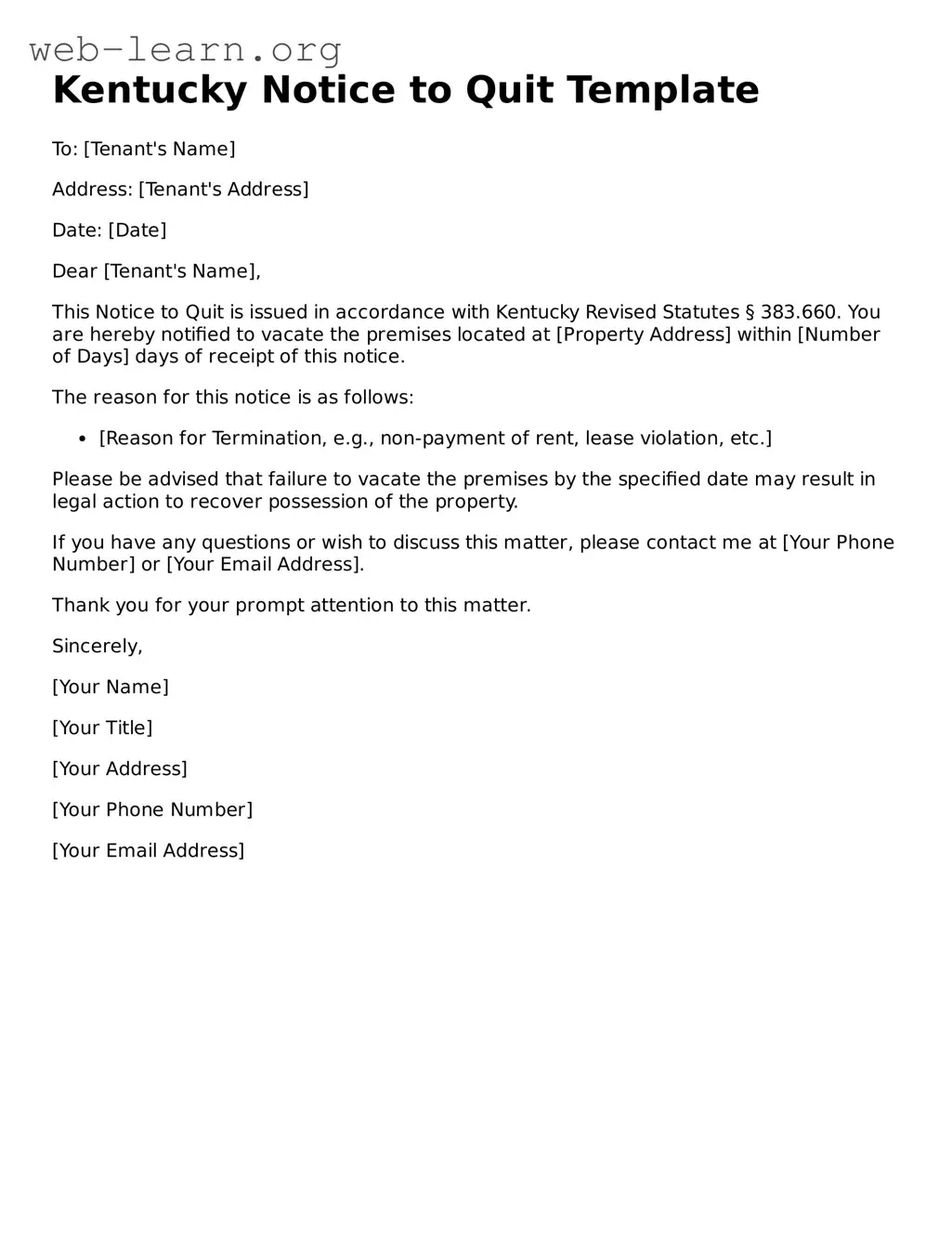
The Kentucky Notice to Quit form plays a crucial role in the landlord-tenant relationship, particularly when it comes to terminating a lease agreement. This document serves as a formal notification to tenants, indicating that they must vacate the rental property within a specified time frame. The form outlines the reasons for the eviction, which can include non-payment of rent, lease violations, or the end of a lease term. It is important for landlords to provide this notice in a clear and concise manner, ensuring that all necessary details are included, such as the tenant's name, the address of the rental property, and the date by which the tenant must leave. Tenants, on the other hand, should understand their rights and the implications of receiving a Notice to Quit. This form is not just a piece of paper; it is a critical step in the eviction process that can have lasting effects on both parties involved. Understanding the specifics of the Kentucky Notice to Quit form can help landlords and tenants navigate this often difficult situation more effectively.
Kentucky Notice to Quit Template
To: [Tenant's Name]
Address: [Tenant's Address]
Date: [Date]
Dear [Tenant's Name],
This Notice to Quit is issued in accordance with Kentucky Revised Statutes § 383.660. You are hereby notified to vacate the premises located at [Property Address] within [Number of Days] days of receipt of this notice.
The reason for this notice is as follows:
Please be advised that failure to vacate the premises by the specified date may result in legal action to recover possession of the property.
If you have any questions or wish to discuss this matter, please contact me at [Your Phone Number] or [Your Email Address].
Thank you for your prompt attention to this matter.
Sincerely,
[Your Name]
[Your Title]
[Your Address]
[Your Phone Number]
[Your Email Address]
| Fact Name | Description |
|---|---|
| Purpose | The Kentucky Notice to Quit form is used by landlords to inform tenants of their intent to terminate the lease agreement. |
| Governing Law | This form is governed by Kentucky Revised Statutes, specifically KRS 383.660 and KRS 383.695. |
| Delivery Method | The notice can be delivered in person, via certified mail, or by posting it on the premises. |
| Timeframe | Tenants typically have a specified number of days to vacate the premises, depending on the reason for the notice. |
After obtaining the Kentucky Notice to Quit form, you will need to fill it out accurately to ensure it meets the necessary requirements. This form is essential for initiating the process of ending a tenancy. Follow the steps below to complete the form correctly.
Once the form is filled out, it must be delivered to the tenant in accordance with Kentucky law. Ensure that you keep a record of how and when the notice was delivered, as this may be necessary for any future legal steps.
What is a Notice to Quit in Kentucky?
A Notice to Quit is a formal document that a landlord provides to a tenant. This notice informs the tenant that they must vacate the rental property. It is often used in situations where the tenant has violated the lease agreement or has not paid rent. The notice serves as the first step in the eviction process.
When is a Notice to Quit required?
A Notice to Quit is typically required when a tenant fails to pay rent, breaches the lease terms, or engages in illegal activities on the property. In Kentucky, landlords must provide this notice before initiating eviction proceedings.
How much notice must be given?
The amount of notice required depends on the reason for the eviction:
What information should be included in the Notice to Quit?
The Notice to Quit should include the following details:
Can a tenant respond to a Notice to Quit?
Yes, a tenant can respond to a Notice to Quit. They may choose to resolve the issue, such as paying overdue rent or correcting lease violations. Communication with the landlord is encouraged to seek a mutually agreeable solution.
What happens if the tenant does not vacate the property?
If the tenant does not vacate the property within the specified time frame, the landlord may proceed with eviction proceedings in court. It is essential for tenants to take the notice seriously and respond promptly.
Is a Notice to Quit the same as an eviction notice?
No, a Notice to Quit is not the same as an eviction notice. The Notice to Quit is a preliminary step that informs the tenant of the need to vacate. If the tenant does not comply, the landlord may then file for eviction, which involves court proceedings.
Where can I find a Kentucky Notice to Quit form?
A Kentucky Notice to Quit form can typically be obtained from legal aid organizations, local courthouses, or online legal resources. It is important to ensure that the form complies with Kentucky state laws.
Filling out the Kentucky Notice to Quit form can be a straightforward process, but many individuals make common mistakes that can complicate matters. One frequent error is failing to include the correct date. It is essential to specify the date on which the notice is served. Without this information, the notice may be considered incomplete, which could delay the eviction process.
Another mistake is not providing the tenant's full name. The form requires the complete legal name of the tenant. Omitting or misspelling this information can lead to confusion and may hinder the enforcement of the notice. It is crucial to double-check the spelling and ensure that the name matches official documents.
Some individuals neglect to specify the reason for the eviction. The Notice to Quit form should clearly state why the tenant is being asked to vacate the premises. Whether it is due to non-payment of rent or lease violations, including this information is vital. A vague or missing reason can weaken the case if it goes to court.
Providing an incorrect address for the rental property is another common oversight. The form must include the full address where the tenant resides. Failing to do so can lead to challenges in delivering the notice and may result in legal complications.
Many people also forget to sign and date the form. A signature is necessary to validate the notice. Without it, the document may be deemed invalid. It is important to ensure that the form is signed by the person who is initiating the eviction process.
In addition, not keeping a copy of the completed form is a mistake that can have serious repercussions. It is essential to retain a copy for personal records. This serves as proof that the notice was served and can be useful if legal action becomes necessary.
Lastly, some individuals fail to follow the proper delivery method for the notice. The Kentucky law outlines specific ways to deliver the Notice to Quit, such as personal delivery or certified mail. Ignoring these guidelines can result in the notice being challenged in court, potentially prolonging the eviction process.
When dealing with rental agreements and tenant evictions in Kentucky, the Notice to Quit form is a crucial document. However, several other forms and documents often accompany this notice to ensure a smooth legal process. Below is a list of commonly used documents that may be relevant.
Understanding these documents can empower landlords and tenants alike, ensuring that all parties are aware of their rights and responsibilities. Proper documentation is essential in navigating the complexities of rental agreements and evictions in Kentucky.
When filling out the Kentucky Notice to Quit form, it is important to follow specific guidelines to ensure the process goes smoothly. Here are ten things you should and shouldn't do:
The Kentucky Notice to Quit form is often misunderstood. Here are six common misconceptions about this important document:
The Notice to Quit is specifically for terminating a lease agreement. It cannot be used for all eviction scenarios, such as those involving non-payment of rent or lease violations without proper grounds.
The notice period can vary based on the type of tenancy. For example, month-to-month tenants may require a longer notice than those on a fixed-term lease.
This is not true. The notice provides a timeframe for the tenant to vacate the property, which must be respected according to state law.
While personal delivery is one option, the Notice to Quit can also be sent via certified mail or posted on the property, depending on local regulations.
While landlords can draft their own notices, using a standard form ensures compliance with legal requirements and reduces the risk of errors.
The Notice to Quit is just the first step. Additional legal processes and documents are often required to complete an eviction.
Filling out and using the Kentucky Notice to Quit form is an important step in the eviction process. Here are key takeaways to keep in mind:
Landlord:23dca7yshec= Eviction Letter - Landlords may choose to issue a Notice to Quit for reasons beyond non-payment, including property damage.
3 Day Notice to Pay or Quit California 2023 - Important for landlords to document all communications.
House Quit Notice Letter - Each state has specific rules governing the content and delivery of a Notice to Quit.
Florida Eviction Notice - Landlords should be prepared for potential disputes following the notice.