When entering into a professional relationship in Kentucky, understanding the nuances of a Non-compete Agreement can be crucial for both employers and employees. This legal document is designed to protect a business's interests by limiting an employee's ability to work for competitors or start a similar business after leaving their current position. Key aspects of the Kentucky Non-compete Agreement include the duration of the restriction, the geographic area it covers, and the specific activities that are prohibited. These agreements must be reasonable in scope to be enforceable, meaning they should not impose undue hardship on the employee while still safeguarding the employer's legitimate business interests. Additionally, Kentucky law requires that such agreements be supported by consideration, which typically means that the employee must receive something of value in exchange for agreeing to the terms. Understanding these elements can help both parties navigate the complexities of employment relationships while ensuring that their rights and interests are adequately protected.
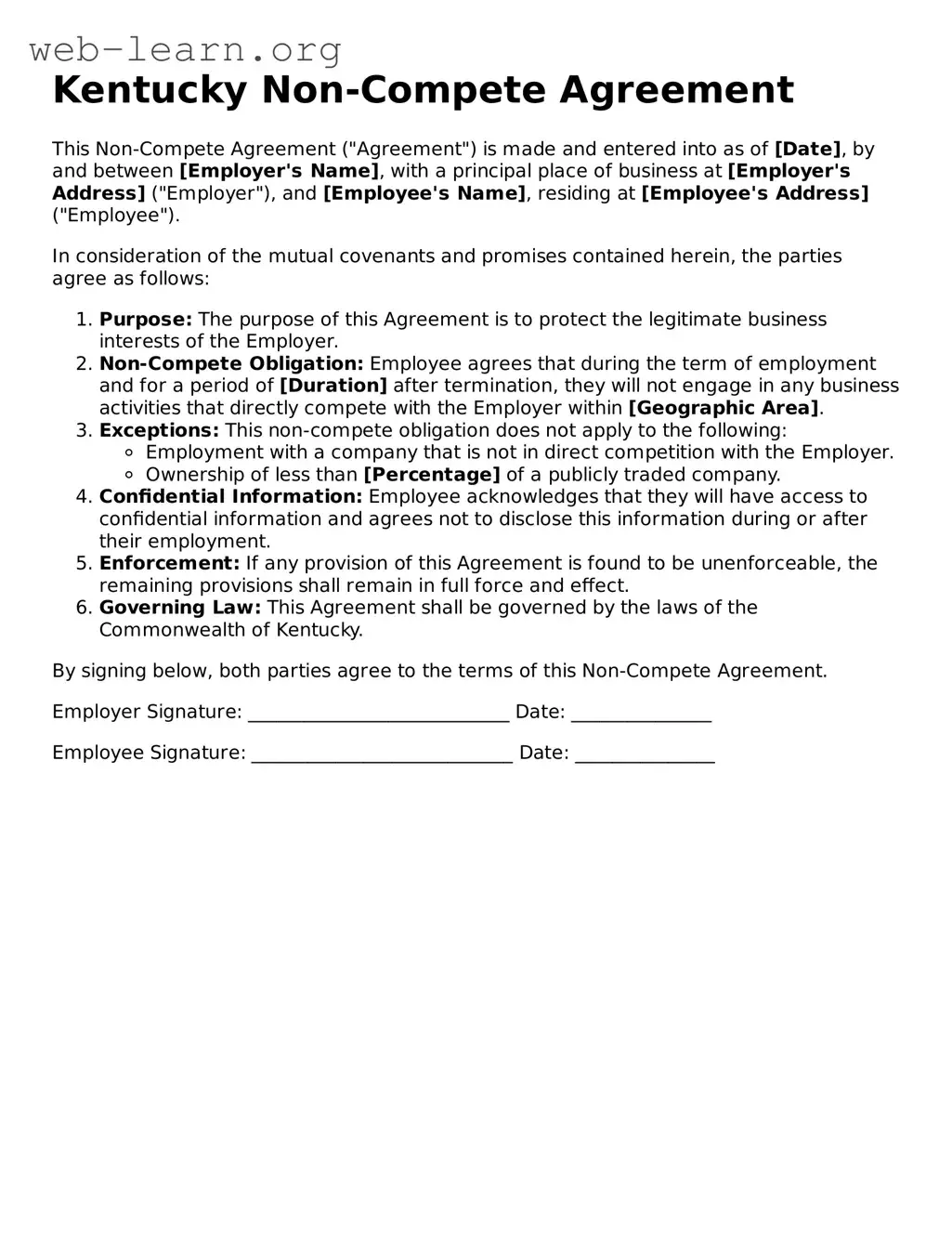
Kentucky Non-Compete Agreement
This Non-Compete Agreement ("Agreement") is made and entered into as of [Date], by and between [Employer's Name], with a principal place of business at [Employer's Address] ("Employer"), and [Employee's Name], residing at [Employee's Address] ("Employee").
In consideration of the mutual covenants and promises contained herein, the parties agree as follows:
By signing below, both parties agree to the terms of this Non-Compete Agreement.
Employer Signature: ____________________________ Date: _______________
Employee Signature: ____________________________ Date: _______________
| Fact Name | Description |
|---|---|
| Governing Law | The Kentucky Non-compete Agreement is governed by Kentucky state law. |
| Enforceability | Non-compete agreements in Kentucky are enforceable if they are reasonable in scope and duration. |
| Duration | Typically, a duration of one to two years is considered reasonable for enforceability. |
| Geographic Scope | The agreement must specify a geographic area where the restrictions apply. |
| Consideration | There must be adequate consideration, such as employment or a promotion, for the agreement to be valid. |
| Employee Protections | Kentucky law prohibits non-compete agreements that unreasonably restrict an employee’s right to work. |
| Judicial Review | Courts in Kentucky may modify overly broad agreements to make them enforceable. |
Once you have the Kentucky Non-compete Agreement form in hand, you will need to fill it out carefully to ensure that all necessary information is provided. This process involves gathering relevant details about the parties involved and clearly stating the terms of the agreement. After completing the form, it will need to be signed by the appropriate parties to be valid.
What is a non-compete agreement?
A non-compete agreement is a contract between an employer and an employee that restricts the employee from engaging in certain competitive activities after leaving the company. These agreements aim to protect the employer’s business interests, including trade secrets and client relationships.
Are non-compete agreements enforceable in Kentucky?
Yes, non-compete agreements are generally enforceable in Kentucky, provided they meet certain criteria. The agreement must be reasonable in scope, duration, and geographic area. Courts will evaluate whether the restrictions are necessary to protect legitimate business interests without unduly restricting the employee's ability to find work.
What factors determine the reasonableness of a non-compete agreement?
Several factors influence the reasonableness of a non-compete agreement in Kentucky, including:
How long can a non-compete agreement last in Kentucky?
While there is no specific time limit set by law, non-compete agreements in Kentucky are typically limited to one to two years. Agreements lasting longer than this may be deemed unreasonable and unenforceable.
Can a non-compete agreement be modified?
Yes, a non-compete agreement can be modified if both parties agree to the changes. Modifications should be documented in writing to ensure clarity and enforceability.
What happens if I violate a non-compete agreement?
If an employee violates a non-compete agreement, the employer may seek legal remedies. This can include injunctive relief to prevent the employee from continuing the competitive activity and potentially monetary damages for any losses incurred due to the violation.
Are there any exceptions to non-compete agreements in Kentucky?
Yes, certain exceptions may apply. For instance, non-compete agreements are generally not enforceable against employees who are laid off or terminated without cause. Additionally, the agreement must not impose undue hardship on the employee.
What should I consider before signing a non-compete agreement?
Before signing, carefully review the terms of the agreement. Consider the duration, geographic scope, and potential impact on your future employment opportunities. It may be wise to consult with a legal professional to understand the implications fully.
Can I negotiate the terms of a non-compete agreement?
Yes, employees can negotiate the terms of a non-compete agreement. It is advisable to discuss any concerns with the employer and propose modifications that would make the agreement more acceptable.
Where can I find a Kentucky non-compete agreement form?
Kentucky non-compete agreement forms can be found through various legal resources, including online legal service providers, law firms, or by consulting with a legal professional who can tailor an agreement to meet specific needs.
Completing a Kentucky Non-compete Agreement form can be a daunting task. It is essential to approach this process with care to avoid common mistakes. One frequent error is failing to clearly define the scope of the non-compete. Without specific details about the activities restricted, the agreement may not hold up in court. Clarity is key in ensuring that both parties understand the limitations imposed.
Another mistake often seen is neglecting to specify the duration of the non-compete. The agreement should include a reasonable time frame during which the restrictions apply. If this duration is too long, it may be deemed unenforceable. Conversely, if it is too short, it may not provide adequate protection for the employer.
Additionally, individuals sometimes overlook the geographical limitations of the non-compete. It is crucial to define the area in which the restrictions apply. A vague or overly broad geographical scope can lead to legal challenges. Therefore, precise language regarding location is vital.
Some people fail to consider the reasonableness of the terms. Courts often evaluate whether the restrictions are necessary to protect legitimate business interests. If the terms are overly restrictive, they may be invalidated. It is essential to strike a balance that protects both the employer's interests and the employee's right to work.
Another common oversight is not consulting with legal counsel before signing the agreement. Legal advice can provide valuable insights into the implications of the non-compete. This step can prevent misunderstandings and ensure that the agreement is fair and enforceable.
Moreover, individuals may not take the time to read the entire document thoroughly. Skimming through the agreement can lead to missing important clauses or conditions. Every detail matters, and understanding the entire context of the agreement is crucial.
Some people mistakenly assume that a non-compete agreement is a standard form that requires no customization. Each situation is unique, and tailoring the agreement to reflect specific circumstances is essential. A generic form may not adequately address the needs of both parties.
Furthermore, individuals sometimes forget to include a clause regarding the consequences of violating the agreement. Outlining the repercussions can serve as a deterrent and provide clarity on what actions may be taken if the terms are breached.
Lastly, failing to keep a copy of the signed agreement is a significant mistake. Both parties should retain a copy for their records. This ensures that everyone is aware of the terms and can refer back to them if necessary.
When entering into a Kentucky Non-compete Agreement, several other forms and documents may be relevant to ensure clarity and legal compliance. Each of these documents serves a specific purpose in the context of employment and business relationships.
Understanding these documents can help individuals and businesses navigate their rights and responsibilities effectively. Each plays a crucial role in protecting interests and fostering a respectful and compliant work environment.
When filling out the Kentucky Non-compete Agreement form, it is important to approach the process with care. Here are ten guidelines to consider.
Following these guidelines can help ensure that you are making informed decisions when completing the Kentucky Non-compete Agreement form.
Many people have misunderstandings about the Kentucky Non-compete Agreement form. Here are five common misconceptions:
This is not true. In Kentucky, for a non-compete agreement to be enforceable, it must be reasonable in scope, duration, and geographic area. Courts may refuse to enforce overly broad agreements.
While non-compete agreements can limit where and how employees work, they do not permanently bar individuals from their profession. Restrictions typically last for a specific time period.
Each agreement can vary significantly based on the specific terms and conditions outlined. It’s important to read and understand the details of any non-compete agreement before signing.
This is a misconception. Non-compete agreements can apply to any employee, regardless of their position, if the employer believes it is necessary to protect their business interests.
Many people believe they have to accept the terms as-is. However, it is possible to negotiate the terms of a non-compete agreement before signing. Open communication with your employer can lead to a more favorable agreement.
When filling out and using the Kentucky Non-compete Agreement form, keep these key points in mind:
Are Non Competes Enforceable in Florida - This form helps maintain a company’s competitive edge in the market.
Non Compete Agreement Kansas - Employees should consider consulting a legal professional before signing a Non-compete Agreement.