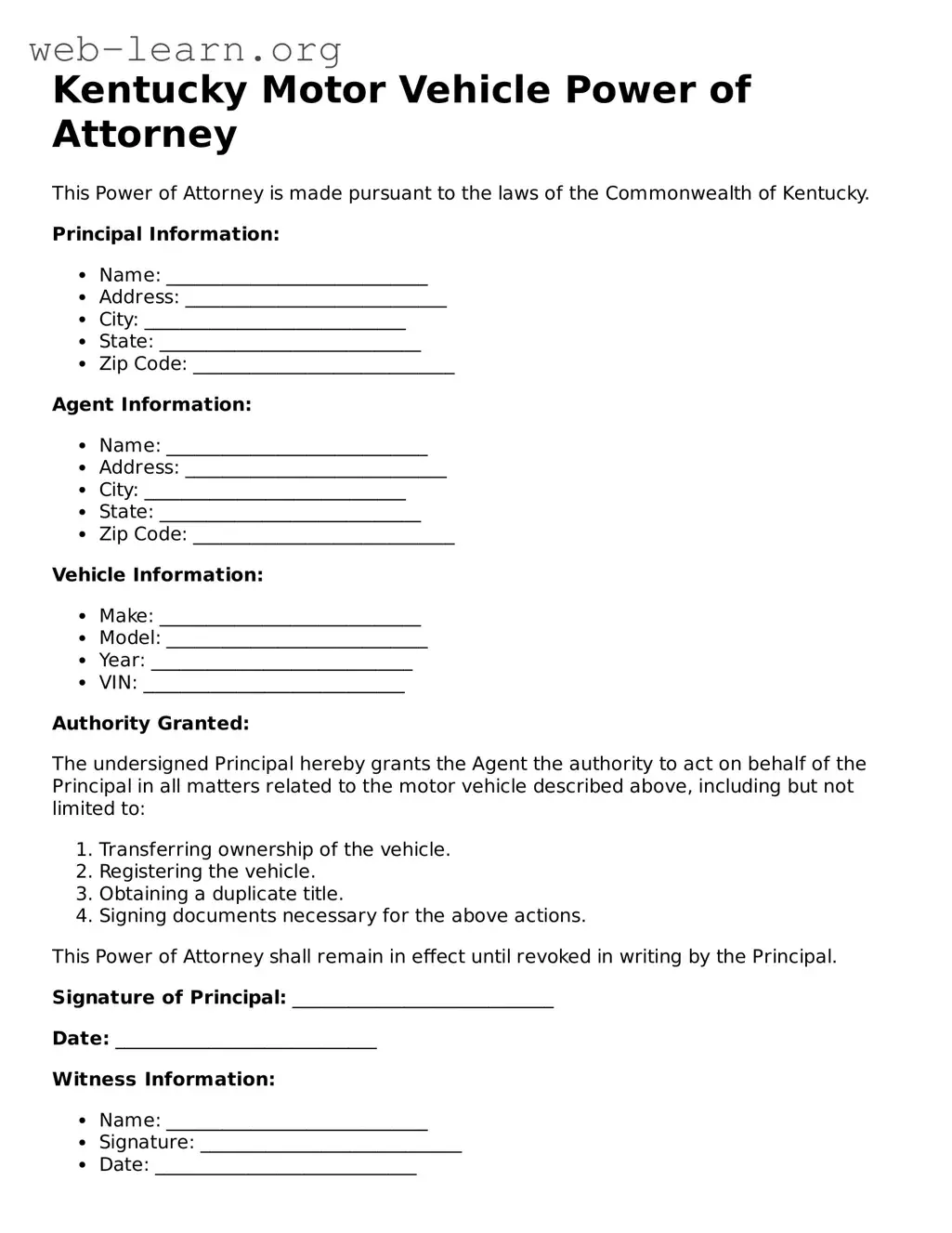
The Kentucky Motor Vehicle Power of Attorney form is an essential document for anyone needing to authorize another person to handle motor vehicle transactions on their behalf. This form allows you to designate an agent who can perform specific actions related to your vehicle, such as registering, transferring ownership, or obtaining a title. Whether you are unable to attend the DMV due to time constraints or physical limitations, this form provides a straightforward solution. It ensures that your chosen representative has the legal authority to act in your best interest. By completing this document, you can streamline the process of managing your vehicle-related matters, allowing for a smoother experience without unnecessary delays. Understanding how to fill out and execute this form correctly is crucial, as it helps prevent potential disputes or misunderstandings in the future.
Kentucky Motor Vehicle Power of Attorney
This Power of Attorney is made pursuant to the laws of the Commonwealth of Kentucky.
Principal Information:
Agent Information:
Vehicle Information:
Authority Granted:
The undersigned Principal hereby grants the Agent the authority to act on behalf of the Principal in all matters related to the motor vehicle described above, including but not limited to:
This Power of Attorney shall remain in effect until revoked in writing by the Principal.
Signature of Principal: ____________________________
Date: ____________________________
Witness Information:
This document must be signed in the presence of a notary public.
Notary Public:
State of Kentucky, County of ____________________________
Subscribed and sworn before me this ____ day of __________, 20__.
Notary Signature: ____________________________
My Commission Expires: ____________________________
| Fact Name | Description |
|---|---|
| Purpose | The Kentucky Motor Vehicle Power of Attorney form allows an individual to designate another person to handle motor vehicle transactions on their behalf. |
| Governing Law | This form is governed by Kentucky Revised Statutes, specifically KRS 186A.230. |
| Signature Requirement | The form must be signed by the principal (the person granting authority) in the presence of a notary public. |
| Duration | The authority granted remains in effect until revoked by the principal or until the specified task is completed. |
| Revocation | The principal can revoke the power of attorney at any time by providing written notice to the agent. |
| Use Cases | This form is commonly used for buying, selling, or transferring ownership of a vehicle, as well as for registering or titling a vehicle. |
After obtaining the Kentucky Motor Vehicle Power of Attorney form, you will need to complete it accurately to ensure it serves its intended purpose. Follow these steps carefully to fill out the form correctly.
Once completed, the form should be kept in a secure location. It may need to be presented to various authorities or institutions when required.
What is a Kentucky Motor Vehicle Power of Attorney?
A Kentucky Motor Vehicle Power of Attorney is a legal document that allows one person (the "agent") to act on behalf of another person (the "principal") in matters related to motor vehicles. This can include tasks such as signing documents for vehicle registration, title transfer, or handling transactions with the Kentucky Transportation Cabinet.
Who can be designated as an agent?
Any adult can be designated as an agent in a Motor Vehicle Power of Attorney. This could be a family member, friend, or even a professional, such as an attorney. It is essential that the person chosen is trustworthy and capable of handling the responsibilities outlined in the document.
What powers can be granted through this form?
The form can grant various powers related to motor vehicles, including:
It's important to specify the powers clearly to avoid any confusion.
How do I complete the form?
To complete the Kentucky Motor Vehicle Power of Attorney form, follow these steps:
Ensure that all information is accurate to avoid any issues later.
Do I need to have the form notarized?
Yes, the Kentucky Motor Vehicle Power of Attorney must be notarized to be considered valid. This step helps ensure that the identities of the parties involved are verified and that the document is executed properly.
How long is the Power of Attorney valid?
The validity of the Power of Attorney can vary based on the specific terms outlined in the document. Generally, it remains in effect until the principal revokes it, the principal passes away, or the specific task is completed. It is advisable to specify an expiration date if you want it to be temporary.
Can I revoke a Power of Attorney once it has been established?
Yes, you can revoke a Power of Attorney at any time as long as you are mentally competent. To do this, you should create a written revocation document and notify the agent and any relevant parties, such as the DMV. Keeping a copy of the revocation for your records is also recommended.
Filling out the Kentucky Motor Vehicle Power of Attorney form can be straightforward, but several common mistakes can lead to complications. One frequent error is not providing complete information about the vehicle. This includes the vehicle identification number (VIN), make, model, and year. Omitting any of these details can cause delays or even invalidate the power of attorney. Ensure that every piece of information is accurate and thorough.
Another common mistake is failing to properly sign the form. The person granting the power of attorney must sign the document in the designated area. If the signature is missing or does not match the name printed on the form, it may raise questions about the authenticity of the document. Always double-check that the signature is clear and matches the name provided.
People often overlook the importance of having the form notarized. In Kentucky, a notary public must witness the signing of the Motor Vehicle Power of Attorney form. If this step is skipped, the document may not be legally recognized. It is crucial to find a notary and complete this requirement to ensure the power of attorney is valid.
Lastly, many individuals forget to specify the powers being granted. The form should clearly outline what the agent is authorized to do on behalf of the principal. Without this clarity, the agent may not have the necessary authority to perform specific tasks related to the vehicle. Take the time to detail the powers being granted to avoid any confusion or misinterpretation later on.
When dealing with motor vehicle transactions in Kentucky, several forms and documents may accompany the Motor Vehicle Power of Attorney form. These documents help streamline the process and ensure all legal requirements are met. Below is a list of common forms you might encounter.
Using the appropriate forms ensures a smoother transaction process and helps avoid potential legal issues. Always double-check that you have the correct documents ready before proceeding with any motor vehicle transactions in Kentucky.
When filling out the Kentucky Motor Vehicle Power of Attorney form, careful attention to detail is crucial. Here are some important dos and don'ts to consider:
Understanding the Kentucky Motor Vehicle Power of Attorney form can be challenging, and several misconceptions often arise. Here are seven common misunderstandings that people have about this important legal document.
Many believe that this form is solely for the purpose of selling a vehicle. In reality, it can also be used for a variety of tasks, including registering a vehicle, obtaining a title, or handling any necessary paperwork on behalf of the vehicle owner.
While notarization adds an extra layer of authenticity, it is not a requirement for the Kentucky Motor Vehicle Power of Attorney form. The form can be valid without a notary's signature, as long as it is properly filled out and signed by the principal.
Some think that any person can act as an agent under this power of attorney. However, it is crucial to choose someone trustworthy and capable, as they will have significant authority over your vehicle-related matters.
This form does not grant permanent authority. The power of attorney can be revoked at any time by the principal, as long as they are of sound mind and able to communicate their wishes.
Another misconception is that only individuals can use this form. In fact, businesses and organizations can also designate an agent to manage vehicle-related transactions on their behalf.
People often assume that a power of attorney form from Kentucky is valid in all states. However, each state has its own laws and requirements regarding power of attorney documents, so it is essential to verify its validity in other jurisdictions.
Lastly, many feel that drafting this form is a complex process. In truth, the Kentucky Motor Vehicle Power of Attorney form is straightforward and can be completed with basic information, making it accessible to most individuals.
By addressing these misconceptions, individuals can better understand the Kentucky Motor Vehicle Power of Attorney form and utilize it effectively for their vehicle-related needs.
When filling out and using the Kentucky Motor Vehicle Power of Attorney form, consider the following key takeaways:
How to Get Power of Attorney in Hawaii - Grant authority for your agent to make decisions regarding vehicle repairs.
Kansas Vehicle Power of Attorney - It is a legal instrument that provides peace of mind regarding vehicle management.