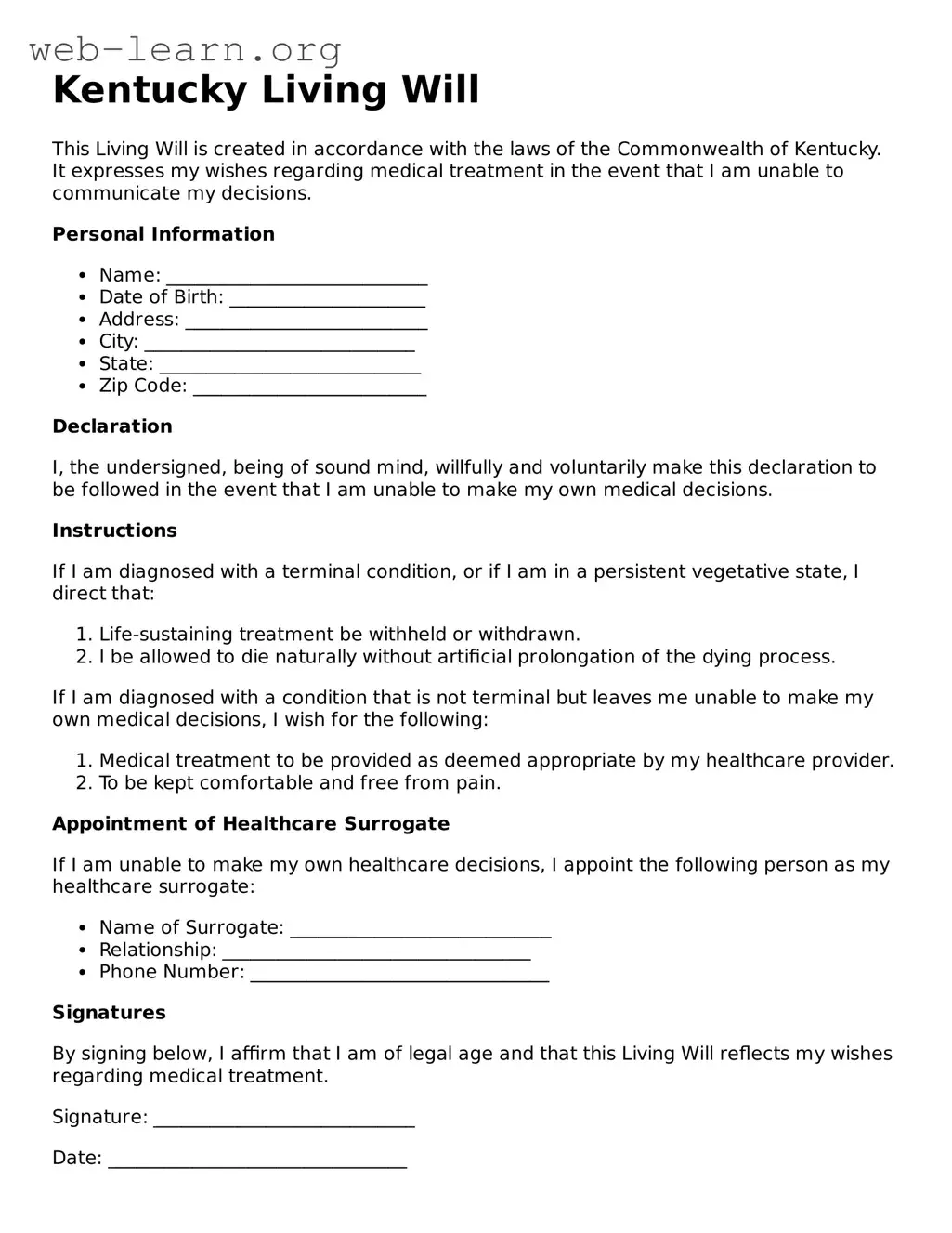
In Kentucky, the Living Will form serves as a crucial document for individuals who wish to outline their preferences regarding medical treatment in the event they become unable to communicate their wishes. This form allows a person to specify which life-sustaining treatments they want or do not want, particularly in situations where they are diagnosed with a terminal condition or are in a persistent vegetative state. By completing a Living Will, individuals can ensure that their healthcare providers and loved ones understand their desires, thereby reducing the burden of decision-making during emotionally challenging times. It is important to note that the Living Will must be signed in the presence of two witnesses or a notary public to be considered valid. Additionally, this document can be revoked or modified at any time, providing flexibility as personal circumstances or beliefs evolve. Understanding the Living Will form is essential for anyone who wants to maintain control over their medical care and ensure that their values are respected, even when they can no longer express them directly.
Kentucky Living Will
This Living Will is created in accordance with the laws of the Commonwealth of Kentucky. It expresses my wishes regarding medical treatment in the event that I am unable to communicate my decisions.
Personal Information
Declaration
I, the undersigned, being of sound mind, willfully and voluntarily make this declaration to be followed in the event that I am unable to make my own medical decisions.
Instructions
If I am diagnosed with a terminal condition, or if I am in a persistent vegetative state, I direct that:
If I am diagnosed with a condition that is not terminal but leaves me unable to make my own medical decisions, I wish for the following:
Appointment of Healthcare Surrogate
If I am unable to make my own healthcare decisions, I appoint the following person as my healthcare surrogate:
Signatures
By signing below, I affirm that I am of legal age and that this Living Will reflects my wishes regarding medical treatment.
Signature: ____________________________
Date: ________________________________
Witness 1: ____________________________
Date: ________________________________
Witness 2: ____________________________
Date: ________________________________
This document must be signed in the presence of two witnesses who are not related to you and who will not inherit from you.
| Fact Name | Description |
|---|---|
| Purpose | The Kentucky Living Will form allows individuals to express their wishes regarding medical treatment in the event they become unable to communicate those wishes themselves. |
| Governing Law | This form is governed by Kentucky Revised Statutes (KRS) § 311.623 through § 311.643. |
| Eligibility | Any adult who is 18 years or older can complete a Living Will in Kentucky. |
| Signature Requirements | The form must be signed by the individual and witnessed by two people or notarized to be legally valid. |
| Revocation | A Living Will can be revoked at any time by the individual, either verbally or in writing. |
| Healthcare Proxy | While a Living Will outlines treatment preferences, individuals can also designate a healthcare proxy to make decisions on their behalf. |
Filling out the Kentucky Living Will form is an important step in ensuring your healthcare wishes are known and respected. This process requires careful consideration and attention to detail. Once completed, the form will need to be signed and witnessed to be valid.
What is a Living Will in Kentucky?
A Living Will is a legal document that allows individuals to express their wishes regarding medical treatment in the event they become unable to communicate their preferences. This document specifically addresses end-of-life care and can guide healthcare providers and loved ones in making decisions that align with your values and desires.
Who can create a Living Will in Kentucky?
Any adult who is at least 18 years old and of sound mind can create a Living Will in Kentucky. This means you should be able to understand the nature and consequences of your decisions when drafting the document.
What should be included in a Living Will?
A Living Will typically includes:
It’s important to be clear and specific about your wishes to avoid confusion later on.
How do I create a Living Will in Kentucky?
To create a Living Will in Kentucky, you can use a standard form provided by the state or draft your own document. Ensure that it is signed by you and witnessed by two individuals who are not related to you or beneficiaries of your estate. Alternatively, you can have the document notarized.
Can I change or revoke my Living Will?
Yes, you have the right to change or revoke your Living Will at any time, as long as you are of sound mind. To revoke your Living Will, you can simply destroy the document or create a new one that explicitly states your updated wishes.
Is a Living Will the same as a Durable Power of Attorney for Health Care?
No, a Living Will and a Durable Power of Attorney for Health Care are different documents. A Living Will focuses on your specific medical treatment preferences, while a Durable Power of Attorney allows you to appoint someone to make healthcare decisions on your behalf if you are unable to do so. You may choose to have both documents to ensure comprehensive coverage of your healthcare wishes.
When does a Living Will take effect?
A Living Will takes effect when you are unable to communicate your wishes due to a medical condition, such as being in a coma or suffering from a terminal illness. Your healthcare providers will refer to your Living Will to guide their decisions regarding your care.
How do I ensure my Living Will is honored?
To ensure your Living Will is honored, share copies with your healthcare providers, family members, and anyone else involved in your care. Discuss your wishes with them openly. It can also be beneficial to keep a copy in your medical records.
Can I use a Living Will from another state in Kentucky?
While Kentucky generally recognizes Living Wills created in other states, it is advisable to use a Kentucky-specific form to ensure compliance with local laws. If you move to Kentucky from another state, consider reviewing your existing Living Will with a legal professional to ensure it meets Kentucky requirements.
When filling out the Kentucky Living Will form, individuals often encounter several common mistakes that can lead to confusion or unintended consequences. Understanding these pitfalls can help ensure that your wishes regarding medical treatment are clearly communicated and respected. Here are seven mistakes to avoid.
One frequent error is failing to be specific about medical treatments. Many people assume that general statements will suffice, but it’s crucial to outline your preferences clearly. For example, if you have strong feelings about life-sustaining treatments, specify which ones you want or do not want. This clarity helps healthcare providers make decisions that align with your values.
Another common mistake is neglecting to date the document. A Living Will without a date can create ambiguity regarding when your wishes were expressed. Always include the date you complete the form to ensure that it reflects your most current intentions.
Some individuals overlook the importance of having witnesses. In Kentucky, the law requires that the Living Will be signed in the presence of two witnesses. Failing to do this can render the document invalid. Make sure your witnesses are not related to you or your healthcare providers to avoid any conflicts of interest.
Additionally, people often forget to review and update their Living Will regularly. Life circumstances change, and so can your preferences regarding medical treatment. It’s wise to revisit your Living Will periodically, especially after significant life events such as marriage, divorce, or the diagnosis of a serious illness.
Another mistake is not discussing your wishes with family members or healthcare proxies. While the Living Will is a legal document, it’s also a communication tool. Engaging in open conversations with loved ones ensures they understand your preferences and can advocate for you if needed.
Some individuals may also assume that once the Living Will is signed, it cannot be changed. This is not true. You have the right to modify or revoke your Living Will at any time, as long as you are mentally competent. Make sure to follow the proper procedures for updating your document to avoid any confusion.
Finally, people sometimes forget to distribute copies of their Living Will. Simply completing the form is not enough. Share copies with your healthcare providers, family members, and anyone designated as your healthcare proxy. This ensures that your wishes are known and can be honored when the time comes.
When preparing for end-of-life decisions, the Kentucky Living Will form is an essential document. However, it is often beneficial to consider additional forms and documents that complement it. These documents can help ensure that your healthcare wishes are respected and that your loved ones are prepared to make decisions on your behalf when necessary.
Having these additional documents in place can provide peace of mind for you and your loved ones. They ensure that your healthcare preferences are clearly communicated and respected, allowing you to focus on what truly matters.
A Living Will is an important document that outlines your preferences for medical treatment in situations where you cannot communicate your wishes. There are several other documents that serve similar purposes, each addressing different aspects of healthcare decisions and personal preferences. Here’s a list of ten documents that are similar to a Living Will:
Understanding these documents can empower you to make informed decisions about your healthcare and ensure that your wishes are honored, even when you cannot communicate them directly. It’s crucial to consider your options and discuss them with loved ones and professionals to create a comprehensive plan that reflects your values and preferences.
When filling out the Kentucky Living Will form, it is important to follow certain guidelines to ensure that your wishes are clearly expressed and legally recognized. Here are four things you should and shouldn't do:
Many people have misunderstandings about the Kentucky Living Will form. These misconceptions can lead to confusion about end-of-life decisions. Here are eight common misconceptions, along with clarifications.
A Living Will specifically addresses medical treatment preferences in case an individual becomes unable to communicate. In contrast, a Last Will and Testament deals with the distribution of assets after death.
While legal advice can be helpful, it is not required to complete a Living Will. Many forms are available online, and individuals can fill them out independently.
This form can also guide decisions in situations where a person is in a persistent vegetative state or unable to communicate due to severe injury or illness.
Individuals can modify or revoke their Living Will at any time, as long as they are mentally competent to do so.
While most healthcare professionals respect Living Wills, it is essential to ensure that your medical team is aware of your wishes and has access to the document.
Anyone, regardless of age, can benefit from having a Living Will. Accidents or sudden health issues can happen to anyone.
In fact, having both can provide comprehensive coverage for medical decisions. A Power of Attorney can make decisions on your behalf if you are unable, while a Living Will outlines your specific wishes.
It is wise for everyone to have a Living Will, as it provides clarity and peace of mind regarding your wishes, regardless of current health status.
Understanding these misconceptions can empower individuals to make informed decisions about their healthcare preferences. A Living Will is an important document that can ensure your wishes are respected during critical moments.
Filling out and using the Kentucky Living Will form is an important step in making your healthcare preferences known. Here are some key takeaways to consider:
By understanding these key points, you can ensure that your healthcare preferences are clearly communicated and respected.
Medical Power of Attorney Form Idaho - Some states have specific requirements for a Living Will, so it’s important to understand your local laws.
Does an Advance Directive Need to Be Notarized - It is advisable to review your Living Will periodically to ensure it still reflects your current wishes.