Creating a Last Will and Testament is an essential step in ensuring that your wishes are honored after your passing. In Kentucky, this legal document serves as a guide for distributing your assets, appointing guardians for minor children, and designating an executor to manage your estate. The Kentucky Last Will and Testament form is straightforward, allowing individuals to outline their desires clearly. It typically includes sections for naming beneficiaries, specifying how property should be divided, and detailing any special instructions. Additionally, the form requires the signatures of witnesses to validate its authenticity, ensuring that your final wishes are respected. Understanding the key components of this form can empower you to make informed decisions about your estate planning, ultimately providing peace of mind for you and your loved ones.
Kentucky Last Will and Testament
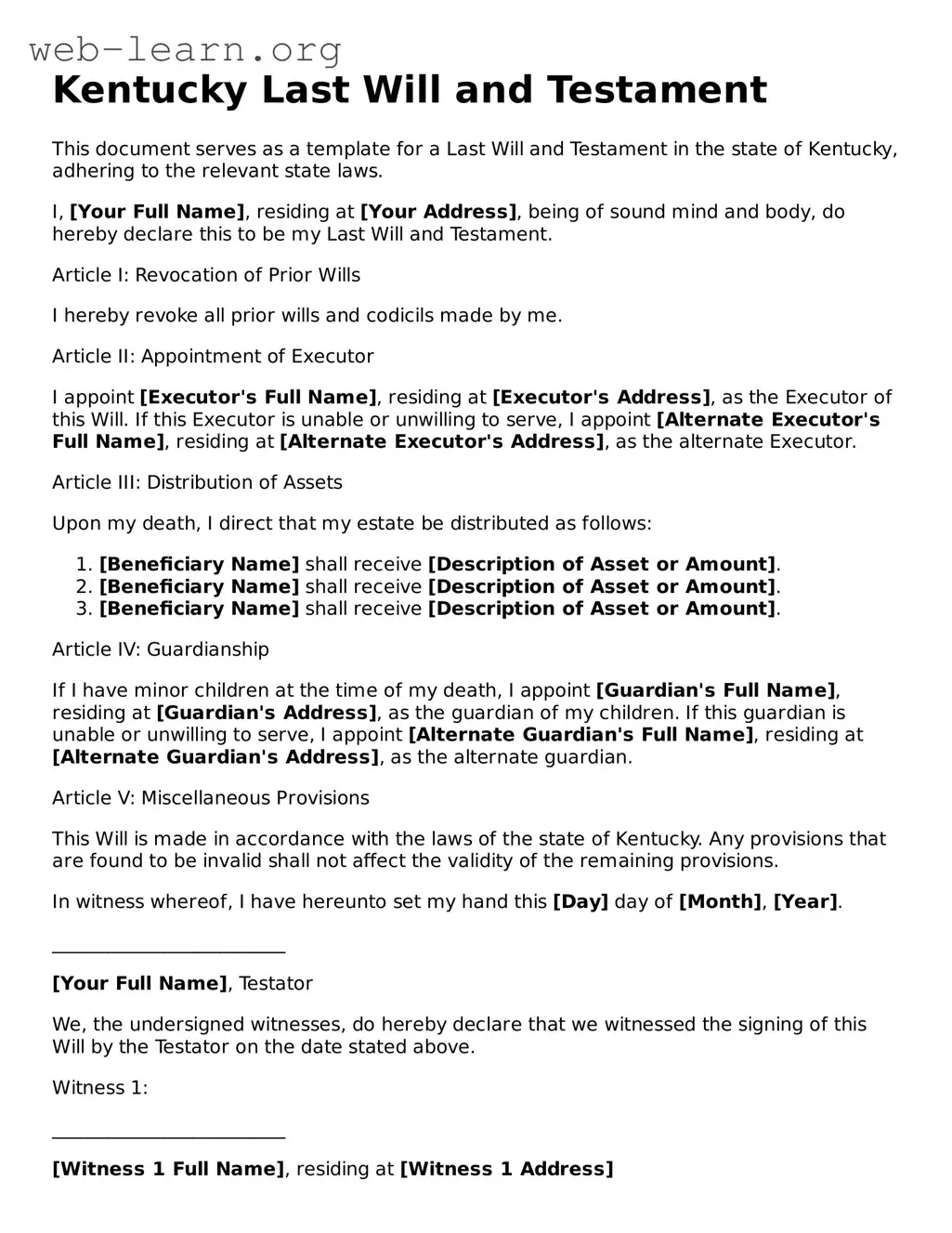
This document serves as a template for a Last Will and Testament in the state of Kentucky, adhering to the relevant state laws.
I, [Your Full Name], residing at [Your Address], being of sound mind and body, do hereby declare this to be my Last Will and Testament.
Article I: Revocation of Prior Wills
I hereby revoke all prior wills and codicils made by me.
Article II: Appointment of Executor
I appoint [Executor's Full Name], residing at [Executor's Address], as the Executor of this Will. If this Executor is unable or unwilling to serve, I appoint [Alternate Executor's Full Name], residing at [Alternate Executor's Address], as the alternate Executor.
Article III: Distribution of Assets
Upon my death, I direct that my estate be distributed as follows:
Article IV: Guardianship
If I have minor children at the time of my death, I appoint [Guardian's Full Name], residing at [Guardian's Address], as the guardian of my children. If this guardian is unable or unwilling to serve, I appoint [Alternate Guardian's Full Name], residing at [Alternate Guardian's Address], as the alternate guardian.
Article V: Miscellaneous Provisions
This Will is made in accordance with the laws of the state of Kentucky. Any provisions that are found to be invalid shall not affect the validity of the remaining provisions.
In witness whereof, I have hereunto set my hand this [Day] day of [Month], [Year].
_________________________
[Your Full Name], Testator
We, the undersigned witnesses, do hereby declare that we witnessed the signing of this Will by the Testator on the date stated above.
Witness 1:
_________________________
[Witness 1 Full Name], residing at [Witness 1 Address]
Witness 2:
_________________________
[Witness 2 Full Name], residing at [Witness 2 Address]
| Fact Name | Description |
|---|---|
| Governing Law | The Kentucky Last Will and Testament is governed by KRS Chapter 394. |
| Age Requirement | In Kentucky, the testator must be at least 18 years old to create a valid will. |
| Witness Requirement | Two witnesses must sign the will for it to be valid, confirming the testator's signature. |
| Holographic Wills | Kentucky recognizes holographic wills, which are handwritten and signed by the testator. |
| Revocation | A will can be revoked by creating a new will or by physically destroying the original document. |
| Probate Process | After the testator's death, the will must go through probate to ensure its validity and distribution of assets. |
After obtaining the Kentucky Last Will and Testament form, you will need to carefully fill it out to ensure that your wishes are clearly communicated. This is an important step in planning for the future, and accuracy is crucial. Follow the steps below to complete the form correctly.
What is a Last Will and Testament in Kentucky?
A Last Will and Testament is a legal document that outlines how an individual's assets and affairs will be handled after their death. In Kentucky, this document allows a person, known as the testator, to specify beneficiaries, appoint an executor, and make decisions regarding guardianship of minor children, among other matters.
Who can create a Last Will and Testament in Kentucky?
Any individual who is at least 18 years old and of sound mind can create a Last Will and Testament in Kentucky. This means that the person must understand the nature of the document and its implications. Additionally, the testator should not be under undue influence or duress when making the will.
What are the requirements for a valid will in Kentucky?
For a will to be considered valid in Kentucky, it must meet several criteria:
Can I change my will after it has been created?
Yes, a testator can change their will at any time before their death. This can be done by creating a new will or by drafting a codicil, which is an amendment to the existing will. It is important to ensure that any changes comply with Kentucky's legal requirements for wills.
What happens if I die without a will in Kentucky?
If an individual dies without a will, they are said to have died "intestate." In this case, Kentucky's intestacy laws will dictate how the deceased's assets are distributed. Typically, the estate will be divided among surviving relatives, which may include spouses, children, parents, and siblings, depending on the family structure.
Can I revoke my will in Kentucky?
A will can be revoked in Kentucky by creating a new will that explicitly states the previous will is revoked or by physically destroying the old will. It is crucial to follow proper procedures to ensure that the revocation is legally recognized.
What is the role of an executor in a will?
The executor is the person appointed in the will to manage the deceased's estate. Their responsibilities include gathering assets, paying debts and taxes, and distributing the remaining assets to the beneficiaries according to the terms of the will. The executor must act in the best interests of the estate and its beneficiaries.
Is it necessary to hire a lawyer to create a will in Kentucky?
While it is not legally required to hire a lawyer to create a will in Kentucky, it is highly advisable. A legal professional can help ensure that the will meets all legal requirements, reflects the testator's wishes accurately, and minimizes the risk of disputes among beneficiaries after the testator's death.
How can I ensure my will is properly executed?
To ensure that a will is properly executed, the testator should follow Kentucky's legal requirements closely. This includes having the will signed by the testator and witnessed appropriately. Additionally, keeping the will in a safe place and informing the executor and close family members of its location can help prevent issues after the testator's passing.
Filling out the Kentucky Last Will and Testament form can be a straightforward process, but there are common mistakes that individuals often make. One frequent error is failing to properly identify beneficiaries. It is essential to clearly state who will inherit the assets. Using vague terms, such as "my children," without specifying names can lead to confusion and potential disputes later on.
Another mistake is neglecting to sign the will in the presence of witnesses. Kentucky law requires that a will be signed by the testator and witnessed by at least two individuals who are not beneficiaries. If this step is overlooked, the will may not be considered valid, rendering the testator's wishes unenforceable.
Additionally, individuals sometimes forget to update their wills after major life events, such as marriage, divorce, or the birth of a child. An outdated will can lead to unintended consequences, including assets going to the wrong individuals. Regularly reviewing and updating the will ensures that it reflects the current wishes of the testator.
Finally, some people make the mistake of not keeping the will in a safe and accessible location. A will should be stored in a place where it can be easily found by the executor or family members after the testator's passing. If the will is lost or damaged, it may complicate the probate process and delay the distribution of assets.
When creating a Last Will and Testament in Kentucky, several other forms and documents can complement it, ensuring your wishes are clearly articulated and legally enforceable. Here are four essential documents often used alongside the Last Will and Testament.
Using these documents in conjunction with your Last Will and Testament can help ensure that your wishes are honored and that your loved ones are provided for. It's important to consider each document carefully to create a comprehensive estate plan that reflects your intentions.
When filling out the Kentucky Last Will and Testament form, it's important to approach the task with care. Here are some key dos and don'ts to keep in mind.
By following these guidelines, you can create a clear and effective Last Will and Testament that reflects your wishes.
When it comes to creating a Last Will and Testament in Kentucky, there are several misconceptions that can lead to confusion. Here are four common myths, along with explanations to clarify them:
This is not true. In Kentucky, a handwritten will, also known as a holographic will, can be valid as long as it is signed by the person making the will and the material provisions are in their handwriting.
While having a lawyer can help ensure that your will meets all legal requirements, it is not necessary. Individuals can create their own will as long as they follow Kentucky's laws regarding wills.
This misconception is misleading. In Kentucky, you can also make changes to your will by creating a codicil, which is a legal document that amends your original will without needing to start from scratch.
This is a common misunderstanding. Everyone can benefit from having a will, regardless of their financial situation. A will ensures that your wishes are honored and can simplify the process for your loved ones after your passing.
Filling out and using the Kentucky Last Will and Testament form requires careful attention to detail. Below are key takeaways to consider:
Colorado Diy Will - Enables individuals to leave behind a legacy that reflects their values.
Does an Attorney Have to Prepare a Will - May outline guardianship for minor children or dependents.
Free Ny Will Template - Can include a detailed list of specific bequests, such as jewelry or collectibles.
Will Template Indiana - Can include provisions for charitable donations or legacy gifts.