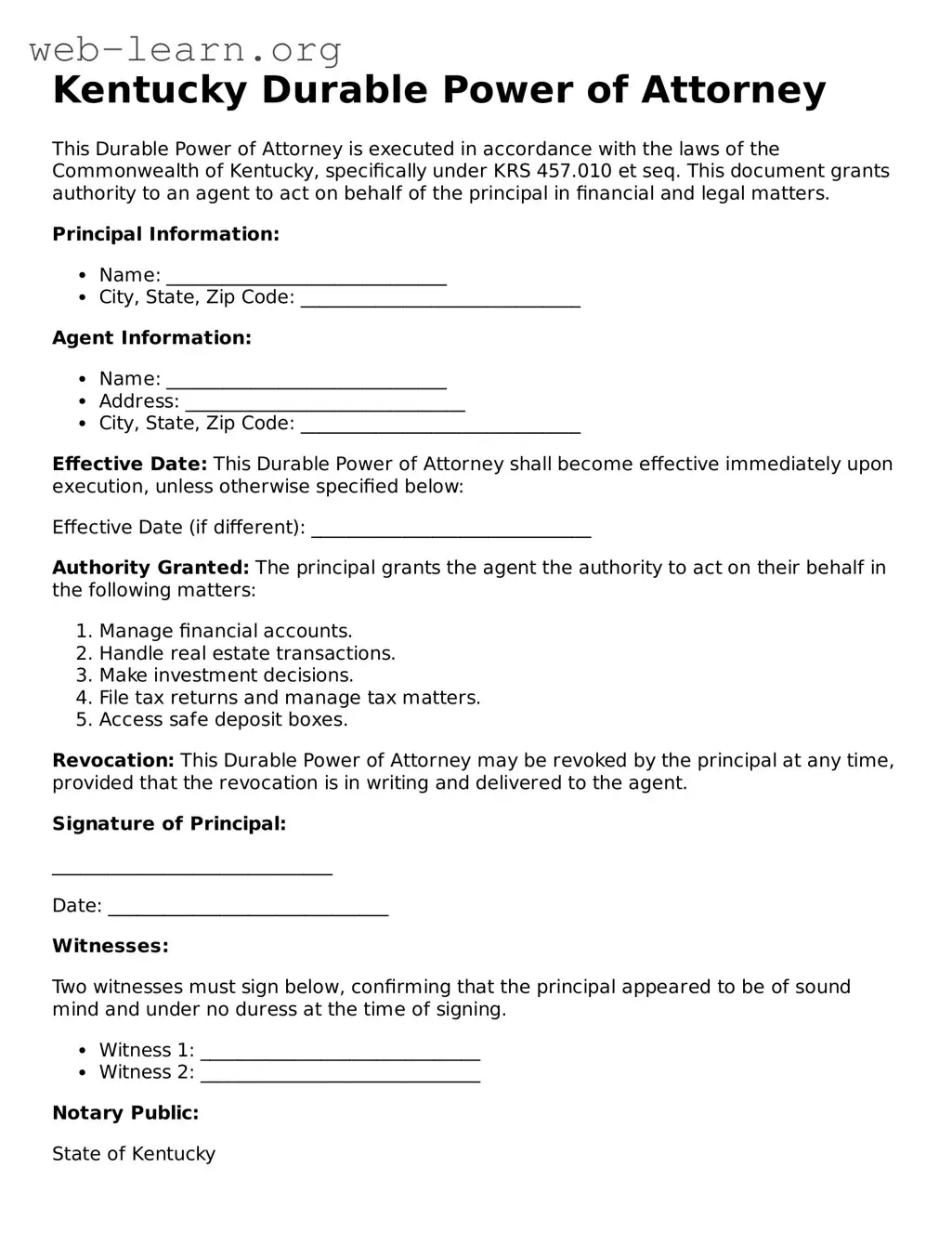
The Kentucky Durable Power of Attorney form is a vital legal document that empowers individuals to designate a trusted person to make decisions on their behalf, particularly in the event they become incapacitated. This form allows for a wide range of powers, from managing financial matters to making healthcare decisions, ensuring that the individual’s wishes are respected even when they cannot communicate them directly. It is important to note that this document remains effective even if the principal becomes unable to manage their affairs due to illness or disability, hence the term "durable." In Kentucky, the form must be signed by the principal and witnessed by two individuals or notarized to ensure its validity. Additionally, individuals can specify the scope of authority granted, allowing for tailored arrangements that reflect their unique needs and preferences. Understanding the intricacies of this form is essential for anyone looking to safeguard their interests and ensure that their chosen representative can act decisively in times of need.
Kentucky Durable Power of Attorney
This Durable Power of Attorney is executed in accordance with the laws of the Commonwealth of Kentucky, specifically under KRS 457.010 et seq. This document grants authority to an agent to act on behalf of the principal in financial and legal matters.
Principal Information:
Agent Information:
Effective Date: This Durable Power of Attorney shall become effective immediately upon execution, unless otherwise specified below:
Effective Date (if different): ______________________________
Authority Granted: The principal grants the agent the authority to act on their behalf in the following matters:
Revocation: This Durable Power of Attorney may be revoked by the principal at any time, provided that the revocation is in writing and delivered to the agent.
Signature of Principal:
______________________________
Date: ______________________________
Witnesses:
Two witnesses must sign below, confirming that the principal appeared to be of sound mind and under no duress at the time of signing.
Notary Public:
State of Kentucky
County of ______________________________
Subscribed, sworn to, and acknowledged before me by ______________________________ (Principal's Name) on this _____ day of ____________, 20__.
______________________________
Notary Public Signature
My Commission Expires: ______________________________
| Fact Name | Description |
|---|---|
| Definition | A Kentucky Durable Power of Attorney allows an individual to designate someone else to manage their financial and legal affairs if they become incapacitated. |
| Governing Law | The Kentucky Durable Power of Attorney is governed by KRS 457.010 to 457.100. |
| Durability | This type of power of attorney remains effective even if the principal becomes incapacitated, distinguishing it from a regular power of attorney. |
| Agent Authority | The agent appointed can perform a wide range of actions, including managing bank accounts, paying bills, and making investment decisions. |
| Revocation | The principal can revoke the durable power of attorney at any time, provided they are mentally competent to do so. |
| Execution Requirements | The form must be signed by the principal and witnessed by two individuals or notarized to be valid in Kentucky. |
To fill out the Kentucky Durable Power of Attorney form, you will need to gather some essential information and follow a series of straightforward steps. This process ensures that you accurately designate an agent to make decisions on your behalf when you are unable to do so.
A Durable Power of Attorney (DPOA) is a legal document that allows an individual, known as the principal, to appoint another person, called the agent or attorney-in-fact, to manage their financial and legal affairs. The term "durable" means that the authority granted to the agent remains effective even if the principal becomes incapacitated.
The form typically includes:
In Kentucky, any competent adult can be appointed as an agent. This can include family members, friends, or professionals such as attorneys or financial advisors. It is essential to choose someone trustworthy, as they will have significant control over the principal's affairs.
Yes, the principal can customize the Durable Power of Attorney by specifying which powers are granted to the agent. This can range from managing bank accounts to making healthcare decisions. It’s advisable to clearly outline these powers to avoid any confusion in the future.
A Durable Power of Attorney can become effective immediately upon signing or can be set to activate only upon the principal's incapacitation. The principal should clearly state their intentions in the document to ensure the agent knows when to act.
The principal can revoke a Durable Power of Attorney at any time, as long as they are competent. This is typically done by creating a written revocation document and notifying the agent and any institutions that have a copy of the original DPOA.
If a principal becomes incapacitated without a Durable Power of Attorney, family members may need to go through a court process to obtain guardianship or conservatorship. This can be time-consuming and may not align with the principal's wishes, making it essential to have a DPOA in place.
While it is not legally required to have a lawyer to create a Durable Power of Attorney, consulting with one is highly recommended. A lawyer can help ensure that the document is properly drafted, complies with state laws, and reflects the principal’s wishes accurately.
Filling out the Kentucky Durable Power of Attorney form can be a straightforward process, but mistakes can lead to complications. One common error is failing to specify the powers granted to the agent. It is essential to clearly outline what the agent can and cannot do on behalf of the principal. Without this clarity, the agent may not have the authority to make important decisions.
Another mistake is neglecting to sign the document in the presence of a notary. The Kentucky Durable Power of Attorney must be notarized to be legally valid. Without a notary’s signature, the document may not be recognized by financial institutions or healthcare providers.
People often overlook the importance of choosing the right agent. Selecting someone who is not trustworthy or lacks the ability to handle financial matters can lead to poor decision-making. It is crucial to choose an individual who is reliable and understands the responsibilities involved.
Additionally, individuals sometimes forget to update the document after significant life changes, such as marriage, divorce, or the death of a previous agent. It is important to review and revise the Durable Power of Attorney regularly to ensure it reflects current wishes and circumstances.
Another frequent error is not providing alternate agents. In the event that the primary agent is unable or unwilling to act, having a backup agent is essential. This ensures that there is always someone available to make decisions when needed.
Some individuals fail to discuss their intentions with the chosen agent before completing the form. Open communication about the principal's wishes and expectations can prevent misunderstandings later. It is advisable to have a candid conversation about the responsibilities involved.
People also sometimes forget to include specific instructions regarding health care decisions. The Durable Power of Attorney can cover both financial and medical decisions, but failing to specify health care preferences may lead to confusion during critical times.
Finally, not keeping copies of the completed form can pose a problem. Once the Durable Power of Attorney is executed, it is vital to distribute copies to the agent, healthcare providers, and any relevant institutions. This ensures that the document can be easily accessed when needed.
When considering the Kentucky Durable Power of Attorney form, it's important to understand that it often works in conjunction with several other documents. Each of these forms serves a unique purpose and can provide additional clarity and support in managing one’s affairs. Below is a list of commonly used forms that complement the Durable Power of Attorney.
Each of these documents plays a vital role in ensuring that your wishes are respected and that your affairs are managed according to your preferences. By understanding these forms, individuals can better prepare for the future and safeguard their interests.
When filling out the Kentucky Durable Power of Attorney form, it’s important to approach the task with care. Here are some things you should and shouldn't do:
Understanding the Kentucky Durable Power of Attorney (DPOA) form is essential for anyone considering its use. However, several misconceptions can lead to confusion. Here are five common misunderstandings:
Many people believe that a DPOA only covers financial decisions. In reality, it can also grant authority for medical decisions, depending on how the document is drafted. Individuals can specify the powers they wish to grant.
Some think that a DPOA is only activated when the principal is unable to make decisions. However, a DPOA can be effective immediately upon signing, unless the document states otherwise. This allows the agent to act on behalf of the principal right away.
This is incorrect. A principal can revoke a DPOA at any time, as long as they are competent. This flexibility ensures that individuals have control over their legal decisions.
While it is true that the principal can choose their agent, there are certain limitations. For instance, some individuals may not be suitable due to conflicts of interest or legal restrictions. It's important to select someone trustworthy and capable.
Although both documents deal with decision-making, they serve different purposes. A DPOA appoints someone to make decisions on behalf of the principal, while a living will outlines the principal's wishes regarding medical treatment in end-of-life situations.
By clearing up these misconceptions, individuals can make more informed decisions regarding their legal planning in Kentucky.
Filling out a Durable Power of Attorney (DPOA) form in Kentucky is an important step in planning for your future. Here are some key takeaways to keep in mind:
Taking the time to understand and properly fill out your Durable Power of Attorney form can provide peace of mind for you and your loved ones. Make informed choices that align with your wishes and needs.
Living Will Kansas - With a Durable Power of Attorney, you maintain control over your choices, even when you cannot express them.
Power of Attorney Arizona - This document allows you to specify when the authority becomes effective, whether immediately or upon incapacity.
Louisiana Durable Power of Attorney Pdf - This form can be useful for individuals with chronic health issues.