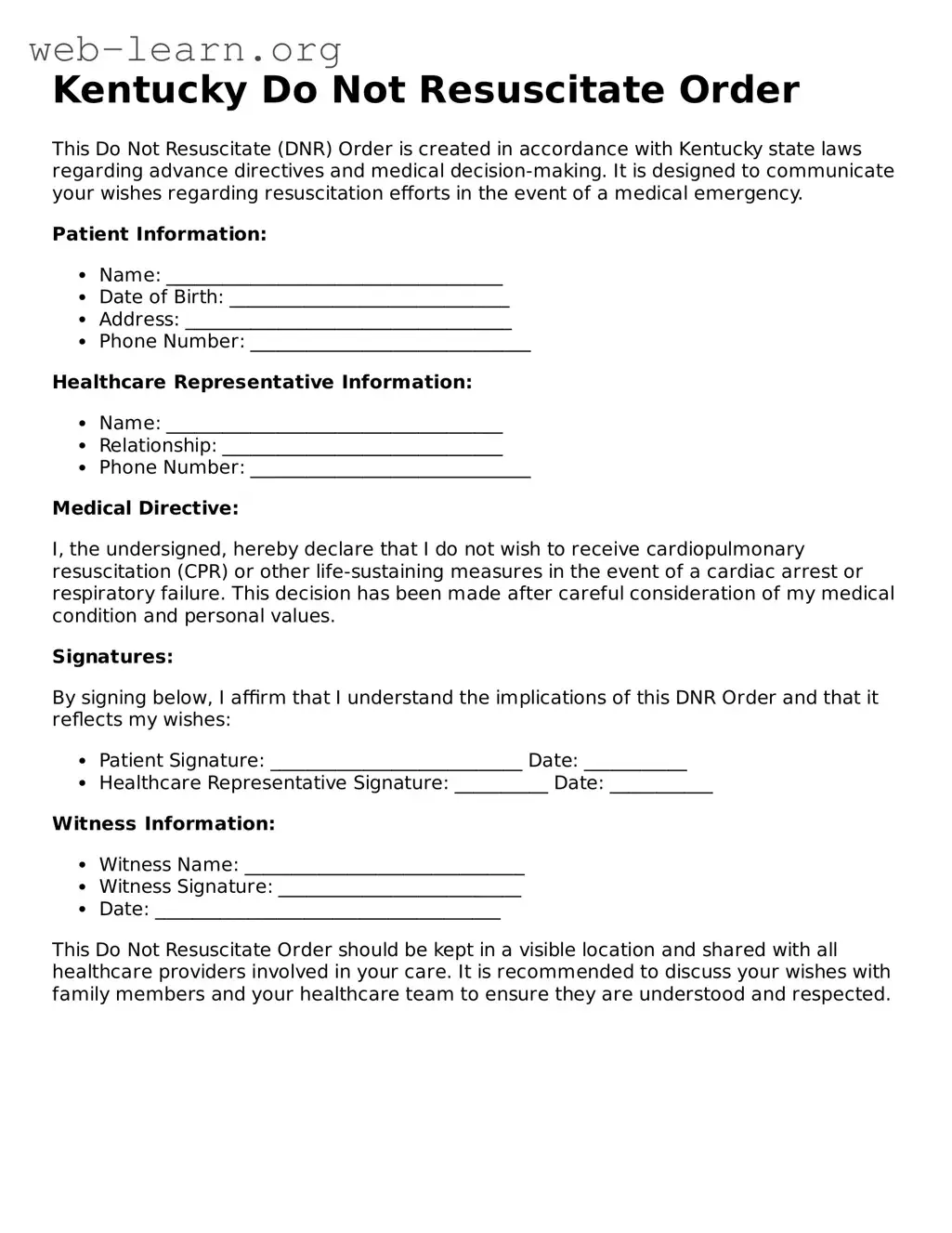
The Kentucky Do Not Resuscitate Order (DNR) form is an important legal document that allows individuals to express their wishes regarding medical treatment in emergency situations. This form is specifically designed for those who do not wish to receive cardiopulmonary resuscitation (CPR) or other life-saving measures if their heart stops beating or they stop breathing. It is crucial for patients to understand that a DNR order must be completed and signed by a licensed physician, ensuring that the decision is medically informed. The form also requires the signature of the patient or their legal representative, which emphasizes the importance of personal choice in medical care. Additionally, the DNR order should be easily accessible to medical personnel, often kept in a visible location, such as on the refrigerator or in a medical file. Understanding the implications of this form can help individuals make informed decisions about their end-of-life care, ensuring that their preferences are respected during critical moments.
Kentucky Do Not Resuscitate Order
This Do Not Resuscitate (DNR) Order is created in accordance with Kentucky state laws regarding advance directives and medical decision-making. It is designed to communicate your wishes regarding resuscitation efforts in the event of a medical emergency.
Patient Information:
Healthcare Representative Information:
Medical Directive:
I, the undersigned, hereby declare that I do not wish to receive cardiopulmonary resuscitation (CPR) or other life-sustaining measures in the event of a cardiac arrest or respiratory failure. This decision has been made after careful consideration of my medical condition and personal values.
Signatures:
By signing below, I affirm that I understand the implications of this DNR Order and that it reflects my wishes:
Witness Information:
This Do Not Resuscitate Order should be kept in a visible location and shared with all healthcare providers involved in your care. It is recommended to discuss your wishes with family members and your healthcare team to ensure they are understood and respected.
| Fact Name | Description |
|---|---|
| Definition | A Do Not Resuscitate (DNR) Order is a legal document that instructs medical personnel not to perform cardiopulmonary resuscitation (CPR) in the event of cardiac or respiratory arrest. |
| Governing Law | The Kentucky Do Not Resuscitate Order is governed by KRS 311.623 and KRS 311.624. |
| Eligibility | Any adult who is capable of making their own medical decisions can complete a DNR Order. |
| Signature Requirement | The DNR Order must be signed by a physician and the patient or their legal representative. |
| Form Availability | The Kentucky DNR Order form is available through healthcare providers and can also be downloaded from official state health department websites. |
| Revocation | A DNR Order can be revoked at any time by the patient or their legal representative, verbally or in writing. |
Filling out the Kentucky Do Not Resuscitate Order form requires careful attention to detail and clear communication of your wishes. Once the form is completed, it should be signed and dated to ensure its validity. It is important to keep copies of the signed document in accessible locations, such as with your healthcare provider or family members.
What is a Do Not Resuscitate (DNR) Order in Kentucky?
A Do Not Resuscitate Order is a medical order that instructs healthcare providers not to perform cardiopulmonary resuscitation (CPR) in the event that a patient’s heart stops beating or they stop breathing. In Kentucky, this order is typically used by individuals who have a serious illness or are at the end of life and wish to avoid aggressive resuscitation measures.
Who can initiate a DNR Order in Kentucky?
In Kentucky, a DNR Order can be initiated by a patient who is at least 18 years old and is capable of making informed medical decisions. Additionally, a legally authorized representative, such as a healthcare surrogate or a power of attorney, may also initiate a DNR Order on behalf of an incapacitated individual.
How is a DNR Order documented in Kentucky?
The DNR Order must be documented on a specific form provided by the state. This form must be signed by the patient or their authorized representative and a physician. It is crucial that the completed form is kept in a location where it can be easily accessed by emergency medical personnel and healthcare providers.
Can a DNR Order be revoked?
Yes, a DNR Order can be revoked at any time by the patient or their authorized representative. To revoke the order, the individual should inform their healthcare provider and may need to complete a revocation form. It is important to ensure that all relevant parties, including family members and healthcare providers, are aware of the revocation.
What should individuals consider before completing a DNR Order?
Individuals should carefully consider their personal values, beliefs, and medical circumstances before completing a DNR Order. Discussions with family members, healthcare providers, and legal advisors can provide clarity and ensure that the decision aligns with the individual’s wishes. It is also important to understand the implications of the order and how it may affect end-of-life care.
Where can I obtain a DNR Order form in Kentucky?
The DNR Order form can be obtained from various sources, including healthcare facilities, hospitals, and online from the Kentucky Department for Public Health’s website. It is advisable to use the official form to ensure compliance with state regulations.
Filling out a Do Not Resuscitate (DNR) Order form in Kentucky can be a straightforward process, but mistakes can lead to confusion and unwanted outcomes. One common error is not having the form signed by a qualified physician. In Kentucky, a DNR must be signed by a licensed physician to be valid. Without this signature, the document may not be recognized by medical personnel, which can defeat its purpose.
Another frequent mistake involves failing to ensure that the form is completed in its entirety. People often overlook sections that require specific information, such as the patient's name, date of birth, and the date the form is completed. Incomplete forms can create uncertainty in emergency situations, leaving healthcare providers unsure about the patient's wishes.
Additionally, individuals sometimes forget to communicate their DNR status to family members and caregivers. A DNR order is only effective if those involved in the patient’s care are aware of it. Without proper communication, loved ones may not understand the patient's wishes during a medical emergency, leading to stress and potential conflict.
Finally, some people neglect to review and update their DNR orders as circumstances change. Life events, such as a change in health status or a move to a different facility, may necessitate a revision of the DNR form. Keeping the document current ensures that it accurately reflects the patient’s wishes and that healthcare providers have the most up-to-date information at hand.
When considering end-of-life care options, it's important to have a comprehensive understanding of various documents that work alongside the Kentucky Do Not Resuscitate Order (DNR) form. Each of these documents serves a specific purpose in ensuring that your healthcare wishes are respected and communicated effectively. Below is a list of forms and documents that are commonly used in conjunction with a DNR order.
Understanding these documents can empower you to make informed decisions about your healthcare. By having a complete set of forms, you can ensure that your wishes are clearly communicated and respected by medical professionals and loved ones alike. Taking the time to prepare these documents can bring peace of mind, knowing that your preferences are documented and will be followed in critical situations.
When filling out the Kentucky Do Not Resuscitate (DNR) Order form, it is essential to approach the process with care and consideration. This document is significant, as it expresses a person's wishes regarding medical treatment in emergency situations. Here are some important dos and don'ts to keep in mind:
By following these guidelines, individuals can ensure that their DNR order accurately reflects their wishes and is respected in medical situations.
The Kentucky Do Not Resuscitate (DNR) Order form is a critical document for individuals who wish to make their healthcare preferences known. However, several misconceptions surround this form. Understanding these misconceptions can help ensure that individuals make informed decisions regarding their medical care. Here are nine common misconceptions:
Clarifying these misconceptions can empower individuals to make informed decisions about their healthcare preferences and ensure that their wishes are respected in critical situations.
Filling out and using the Kentucky Do Not Resuscitate (DNR) Order form is an important step for individuals who wish to express their preferences regarding medical treatment in emergency situations. Here are some key takeaways to consider:
Understanding these key points can help individuals make informed decisions about their healthcare preferences and ensure their wishes are respected in critical situations.
How Old Do You Have to Be to Sign a Dnr - Some individuals may choose a DNR to avoid the physical and emotional toll of resuscitation attempts.
Is a Dnr an Advance Directive - A DNR order is a proactive step towards making informed decisions about end-of-life care.