When it comes to transferring property ownership in Kentucky, understanding the Kentucky Deed form is essential. This legal document serves as the official record of the transfer, ensuring that all parties involved are clear about their rights and responsibilities. The form typically includes critical details such as the names of the grantor and grantee, a description of the property being transferred, and the consideration or payment involved in the transaction. Additionally, the Kentucky Deed form may specify any conditions or restrictions related to the property, helping to prevent future disputes. It's important to note that the document must be signed and notarized to be valid, and it should be filed with the appropriate county clerk's office to complete the transfer process. By understanding the components and requirements of this form, individuals can navigate property transactions with confidence, ensuring a smooth and legally sound transfer of ownership.
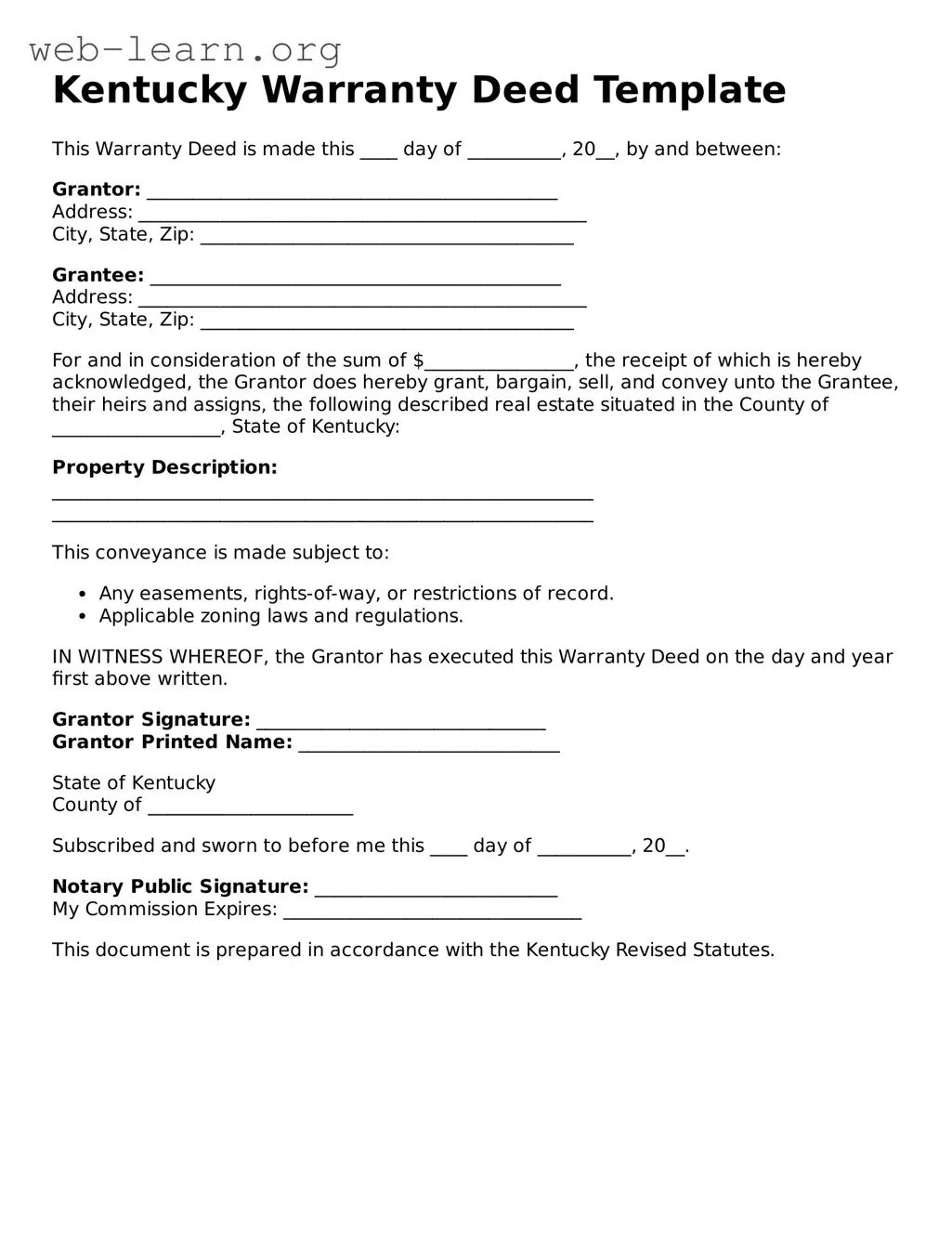
Kentucky Warranty Deed Template
This Warranty Deed is made this ____ day of __________, 20__, by and between:
Grantor: ____________________________________________
Address: ________________________________________________
City, State, Zip: ________________________________________
Grantee: ____________________________________________
Address: ________________________________________________
City, State, Zip: ________________________________________
For and in consideration of the sum of $________________, the receipt of which is hereby acknowledged, the Grantor does hereby grant, bargain, sell, and convey unto the Grantee, their heirs and assigns, the following described real estate situated in the County of __________________, State of Kentucky:
Property Description:
__________________________________________________________
__________________________________________________________
This conveyance is made subject to:
IN WITNESS WHEREOF, the Grantor has executed this Warranty Deed on the day and year first above written.
Grantor Signature: _______________________________
Grantor Printed Name: ____________________________
State of Kentucky
County of ______________________
Subscribed and sworn to before me this ____ day of __________, 20__.
Notary Public Signature: __________________________
My Commission Expires: ________________________________
This document is prepared in accordance with the Kentucky Revised Statutes.
| Fact Name | Details |
|---|---|
| Governing Law | The Kentucky Deed form is governed by Kentucky Revised Statutes (KRS) Chapter 381. |
| Types of Deeds | Common types include warranty deeds, quitclaim deeds, and special warranty deeds. |
| Parties Involved | The form includes a grantor (seller) and a grantee (buyer). |
| Property Description | A legal description of the property must be included in the deed. |
| Consideration | The deed should state the consideration or payment made for the property. |
| Execution Requirements | The deed must be signed by the grantor and may require notarization. |
| Recording | To protect the interests of the grantee, the deed should be recorded with the county clerk. |
| Transfer of Title | Upon execution and delivery, the title to the property transfers to the grantee. |
| Additional Provisions | Additional clauses may be included, such as covenants or restrictions on the property. |
Filling out the Kentucky Deed form is an important step in transferring property ownership. Once you have completed the form, you will need to file it with the appropriate county clerk's office to ensure the transfer is legally recognized.
A Kentucky Deed form is a legal document used to transfer ownership of real property from one party to another in the state of Kentucky. This form outlines the details of the transaction, including the names of the parties involved, a description of the property, and any conditions or terms related to the transfer.
In Kentucky, there are several types of deeds, including:
To complete a Kentucky Deed form, follow these steps:
Yes, notarization is required for a Kentucky Deed. The signatures of both the grantor and grantee must be notarized to ensure the document is legally binding and enforceable.
The completed Kentucky Deed form should be filed with the county clerk's office in the county where the property is located. Filing the deed ensures that the transfer of ownership is recorded and publicly accessible.
Yes, there are typically fees associated with filing a Kentucky Deed. These fees vary by county and may include recording fees and, in some cases, transfer taxes. It is advisable to check with the local county clerk’s office for specific amounts.
A Kentucky Deed form can be used for most types of real property, including residential, commercial, and agricultural properties. However, certain properties, such as those held in trust or subject to specific regulations, may require additional documentation.
If a Kentucky Deed form is not properly executed, it may lead to disputes regarding ownership and could render the deed invalid. It is crucial to ensure that all required signatures are obtained, notarization is completed, and the document is filed correctly to avoid potential legal complications.
Filling out a Kentucky Deed form can seem straightforward, but many people make common mistakes that can lead to delays or complications in the property transfer process. One frequent error is not providing the correct legal description of the property. This description should be precise and should match what is recorded in public records. Omitting details or using vague language can cause confusion and potential legal issues.
Another mistake often made is failing to include all necessary parties. Both the grantor (the person transferring the property) and the grantee (the person receiving the property) must be clearly identified. If a co-owner is not listed, it may result in disputes later on. Always double-check that all names are spelled correctly and that titles, such as "Mr." or "Mrs.," are included where appropriate.
Many people also overlook the importance of signatures. The deed must be signed by the grantor. If the grantor is married, the spouse may also need to sign, depending on how the property is held. Not obtaining the required signatures can render the deed invalid. Additionally, the signature should be notarized to ensure authenticity.
Another common error is neglecting to include the date of the transfer. This date is crucial for establishing the timeline of ownership. Without it, there could be confusion about when the property officially changes hands. It is essential to fill this out accurately to avoid potential disputes in the future.
Some individuals mistakenly assume that a simple form will suffice for all types of property transfers. However, different situations may require specific types of deeds, such as a warranty deed or a quitclaim deed. Using the wrong type can lead to unintended consequences regarding the rights and responsibilities of the parties involved.
Additionally, people often forget to check local requirements. Each county in Kentucky may have its own regulations regarding the recording of deeds. Failing to adhere to these local rules can delay the recording process and may even lead to rejection of the deed.
Finally, many individuals do not keep copies of the completed deed. It is important to retain a copy for personal records. This can be helpful for future reference, especially if questions arise about the transaction. Keeping organized records can simplify any future dealings with the property.
The Kentucky Deed form is a crucial document for transferring property ownership. In addition to the Deed itself, several other forms and documents are commonly used in real estate transactions in Kentucky. Each of these documents serves a specific purpose and helps ensure that the transfer of property is legally sound and properly documented.
Understanding these additional documents can facilitate a smoother real estate transaction in Kentucky. Each plays a vital role in ensuring that property transfers are handled correctly and in accordance with the law.
When filling out the Kentucky Deed form, it is important to follow specific guidelines to ensure accuracy and compliance. Below is a list of things you should and shouldn't do.
When it comes to the Kentucky Deed form, there are several misconceptions that can lead to confusion. Understanding these common misunderstandings can help ensure a smoother property transfer process.
Many people believe that a deed is only required when selling property. In reality, deeds are also needed for transfers between family members, gifts, or even when placing property into a trust.
Not all deeds serve the same purpose. In Kentucky, there are different types of deeds, such as warranty deeds and quitclaim deeds, each with its own implications regarding ownership rights and guarantees.
While notarization is important for many legal documents, in Kentucky, a deed is valid as long as it is signed by the grantor. However, having it notarized can help avoid disputes in the future.
Using the correct type of deed is crucial. For instance, a quitclaim deed may not provide the same protections as a warranty deed, which could leave you vulnerable if issues arise after the transfer.
While it is true that changing a deed can be complicated, it is not impossible. If a mistake is made or circumstances change, you can often file a corrective deed to amend the original.
Being informed about these misconceptions can help you navigate the process of property transfer in Kentucky with confidence.
When filling out and using the Kentucky Deed form, it is essential to follow specific guidelines to ensure the document is legally valid and effective. Here are key takeaways to consider:
By following these key takeaways, individuals can navigate the Kentucky Deed form process more effectively, ensuring a smooth property transfer.
Quick Claim Deeds Kansas - Different types of Deed forms serve various legal purposes.
Alabama Deed Transfer Form - A warranty deed guarantees that the seller has clear title to the property.