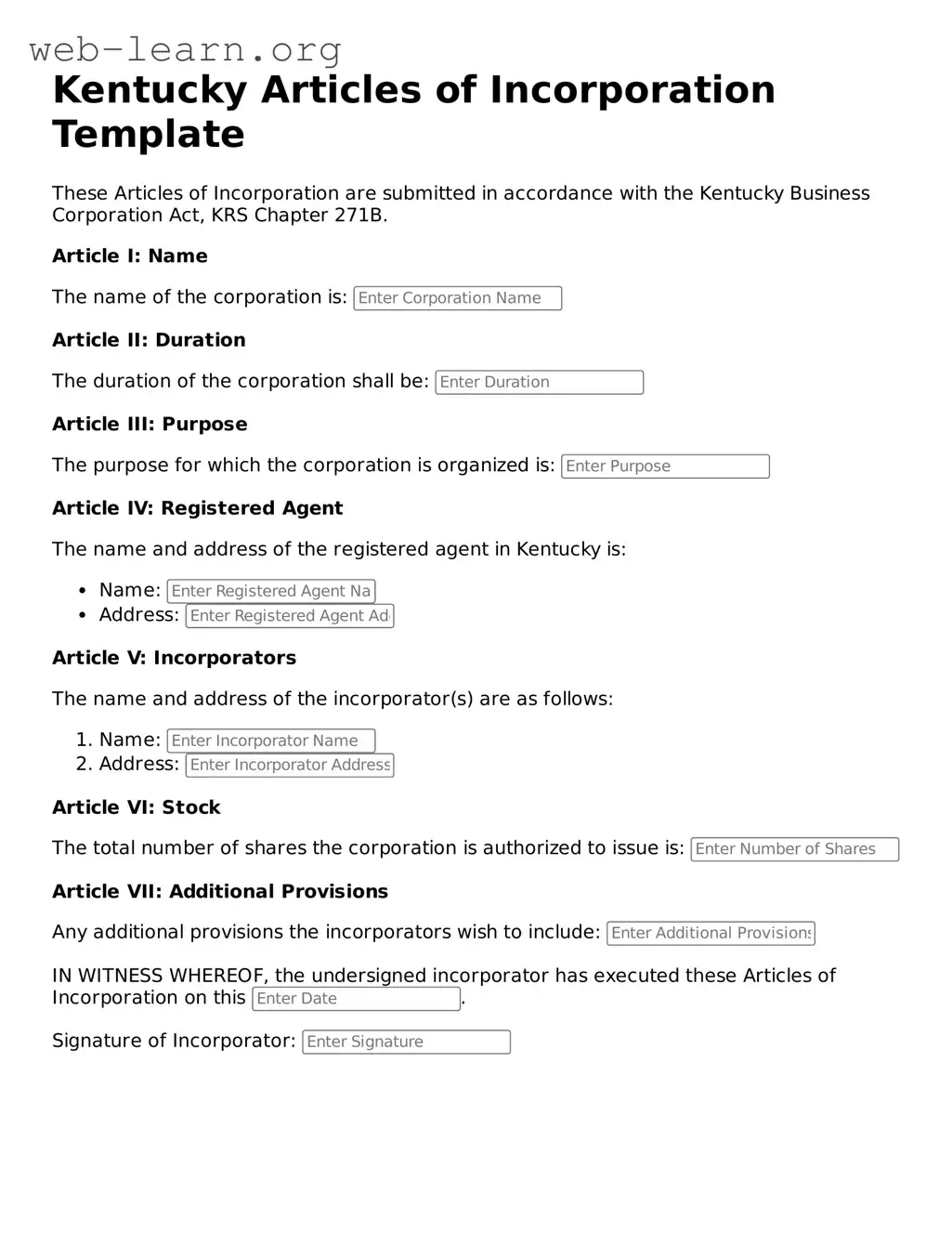
When starting a business in Kentucky, one of the first steps is to file the Articles of Incorporation. This essential document lays the groundwork for your corporation and provides vital information to the state. It includes details such as the corporation's name, which must be unique and comply with state naming rules. Additionally, the form requires the purpose of the corporation, which outlines the business activities you plan to engage in. Another key aspect is the registered agent, a person or business designated to receive legal documents on behalf of the corporation. Furthermore, the Articles of Incorporation must include the address of the corporation's principal office and the number of shares the corporation is authorized to issue. By completing this form accurately, you not only comply with state regulations but also establish a legal identity for your business, paving the way for future growth and success.
Kentucky Articles of Incorporation Template
These Articles of Incorporation are submitted in accordance with the Kentucky Business Corporation Act, KRS Chapter 271B.
Article I: Name
The name of the corporation is:
Article II: Duration
The duration of the corporation shall be:
Article III: Purpose
The purpose for which the corporation is organized is:
Article IV: Registered Agent
The name and address of the registered agent in Kentucky is:
Article V: Incorporators
The name and address of the incorporator(s) are as follows:
Article VI: Stock
The total number of shares the corporation is authorized to issue is:
Article VII: Additional Provisions
Any additional provisions the incorporators wish to include:
IN WITNESS WHEREOF, the undersigned incorporator has executed these Articles of Incorporation on this .
Signature of Incorporator:
| Fact Name | Description |
|---|---|
| Purpose | The Kentucky Articles of Incorporation form is used to legally establish a corporation in the state of Kentucky. |
| Governing Law | This form is governed by the Kentucky Business Corporation Act, specifically KRS Chapter 271B. |
| Filing Requirement | To create a corporation, the form must be filed with the Kentucky Secretary of State. |
| Information Required | The form requires details such as the corporation's name, purpose, registered agent, and the number of shares authorized. |
| Filing Fee | A filing fee is required when submitting the Articles of Incorporation, which varies based on the type of corporation. |
| Effective Date | The corporation can specify an effective date for the Articles, which can be the filing date or a future date. |
After completing the Kentucky Articles of Incorporation form, you will be ready to submit it to the Secretary of State. This is a crucial step in officially establishing your corporation in Kentucky. Make sure to double-check your information for accuracy before sending it off.
What are Articles of Incorporation?
Articles of Incorporation are legal documents that establish a corporation in Kentucky. They outline essential details about the business, such as its name, purpose, and structure. Filing these documents is the first step in forming a corporation and allows the entity to operate legally within the state.
Who needs to file Articles of Incorporation?
Any individual or group looking to create a corporation in Kentucky must file Articles of Incorporation. This includes businesses of all sizes, from small startups to large enterprises. If you plan to operate as a corporation, completing this form is essential.
What information is required on the form?
The Articles of Incorporation form requires several key pieces of information, including:
Providing accurate information is crucial, as it will be part of the public record.
How do I file the Articles of Incorporation?
To file the Articles of Incorporation in Kentucky, you can submit the form online or by mail. If filing online, visit the Kentucky Secretary of State's website. For mail submissions, download the form, fill it out, and send it along with the required filing fee to the appropriate office.
What is the filing fee for the Articles of Incorporation?
The filing fee for the Articles of Incorporation in Kentucky varies depending on the type of corporation you are forming. Generally, the fee ranges from $50 to $100. Check the Kentucky Secretary of State's website for the most current fee schedule.
How long does it take for the Articles of Incorporation to be processed?
Processing times can vary. Typically, if filed online, you can expect a quicker turnaround, often within a few business days. If submitted by mail, it may take longer, sometimes up to two weeks. Be sure to plan accordingly.
Do I need an attorney to file the Articles of Incorporation?
While it's not legally required to hire an attorney to file the Articles of Incorporation, it can be beneficial. An attorney can help ensure that the form is completed correctly and that your corporation complies with all state laws. If you feel confident in your understanding of the process, you can file without legal assistance.
What happens after I file the Articles of Incorporation?
Once your Articles of Incorporation are approved, your corporation is officially formed. You will receive a certificate of incorporation from the state. After that, you can proceed with other important steps, such as obtaining an Employer Identification Number (EIN) and setting up your business structure.
Filing the Kentucky Articles of Incorporation is a critical step in establishing a business. However, many individuals make common mistakes that can delay the process or lead to complications down the line. One frequent error is failing to choose a unique name for the corporation. The name must not be the same as or too similar to existing businesses registered in Kentucky. Conducting a thorough name search beforehand can prevent this issue.
Another mistake involves not including the required information about the registered agent. The registered agent serves as the official point of contact for legal documents. Omitting this information can result in the rejection of the application. Ensure that the registered agent’s name and address are accurate and complete.
Many people overlook the importance of specifying the purpose of the corporation. The Articles of Incorporation should clearly outline the business's intended activities. A vague or overly broad description can lead to confusion or legal challenges later. Clarity is key.
Some filers neglect to indicate the number of shares the corporation is authorized to issue. This detail is crucial for establishing ownership and investment opportunities. If this information is missing or incorrect, it could lead to complications in future fundraising efforts.
Additionally, failing to sign the form correctly is a common pitfall. The Articles of Incorporation must be signed by the incorporator(s). If the signature is missing or not properly executed, the application will not be processed. Double-checking the signature can save time and effort.
Another frequent error is not providing the correct filing fee. Each submission requires a specific payment, and submitting the wrong amount can delay the incorporation process. Always verify the current fee schedule before filing.
Some individuals mistakenly believe that they can submit the Articles of Incorporation without a physical address for the corporation. A valid business address is necessary for official correspondence. Ensure that this information is included to avoid potential issues.
People often forget to review the document for accuracy before submission. Typos and incorrect information can lead to rejections or delays. Taking the time to proofread can help ensure that the application is complete and correct.
Another common mistake is failing to understand the implications of choosing a corporation structure. Each structure has different tax and liability consequences. It’s essential to consider these factors before finalizing the incorporation process.
Lastly, many applicants do not keep a copy of the submitted Articles of Incorporation. Retaining a copy is important for future reference and can assist in maintaining compliance with state regulations. Always make sure to keep a record of all documents submitted.
When forming a corporation in Kentucky, the Articles of Incorporation serve as a foundational document. However, several other forms and documents are often necessary to ensure compliance with state regulations and to establish the corporation's operational framework. Below is a list of these essential documents, each playing a vital role in the incorporation process.
Each of these documents plays a significant role in ensuring that your corporation operates smoothly and in compliance with the law. Properly preparing and filing these forms can help prevent future legal complications and set a strong foundation for your business's success.
The Articles of Incorporation form is a foundational document for establishing a corporation. It shares similarities with several other important documents. Here’s a list of eight documents that are similar in purpose or function:
When filling out the Kentucky Articles of Incorporation form, there are specific actions to take and avoid to ensure a smooth process. Below is a list of things you should and shouldn't do:
Following these guidelines will help in successfully completing the Articles of Incorporation form in Kentucky.
Understanding the Kentucky Articles of Incorporation form is essential for anyone looking to start a business in the state. However, several misconceptions can lead to confusion. Here are eight common misconceptions:
Many small businesses and startups also need to file this form to establish their legal status. It is not limited to larger corporations.
All filings must be submitted in writing. A completed form must be submitted to the Kentucky Secretary of State.
While incorporation provides legal protection and credibility, it does not ensure profitability or success in the market.
While there is a standard form, businesses can customize certain sections to reflect their specific needs and structure.
Changes can be made, but they require additional filings and possibly fees. Businesses can amend their Articles as necessary.
Filing fees do apply and vary depending on the type of corporation being formed. It is important to check the current fee schedule.
Nonprofit organizations can also file Articles of Incorporation to establish their legal status and protect their assets.
Ongoing compliance is required. Corporations must file annual reports and maintain good standing with the state.
Being informed about these misconceptions can help individuals navigate the process of incorporating a business in Kentucky more effectively.
When considering the Kentucky Articles of Incorporation form, it is essential to understand several key aspects to ensure a smooth filing process. Here are some important takeaways:
Articles of Organization Colorado - Defines how profits will be distributed among shareholders.
Articles of Organization Indiana - Document that establishes a corporation's existence in the state.
Michigan Llc Filing - Specifies any restrictions on share transfers.
Kansas Llc Requirements - This form can facilitate easier compliance with state laws.