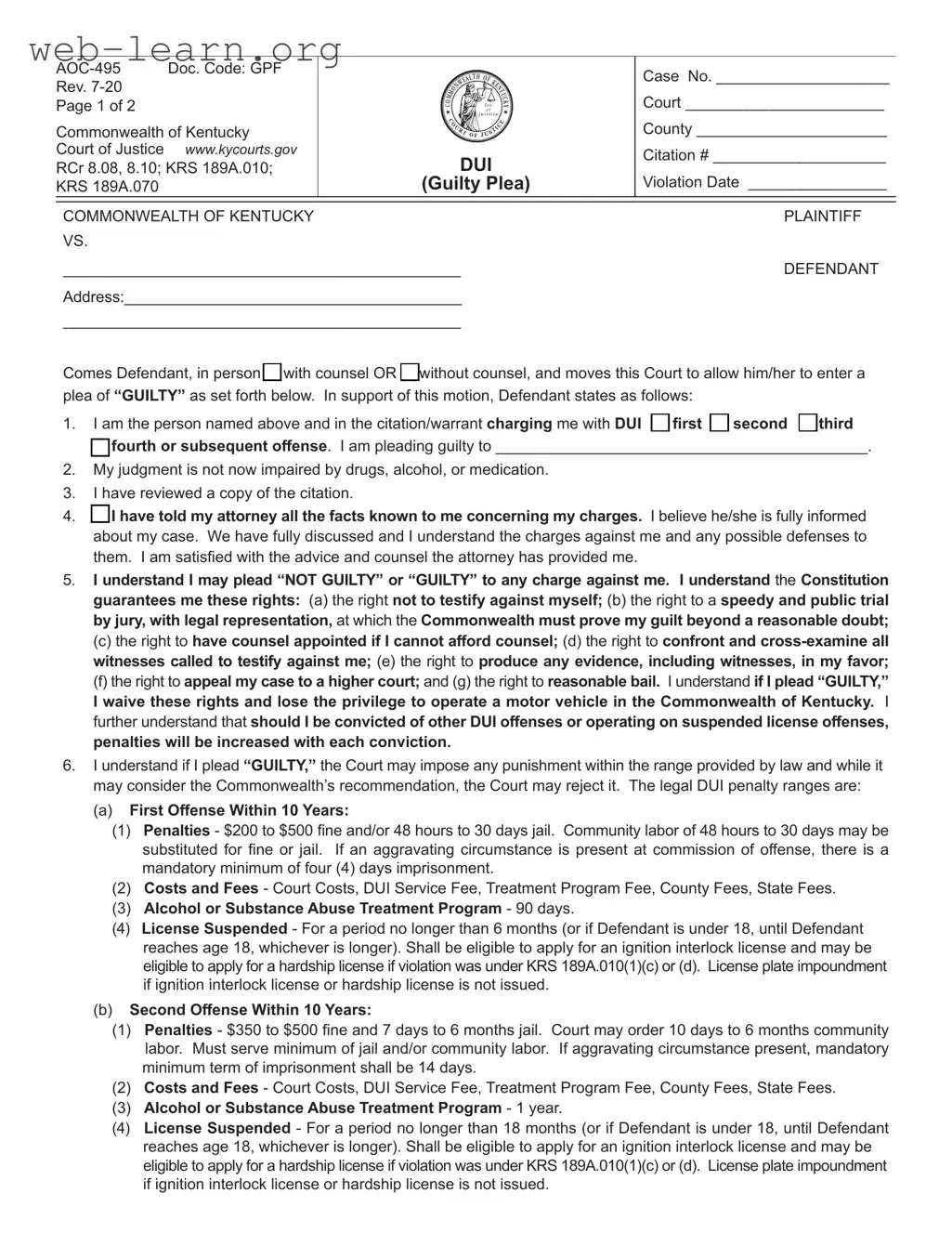
The Kentucky AOC 495 form plays a crucial role in the legal process for individuals charged with driving under the influence (DUI). This form is primarily used when a defendant wishes to enter a guilty plea for DUI offenses. It outlines the necessary information, including the case number, court details, and the specifics of the violation. The defendant must affirm their identity and acknowledge the charges against them, whether it's their first or subsequent offense. Importantly, the form requires the defendant to confirm that they are not impaired at the time of the plea and that they have discussed their case with legal counsel. It emphasizes the rights being waived by pleading guilty, such as the right to a trial and the right to appeal. Furthermore, the form provides details on potential penalties associated with different DUI offenses, including fines, jail time, and license suspensions. Understanding these components is essential for anyone navigating the complexities of DUI charges in Kentucky.

Rev.
Page 1 of 2
Commonwealth of Kentucky Court of Justice www.kycourts.gov RCr 8.08, 8.10; KRS 189A.010; KRS 189A.070
|
|
|
|
|
LT H |
OF |
|
|
|
|
|
EA |
K |
|
|||
|
|
|
W |
|
|
|
||
|
|
|
|
|
E |
|
||
|
|
O |
N |
|
|
|
N |
|
|
M |
|
|
|
|
T |
||
M |
|
|
|
|
|
|
U |
|
|
|
|
|
|
|
|
|
C |
O |
|
|
|
|
|
l e x |
K |
|
C |
|
|
|
|
|
Y |
||
|
|
|
|
|
|
e t |
|
|
|
|
|
|
|
j u s t i t i a |
E |
||
O |
|
|
|
|
||||
C |
|
|
|
|
|
|
||
|
|
U |
|
|
|
IC |
|
|
|
|
|
R |
T |
|
|
T |
|
|
|
|
|
|
O F |
JU |
|
|
DUI
(Guilty Plea)
Case No. ____________________
Court _______________________
County ______________________
Citation # ____________________
Violation Date ________________
COMMONWEALTH OF KENTUCKY
VS.
______________________________________________
Address:_______________________________________
______________________________________________
PLAINTIFF
DEFENDANT
Comes Defendant, in person with counsel OR without counsel, and moves this Court to allow him/her to enter a plea of “GUILTY” as set forth below. In support of this motion, Defendant states as follows:
1.I am the person named above and in the citation/warrant charging me with DUI first second third fourth or subsequent offense. I am pleading guilty to ___________________________________________.
2.My judgment is not now impaired by drugs, alcohol, or medication.
3.I have reviewed a copy of the citation.
4. I have told my attorney all the facts known to me concerning my charges. I believe he/she is fully informed about my case. We have fully discussed and I understand the charges against me and any possible defenses to them. I am satisfied with the advice and counsel the attorney has provided me.
5.I understand I may plead “NOT GUILTY” or “GUILTY” to any charge against me. I understand the Constitution guarantees me these rights: (a) the right not to testify against myself; (b) the right to a speedy and public trial
by jury, with legal representation, at which the Commonwealth must prove my guilt beyond a reasonable doubt;
(c) the right to have counsel appointed if I cannot afford counsel; (d) the right to confront and
(f) the right to appeal my case to a higher court; and (g) the right to reasonable bail. I understand if I plead “GUILTY,”
I waive these rights and lose the privilege to operate a motor vehicle in the Commonwealth of Kentucky. I further understand that should I be convicted of other DUI offenses or operating on suspended license offenses,
penalties will be increased with each conviction.
6.I understand if I plead “GUILTY,” the Court may impose any punishment within the range provided by law and while it may consider the Commonwealth’s recommendation, the Court may reject it. The legal DUI penalty ranges are:
(a)First Offense Within 10 Years:
(1)Penalties - $200 to $500 fine and/or 48 hours to 30 days jail. Community labor of 48 hours to 30 days may be substituted for fine or jail. If an aggravating circumstance is present at commission of offense, there is a mandatory minimum of four (4) days imprisonment.
(2)Costs and Fees - Court Costs, DUI Service Fee, Treatment Program Fee, County Fees, State Fees.
(3)Alcohol or Substance Abuse Treatment Program - 90 days.
(4)License Suspended - For a period no longer than 6 months (or if Defendant is under 18, until Defendant reaches age 18, whichever is longer). Shall be eligible to apply for an ignition interlock license and may be eligible to apply for a hardship license if violation was under KRS 189A.010(1)(c) or (d). License plate impoundment if ignition interlock license or hardship license is not issued.
(b)Second Offense Within 10 Years:
(1)Penalties - $350 to $500 fine and 7 days to 6 months jail. Court may order 10 days to 6 months community labor. Must serve minimum of jail and/or community labor. If aggravating circumstance present, mandatory minimum term of imprisonment shall be 14 days.
(2)Costs and Fees - Court Costs, DUI Service Fee, Treatment Program Fee, County Fees, State Fees.
(3)Alcohol or Substance Abuse Treatment Program - 1 year.
(4)License Suspended - For a period no longer than 18 months (or if Defendant is under 18, until Defendant reaches age 18, whichever is longer). Shall be eligible to apply for an ignition interlock license and may be eligible to apply for a hardship license if violation was under KRS 189A.010(1)(c) or (d). License plate impoundment if ignition interlock license or hardship license is not issued.

Rev.
Page 2 of 2
(c) Third Offense Within 10 Years:
(1) Penalties - $500 to $1000 fine and 30 days to 12 months jail, and court may order 10 days to 12 months community labor. Must serve minimum of jail and/or community labor. If aggravating circumstance present, mandatory minimum term of imprisonment shall be 60 days.
(2) Costs and Fees - Court Costs, DUI Service Fee, Treatment Program Fee, County Fees, State Fees.
(3) Alcohol or Substance Abuse Treatment Program - 1 year.
(4) License Suspended - For a period no longer than 36 months (or if Defendant is under 18, until Defendant reaches age 18, whichever is longer). Shall be eligible to apply for an ignition interlock license and may be eligible to apply for a hardship license if violation was under KRS 189A.010(1)(c) or (d). License plate impoundment if ignition interlock license or hardship license is not issued.
(d) Fourth or Subsequent Offense Within 10 Years:
(1) Penalties - 1 to 5 years (Class D Felony). Must serve 120 days. If aggravating circumstance present, mandatory minimum term of imprisonment shall be 240 days.
(2) Costs and Fees - Court Costs, DUI Service Fee, Treatment Program Fee, County Fees, State Fees.
(3) Alcohol or Substance Abuse Treatment Program - 1 year.
(4) License Suspended - For a period no longer than 60 months (or if Defendant is under 18, until Defendant reaches age 18, whichever is longer). Shall be eligible to apply for an ignition interlock license and may be eligible to apply for a hardship license if violation was under KRS 189A.010(1)(c) or (d). License plate impoundment if ignition interlock license or hardship license is not issued.
(e) Aggravating Circumstances referred to above are: (1) Operating motor vehicle (MV) in excess of 30 miles per hour above the speed limit; (2) Operating MV in wrong direction on limited access highway; (3) Operating MV that causes accident resulting in death or serious physical injury; (4) Operating MV while alcohol concentration in operator’s blood or breath is 0.15 or more as measured by test(s) of a sample of the operator’s blood or breathtaken within 2 hours of cessation of operation of MV; (5) Refusing to submit to any test(s) [blood, breath, or urine] requested by offi cer having reasonable grounds to believe person was operating or in physical control of a MV in violation of KRS 189A.010(1), except for a fi rst off ense under KRS 189A.010(5)(a); and (6) Operating MV that is transporting a passenger under 12 years of age.
7.I understand that if the Court rejects the plea agreement, it must so inform me and allow me to either persist in my guilty plea, in which case I may receive a less favorable disposition of my case than is contemplated in the plea agreement, or withdraw my guilty plea and proceed to trial.
8.In return for my guilty plea, the Commonwealth has agreed to recommend to the Court the following original/amended
charge(s) and sentence(s):______________________________________________________________________
____________________________________________________________________________________________
Other than the recommendation, no one, including my attorney, has promised me any other benefit in return for my guilty plea, nor has anyone forced or threatened me to plead “GUILTY.”
9. Because I am guilty and make no claim of innocence, I wish to plead “GUILTY” in reliance on the above
recommendation. These facts establish my guilt: On ___________________________, 2_____,
____________________________________________________________________________________________
____________________________________________________________________________________________
OR
Pursuant to North Carolina v. Alford, 400 U.S. 25 (1970), I wish to plead “GUILTY” in reliance on the above recommendation. In so pleading, I do not admit guilt but I believe the evidence against me strongly indicates guilt and my interests are best served by a guilty plea.
10.I understand that because of my conviction here today, I may be subject to greater/enhanced penalties if found guilty and/or convicted of any future criminal offenses. I understand that if I am not a United States citizen, I may be subject to deportation pursuant to the laws and regulations governing the United States Immigration and Naturalization Service.
11.I declare my plea of “GUILTY” is freely, knowingly, intelligently and voluntarily made. I understand the nature of this proceeding, the complete terms of this plea, and all obligations imposed upon me by its terms.
Signed in open court this _______ day of ________________________________, 2______.
______________________________ ______________________________ ______________________________
Signature of Defendant |
Signature of Defense Attorney (if any) |
Print Attorney Name |
| Fact Name | Details |
|---|---|
| Form Purpose | The AOC-495 form is used for defendants in Kentucky who wish to enter a guilty plea for DUI charges. |
| Governing Laws | This form is governed by Kentucky Revised Statutes (KRS) 189A.010 and 189A.070, as well as Rules of Criminal Procedure (RCr) 8.08 and 8.10. |
| Defendant Rights | By pleading guilty, defendants waive certain constitutional rights, including the right to a trial and the right to remain silent. |
| Plea Agreement | The form allows for a plea agreement where the Commonwealth may recommend a specific charge or sentence. |
| Penalties | Penalties for DUI offenses can vary significantly based on the number of offenses, with fines and jail time increasing for subsequent convictions. |
Filling out the Kentucky AOC 495 form is an important step in the legal process for individuals pleading guilty to DUI charges. After completing the form, it should be submitted to the court for review. Ensure all sections are filled out accurately to avoid delays in processing.
What is the purpose of the Kentucky AOC 495 form?
The Kentucky AOC 495 form is used by defendants who wish to enter a guilty plea for DUI (Driving Under the Influence) charges. This form allows individuals to formally state their intention to plead guilty, while also acknowledging their rights and the potential consequences of their plea. By signing this document, defendants confirm that they understand the charges against them and the implications of their decision.
What rights does a defendant waive by pleading guilty using this form?
When a defendant pleads guilty using the AOC 495 form, they waive several important rights. These include:
By entering a guilty plea, the defendant acknowledges that they understand these rights and the consequences of waiving them.
What are the potential penalties for a DUI conviction in Kentucky?
Penalties for a DUI conviction in Kentucky vary based on the number of offenses within a 10-year period. Here are some general guidelines:
Additional costs, fees, and treatment programs may also apply, along with license suspensions that can last from 6 months to 5 years, depending on the offense.
What should a defendant know about the plea agreement process?
When entering a guilty plea, defendants may have a plea agreement in place with the Commonwealth, which outlines the recommended charges and sentences. However, the court is not bound by this recommendation. If the court rejects the plea agreement, it must inform the defendant, who then has the option to either proceed with the guilty plea or withdraw it and go to trial. It’s crucial for defendants to understand that the outcome may not be as favorable as anticipated if they choose to stick with the guilty plea after a rejection.
How does a guilty plea affect future legal issues?
A guilty plea can have significant implications for future legal matters. Defendants should be aware that a conviction may lead to enhanced penalties for any subsequent offenses. Additionally, non-citizens may face deportation as a result of a DUI conviction. Understanding these potential long-term consequences is vital for anyone considering a guilty plea.
Filling out the Kentucky AOC 495 form requires careful attention to detail. One common mistake is failing to complete all required fields. Each section of the form serves a purpose, and missing information can lead to delays or even rejection of the plea. For instance, neglecting to fill in the case number or citation number can create confusion and hinder the processing of the case.
Another frequent error is not clearly indicating the specific DUI offense being pled to. The form provides options for first, second, third, or subsequent offenses. Selecting the wrong option can result in incorrect penalties being applied. It is essential to review the citation thoroughly to ensure that the offense is accurately represented on the form.
Many individuals also overlook the importance of acknowledging their understanding of the rights they are waiving by pleading guilty. This includes rights such as the right to a trial and the right to legal representation. Failing to indicate that they understand these rights can lead to complications later in the legal process.
Additionally, some people mistakenly believe they can submit the form without having discussed their case with an attorney. The form explicitly requires that defendants confirm they have shared all pertinent facts with their attorney. Not doing so can jeopardize the effectiveness of legal representation and may affect the outcome of the case.
Another common oversight is not providing a clear and specific statement of the facts supporting the guilty plea. This section is crucial as it outlines the basis for the plea. Vague or incomplete statements can undermine the plea agreement and may lead to further legal complications.
Moreover, individuals sometimes fail to understand the implications of pleading guilty, particularly regarding future penalties. The form warns that a guilty plea can result in enhanced penalties for future offenses. Ignoring this information can lead to unexpected consequences down the line.
Lastly, individuals may neglect to sign the form in the appropriate places. Both the defendant and their attorney (if applicable) must sign to validate the plea. A missing signature can invalidate the plea and require the process to start over, causing unnecessary delays and complications.
The Kentucky AOC-495 form is used for entering a guilty plea in DUI cases. Several other forms and documents often accompany this form to facilitate the legal process. Below is a list of these documents, each serving a specific purpose in DUI proceedings.
These documents play a crucial role in the DUI legal process, ensuring that defendants are informed of their rights and obligations. Proper completion and submission of these forms can significantly impact the outcome of a case.
When filling out the Kentucky AOC 495 form, it is crucial to approach the process with care and attention to detail. The following guidelines may help ensure a smoother experience:
This form is applicable for all DUI offenders, regardless of whether it’s their first or subsequent offense. It outlines the necessary information and legal implications for each level of DUI charge.
Pleading guilty does not eliminate consequences. In fact, it may lead to significant penalties, including fines, jail time, and license suspension. Understanding these repercussions is crucial before making a decision.
If the court rejects the plea agreement, you have the option to either continue with your guilty plea or withdraw it and proceed to trial. This flexibility allows defendants to reconsider their choices.
The court has the authority to reject the plea agreement. While the Commonwealth may recommend a specific sentence, the final decision rests with the judge, who may impose a different punishment.
While the form allows for a plea agreement, it does not guarantee leniency. The judge will evaluate all circumstances of the case, including prior offenses and any aggravating factors, before determining the sentence.
When filling out and using the Kentucky AOC 495 form, there are several important points to keep in mind:
By following these key takeaways, you can navigate the process of filling out and using the AOC 495 form more effectively.