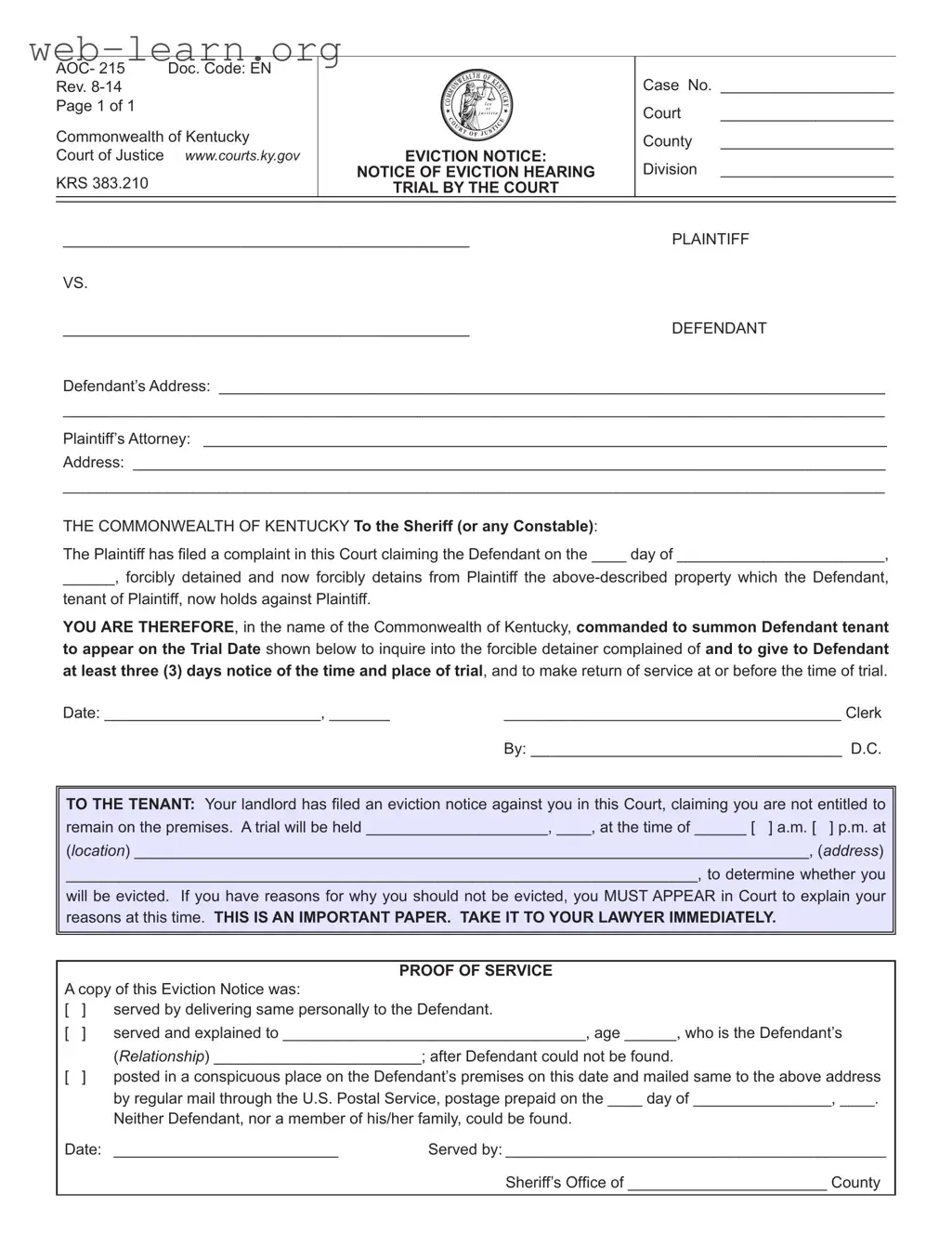
The Kentucky AOC 215 form serves as a critical document in the eviction process, facilitating communication between landlords and tenants within the Commonwealth of Kentucky. This form outlines the essential details of an eviction notice, including the case number, court information, and specific parties involved, such as the plaintiff and defendant. It informs the tenant of the impending eviction hearing, specifying the date, time, and location where the trial will take place. The form emphasizes the importance of the tenant's presence in court, urging them to present any defenses they may have against the eviction. Additionally, it provides instructions for the sheriff or constable responsible for delivering the notice, ensuring that the defendant is adequately informed of the proceedings. The AOC 215 form is not only a procedural requirement but also a vital tool for ensuring that tenants are aware of their rights and obligations in the face of potential eviction.

AOC- 215 |
Doc. Code: EN |
|
|
|
|
|
LT H |
OF |
|
|
|
|
Rev. |
|
|
|
|
EA |
K |
|
Case No. ____________________ |
||||
|
|
|
|
W |
|
|
|
|||||
|
|
|
|
|
|
E |
|
|||||
|
|
|
O |
N |
|
|
|
N |
||||
|
|
M |
|
|
|
|
T |
|||||
|
M |
|
|
|
|
|
U |
|||||
|
|
|
|
|
|
|
C |
|
|
|||
Page 1 of 1 |
|
|
|
|
|
|
|
|
|
|
|
|
|
O |
|
|
|
|
|
l e x |
K |
|
|
||
|
C |
|
|
|
|
|
Y |
Court |
____________________ |
|||
|
|
|
|
|
|
|
e t |
|
|
|||
|
|
|
|
|
|
j u s t i t i a |
|
|||||
|
|
C |
|
|
|
|
|
E |
||||
|
|
O |
|
|
|
IC |
||||||
Commonwealth of Kentucky |
|
|
U |
|
|
|
|
|
|
|||
|
|
|
R |
T |
|
|
T |
|
|
|
||
|
|
|
|
|
O F |
JU |
|
|
County |
____________________ |
||
|
|
|
|
|
|
|
|
|
||||
Court of Justice |
www.courts.ky.gov |
EVICTION NOTICE: |
Division |
____________________ |
||||||||
KRS 383.210 |
|
NOTICE OF EVICTION HEARING |
||||||||||
|
TRIAL BY THE COURT |
|
|
|||||||||
_______________________________________________ |
|
|
|
PLAINTIFF |
||||||||
VS. |
|
|
|
|
|
|
|
|
|
|
|
|
_______________________________________________ |
|
|
|
DEFENDANT |
||||||||
Defendant’s Address: _____________________________________________________________________________ |
||||||||||||
_______________________________________________________________________________________________ |
||||||||||||
Plaintiff’s Attorney: _______________________________________________________________________________ |
||||||||||||
Address: _______________________________________________________________________________________ |
||||||||||||
_______________________________________________________________________________________________ |
||||||||||||
THE COMMONWEALTH OF KENTUCKY To the Sheriff (or any Constable):
The Plaintiff has iled a complaint in this Court claiming the Defendant on the ____ day of ________________________,
______, forcibly detained and now forcibly detains from Plaintiff the
tenant of Plaintiff, now holds against Plaintiff.
YOU ARE THEREFORE, in the name of the Commonwealth of Kentucky, commanded to summon Defendant tenant to appear on the Trial Date shown below to inquire into the forcible detainer complained of and to give to Defendant at least three (3) days notice of the time and place of trial, and to make return of service at or before the time of trial.
Date: _________________________, _______ |
_______________________________________ Clerk |
|
By: ____________________________________ D.C. |
TO THE TENANT: Your landlord has iled an eviction notice against you in this Court, claiming you are not entitled to remain on the premises. A trial will be held _____________________, ____, at the time of ______ [ ] a.m. [ ] p.m. at
(location) ______________________________________________________________________________, (address)
_________________________________________________________________________, to determine whether you
will be evicted. If you have reasons for why you should not be evicted, you MUST APPEAR in Court to explain your reasons at this time. THIS IS AN IMPORTANT PAPER. TAKE IT TO YOUR LAWYER IMMEDIATELY.
A copy of this Eviction Notice was: |
PROOF OF SERVICE |
||
|
|||
[ |
] |
served by delivering same personally to the Defendant. |
|
[ |
] |
served and explained to ___________________________________, age ______, who is the Defendant’s |
|
|
|
(Relationship) ________________________; after Defendant could not be found. |
|
[ |
] |
posted in a conspicuous place on the Defendant’s premises on this date and mailed same to the above address |
|
|
|
by regular mail through the U.S. Postal Service, postage prepaid on the ____ day of ________________, ____. |
|
|
|
Neither Defendant, nor a member of his/her family, could be found. |
|
Date: __________________________ |
Served by: ____________________________________________ |
||
|
|
|
Sheriff’s Ofice of _______________________ County |
| Fact Name | Description |
|---|---|
| Form Title | The form is officially titled "AOC-215," which is an Eviction Notice used in Kentucky. |
| Governing Law | This form is governed by KRS 383.210, which outlines the procedures for eviction in Kentucky. |
| Purpose | AOC-215 serves to notify tenants of an eviction hearing and the details surrounding it. |
| Trial Notification | The form mandates that the tenant must be given at least three days' notice before the trial date. |
| Proof of Service | Multiple methods of service are allowed, including personal delivery, delivery to a family member, or posting on the premises. |
| Importance of Appearance | Tenants are strongly advised to appear in court to present their reasons against eviction. |
Filling out the Kentucky AOC 215 form requires careful attention to detail. This form is essential for initiating the eviction process and must be completed accurately to ensure that all parties are properly notified. Below are the steps you should follow to fill out this form correctly.
Once you have completed the form, it is essential to follow the next steps for filing and serving the notice to ensure compliance with Kentucky law. This may involve submitting the form to the appropriate court and arranging for the sheriff or constable to serve the notice to the tenant.
What is the Kentucky AOC 215 form?
The Kentucky AOC 215 form is an eviction notice that is used in the state of Kentucky. It serves as a formal notification to a tenant that their landlord is seeking to evict them from a rental property. This document outlines the details of the eviction, including the date of the trial and the reasons for the eviction. It is a crucial legal document in the eviction process.
Who fills out the AOC 215 form?
The landlord or their attorney is responsible for filling out the AOC 215 form. They must provide specific information such as the names of the parties involved, the address of the rental property, and the reasons for the eviction. Accurate completion of this form is essential for the eviction process to proceed smoothly.
What information is included in the AOC 215 form?
The AOC 215 form includes several key pieces of information:
All of this information is necessary for the court to understand the situation and to schedule the hearing appropriately.
How is the AOC 215 form served to the tenant?
The form can be served in several ways. It may be delivered personally to the tenant, explained to someone at the tenant's residence, or posted on the premises if the tenant cannot be found. Additionally, a copy must be mailed to the tenant's address. Proper service is crucial, as it ensures that the tenant is aware of the eviction proceedings.
What should a tenant do upon receiving the AOC 215 form?
Upon receiving the AOC 215 form, a tenant should take it seriously. It is recommended that they consult with a lawyer immediately. The notice includes a court date, and the tenant must appear in court to present their side of the case. Ignoring the notice can lead to an automatic eviction.
What happens at the eviction hearing?
During the eviction hearing, both the landlord and tenant will have the opportunity to present their cases. The landlord will explain why they believe the eviction is justified, while the tenant can provide reasons for why they should not be evicted. The judge will then make a determination based on the evidence presented.
Can a tenant contest the eviction?
Yes, a tenant can contest the eviction. They must attend the hearing and present their arguments. Valid defenses might include improper service of the eviction notice, payment of rent, or other circumstances that justify their continued residence in the property. It’s important to prepare thoroughly for this hearing.
What are the potential outcomes of the eviction hearing?
The judge may rule in favor of either the landlord or the tenant. If the landlord wins, the tenant will be ordered to vacate the property, often within a specified timeframe. If the tenant wins, they may be allowed to stay in the property. The court's decision will be based on the evidence and arguments presented during the hearing.
What should landlords know about the AOC 215 form?
Landlords should ensure that they complete the AOC 215 form accurately and follow all legal procedures for serving the notice. It’s also important to keep records of all communications and actions taken related to the eviction. Understanding the legal process can help avoid potential complications and ensure a smoother eviction process.
When completing the Kentucky AOC 215 form, individuals often encounter various pitfalls that can lead to complications in the eviction process. One common mistake is failing to provide accurate case information. The case number, court name, and county must be filled out correctly. Omitting or miswriting these details can result in delays or even dismissal of the eviction notice.
Another frequent error involves incorrect identification of the parties involved. It is crucial to clearly state the names of both the plaintiff and the defendant. If the names are misspelled or if incorrect parties are listed, this can complicate the legal proceedings and may require additional filings to rectify the situation.
Many people overlook the importance of the defendant’s address. This section must be filled out completely and accurately. If the address is incorrect or incomplete, it can hinder the sheriff's ability to serve the eviction notice, thereby prolonging the process and potentially causing frustration for all parties involved.
Additionally, individuals often neglect to specify the trial date and time. This information is vital for the defendant to prepare for the hearing. If this section is left blank or filled out incorrectly, it can lead to confusion and may prevent the defendant from attending the trial, which can adversely affect the outcome.
Another mistake occurs when individuals fail to indicate the method of service for the eviction notice. The proof of service section must be completed accurately to confirm that the defendant has received the notice. If this section is incomplete, the court may question whether the defendant was properly notified, which could jeopardize the eviction process.
Moreover, some people forget to sign and date the form. This is a crucial step in validating the document. Without a signature, the form may be deemed invalid, which can lead to further legal complications and delays in the eviction process.
Finally, individuals sometimes ignore the importance of seeking legal advice before submitting the form. Consulting with a lawyer can help ensure that the form is filled out correctly and that all necessary information is included. This proactive approach can prevent many of the aforementioned mistakes and facilitate a smoother eviction process.
The Kentucky AOC 215 form serves as an eviction notice, outlining the necessary steps for a landlord to initiate eviction proceedings against a tenant. While this form is essential, several other documents are commonly used in conjunction with it to ensure a comprehensive legal process. Below is a list of these documents, each playing a crucial role in the eviction process.
Understanding these documents can help both landlords and tenants navigate the eviction process more effectively. Each plays a distinct role, contributing to the overall legal framework that governs landlord-tenant relationships in Kentucky.
When filling out the Kentucky AOC 215 form, there are important guidelines to follow. Here is a list of things you should and shouldn't do:
Understanding the Kentucky AOC 215 form is crucial for both landlords and tenants involved in eviction proceedings. However, several misconceptions can lead to confusion. Here are eight common misconceptions about this form:
By clarifying these misconceptions, both landlords and tenants can better prepare for the eviction process and understand their rights and responsibilities.
Understanding the Kentucky AOC 215 form is crucial for both landlords and tenants navigating the eviction process. Here are some key takeaways to consider:
By following these guidelines, both landlords and tenants can navigate the complexities of the eviction process more effectively, ensuring that their rights are protected throughout.