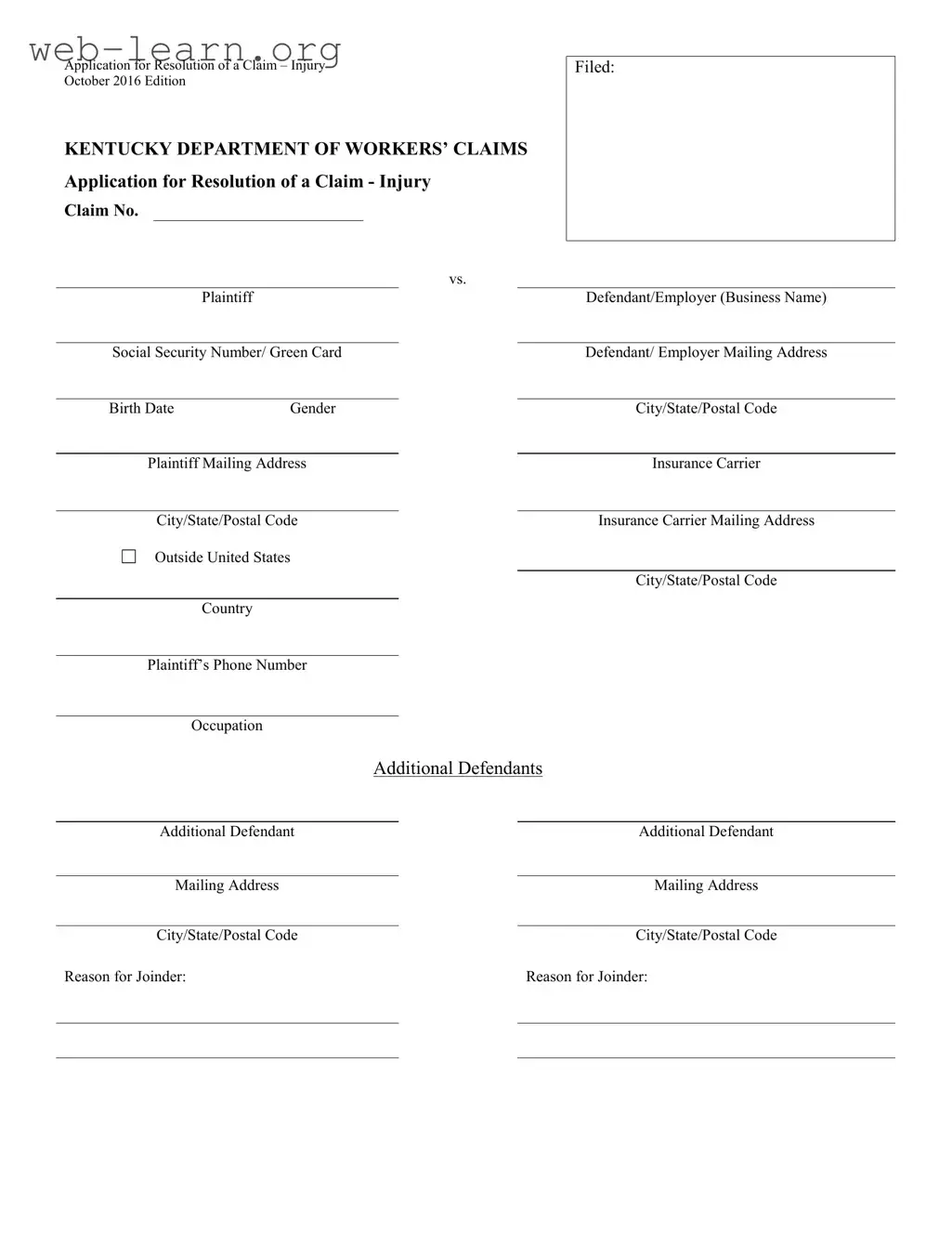
The Kentucky 101 form serves as a critical tool for individuals seeking resolution for workplace injury claims. This application, officially titled "Application for Resolution of a Claim – Injury," is required by the Kentucky Department of Workers’ Claims. It collects essential information about the injured party, including their personal details, the nature of the injury, and the circumstances surrounding the accident. The form prompts the claimant to provide specifics such as the date and location of the injury, a description of how the accident occurred, and details about any medical treatment received. It also inquires about the involvement of additional defendants, previous claims for workers' compensation, and whether the injured worker has dependents. Completing the Kentucky 101 form requires careful attention to detail, as all sections must be filled out accurately and submitted within a specified timeframe. This includes attaching supporting documents like medical reports and proof of wages. Failure to provide complete and accurate information can lead to delays in processing the claim. Overall, the Kentucky 101 form is a vital step in navigating the workers' compensation system in Kentucky, ensuring that injured workers can pursue their rights effectively.

Application for Resolution of a Claim – Injury
October 2016 Edition
KENTUCKY DEPARTMENT OF WORKERS’ CLAIMS
Application for Resolution of a Claim - Injury
Claim No.
vs.
Plaintiff
Social Security Number/ Green Card
Birth DateGender
Plaintiff Mailing Address
City/State/Postal Code
☐Outside United States
Country
Plaintiff’s Phone Number
Occupation
Filed:
Defendant/Employer (Business Name)
Defendant/ Employer Mailing Address
City/State/Postal Code
Insurance Carrier
Insurance Carrier Mailing Address
City/State/Postal Code
Additional Defendants
Additional Defendant
Mailing Address
City/State/Postal Code
Reason for Joinder:
Additional Defendant
Mailing Address
City/State/Postal Code
Reason for Joinder:

I. Nature of Injury
1.Date and location of accident/injury:
Date of Injury |
Location of Injury (City/State/Postal Code) |
☐Plaintiff states that he/she was injured within the scope and course of employment with defendant employer on the above date at the above location.
2.Describe how the accident/injury occurred:
Cause of Injury:
3.Body part injured:
4.When and by what means did the plaintiff give notice of injury to the employer?
5.Describe medical treatment, if any:
6.Name and address (city/state/postal code) of physician whose report will be provided:
7.Will an interpreter be needed for the formal hearing? (Yes / No) If yes, in which language?
8.Dependents
Injured worker is deceased? (Yes / No)
If deceased, dependent information is required for a deceased worker. If work injury resulted in the death of claimant, attach/provide/upload Form F in addition to the application for Resolution of Claim.
9.Have you previously filed for or received workers’ compensation benefits in Kentucky? (Yes / No) If yes, please provide the following information:
Claim Number |
Date of Injury |
Nature of Injury/Disease |
Awards/Benefits |
|
|
|
|
|
|
|
|
|
|
|
|
If not a Kentucky claim, please provide the state in which you were awarded benefits:

10.Was there concurrent employment at the time of injury? (Yes / No)
11.Name and address of concurrent employer:
Concurrent Employer Name
Concurrent Employer City
Concurrent Employer State |
Postal Code |
12.Has the plaintiff worked since the injury? (Yes / No)
13.Name and address of current employer and description of job currently being performed: Current Employer Name
Current Employer City
Current Employer State |
|
Postal Code |
Description of Job Performed:
14.Are you alleging a violation of a safety rule/regulation pursuant to KRS 342.165? (Yes / No) If yes, submit form SVC within 15 days after filing the Application for Resolution of Claim.
Attestations:
I understand that any person who knowingly and with intent to defraud any insurance company or other person files a
☐statement or claim containing any materially false information or conceals, for the purpose of misleading, information concerning any fact material thereto commits a fraudulent insurance act, which is a crime.
☐Plaintiff herein being duly sworn, states that the statements in this application and in Form 104, 105, and 106 to be separately filed, are true.
By entering your name below, you are confirming the accuracy of this form to the best of your knowledge.
This form prepared and submitted by |
|
Relationship to injured worker |
|
|
|
Submitter Phone Number |
|
Submitter Email Address |
|
|
|
Plaintiff Signature |
|
|
Instructions for Completion of – Application for Resolution of a Claim – Injury
1.All sections of this form must be completed, and the following shall be filed within 15 days:
a.Form 104 (Plaintiff’s Employment History)
b.Form 105 (Plaintiff’s Chronological Medical History)
c.Form 106 (Medical Waiver and Consent)
d.Medical report describing and supporting the injury which is the basis of the claim.
e.Proof of Wages, including
2.All information must be typewritten
3.File the original of this form and sufficient copies for all named defendants with the Department of Workers’ Claims, Prevention Park, 657 Chamberlin Avenue, Frankfort, Kentucky, 40601.
4.If you have no telephone number, please list a number at which you may be contacted.
5.If you have questions, call
Note: Special attention should be given to stating the correct name and address of the employer and insurance carrier. Otherwise, claim processing may be delayed.
| Fact Name | Description |
|---|---|
| Form Title | Application for Resolution of a Claim – Injury |
| Governing Law | KRS 342.001 et seq. (Kentucky Workers' Compensation Act) |
| Edition Date | October 2016 |
| Filing Requirement | All sections must be completed and filed within 15 days. |
| Required Forms | Submit Form 104, 105, 106, and medical reports with the application. |
| Claim Number | A unique identifier assigned to each claim submitted. |
| Injury Notification | The plaintiff must indicate when and how they notified the employer of the injury. |
| Interpreter Requirement | The form asks if an interpreter is needed for the formal hearing. |
| Fraud Warning | Submitting false information may lead to criminal charges for fraud. |
| Contact Information | Provide a phone number and email for the person submitting the form. |
Completing the Kentucky 101 form is an important step in addressing your injury claim. Carefully follow the steps below to ensure that all necessary information is accurately provided. Once the form is completed, it will need to be submitted along with additional required documents.
Ensure that all sections of the form are filled out completely. Remember to type your information clearly and submit the original form along with copies for all named defendants. Additional documents, such as Forms 104, 105, and 106, along with medical reports and proof of wages, must be included within 15 days of filing. If you have any questions, assistance is available at 1-800-554-8601.
What is the purpose of the Kentucky 101 form?
The Kentucky 101 form, officially known as the Application for Resolution of a Claim – Injury, serves as a formal request for resolution of a workers' compensation claim. It is specifically designed for individuals who have sustained injuries while working and are seeking benefits. By completing this form, claimants provide essential details about the incident, including the nature of the injury, the circumstances surrounding it, and any prior claims for benefits.
What information is required to complete the Kentucky 101 form?
To accurately fill out the Kentucky 101 form, several key pieces of information are necessary:
Completing all sections of the form is crucial, as incomplete submissions may lead to processing delays.
What happens after submitting the Kentucky 101 form?
Once the Kentucky 101 form is submitted to the Department of Workers’ Claims, the processing of the claim begins. The department will review the provided information and may require additional documentation, such as medical reports and proof of wages. It is important for claimants to ensure that they have included all necessary forms, including Forms 104, 105, and 106, as these must accompany the Kentucky 101 form within 15 days of filing. Failure to do so may result in delays or denial of the claim.
How can I seek assistance if I have questions about the Kentucky 101 form?
If you have questions or need assistance while completing the Kentucky 101 form, you can contact the Department of Workers’ Claims directly. The helpline is available at 1-800-554-8601. Additionally, it may be helpful to consult with a legal professional or a workers’ compensation advocate to ensure that your claim is filed correctly and to understand your rights throughout the process.
Filling out the Kentucky 101 form correctly is essential for a smooth claims process. One common mistake is leaving sections blank. All sections must be completed, even if some information seems irrelevant. Incomplete forms can lead to delays or denials of claims.
Another frequent error involves incorrect personal information. Providing an incorrect Social Security number or misspelling the plaintiff's name can cause significant issues. Double-check all personal details before submission to avoid complications.
Many applicants fail to provide a complete description of the injury and how it occurred. This section is critical for establishing the context of the claim. A vague or unclear explanation can hinder the review process and may result in a denial.
Not including the required supporting documents is also a common oversight. Along with the Kentucky 101 form, additional forms such as Form 104, 105, and 106 must be submitted. Missing documents can lead to delays in processing the claim.
Some individuals neglect to provide accurate contact information for their current and past employers. This can complicate the verification process. Make sure to include complete addresses and phone numbers for all relevant employers.
Another mistake is failing to indicate whether an interpreter is needed for the formal hearing. If language assistance is required, specifying the language is essential. This ensures that all parties can communicate effectively during the proceedings.
Applicants sometimes overlook the question regarding previous workers’ compensation claims. If there is a history of claims, this information must be provided. Failing to disclose prior claims can result in complications or even legal consequences.
Additionally, some people forget to sign the form. A signature is necessary to validate the application. Without it, the form cannot be processed.
Lastly, not following the filing instructions can lead to delays. Ensure that the original form and sufficient copies are sent to the correct address. Adhering to the instructions is crucial for timely processing of the claim.
The Kentucky 101 form serves as a crucial document in the process of filing a workers' compensation claim for injury. However, it is often accompanied by several other forms and documents that provide additional information and context. Each of these documents plays a significant role in ensuring that the claim is processed efficiently and accurately.
Collectively, these documents create a comprehensive picture of the claim, providing necessary details that facilitate the workers' compensation process in Kentucky. Properly completing and submitting these forms is essential for ensuring that the claim is handled effectively and that injured workers receive the benefits they deserve.
The Kentucky 101 form, known as the Application for Resolution of a Claim – Injury, serves as a vital document in the workers' compensation process. Several other documents share similar functions and purposes in different contexts. Here are five such documents:
When filling out the Kentucky 101 form, it is essential to follow specific guidelines to ensure a smooth application process. Below is a list of things you should and shouldn't do.
Misconceptions about the Kentucky 101 form can lead to confusion and delays in the claims process. Here are five common misconceptions clarified:
Understanding these misconceptions can help ensure that the Kentucky 101 form is filled out correctly and submitted on time, facilitating a smoother claims process.
Complete All Sections: Ensure every part of the Kentucky 101 form is filled out. Missing information can delay your claim.
File Additional Forms: Remember to submit Form 104, 105, and 106 along with the medical report and proof of wages within 15 days of filing the application.
Typewritten Information: All information on the form must be typewritten. Handwritten forms may not be accepted.
Correct Employer and Insurance Details: Pay special attention to the names and addresses of the employer and insurance carrier. Errors can lead to processing delays.
Contact Information: If you do not have a phone number, provide an alternative contact number where you can be reached.