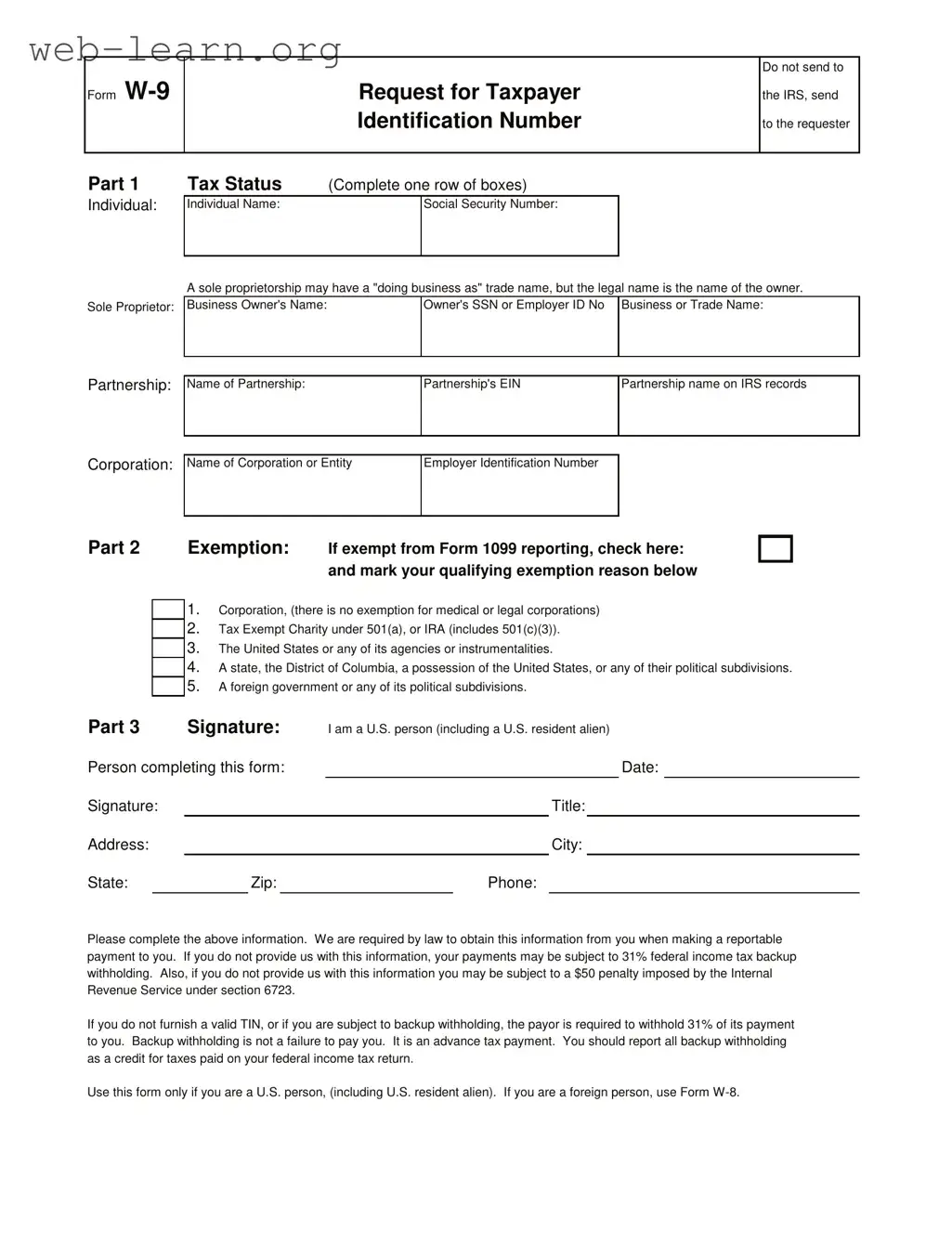
The Kansas W-9 form serves as an essential document for individuals and businesses alike, facilitating the collection of taxpayer identification information necessary for various financial transactions. Primarily, this form is utilized by U.S. persons, including resident aliens, to provide their Taxpayer Identification Number (TIN) to a requester, typically in the context of reportable payments. It encompasses several key components, including sections for individual names, Social Security numbers, and business details for sole proprietorships, partnerships, and corporations. Additionally, the form addresses exemptions from Form 1099 reporting, allowing certain entities, such as tax-exempt charities or government agencies, to indicate their qualifying status. A signature section reinforces the importance of accuracy, as the individual completing the form must affirm their U.S. person status. Failure to provide the requested information can lead to significant consequences, such as backup withholding of federal income tax at a rate of 31% and potential penalties imposed by the IRS. Understanding the nuances of the Kansas W-9 form is crucial for ensuring compliance and protecting oneself from unnecessary tax liabilities.

|
|
Do not send to |
Form |
Request for Taxpayer |
the IRS, send |
|
Identification Number |
to the requester |
|
|
|
Part 1
Individual:
Tax Status |
(Complete one row of boxes) |
|
Individual Name: |
|
Social Security Number: |
|
|
|
A sole proprietorship may have a "doing business as" trade name, but the legal name is the name of the owner.
Sole Proprietor: |
Business Owner's Name: |
Owner's SSN or Employer ID No |
Business or Trade Name: |
|
|
|
|
|
|
|
|
Partnership: |
Name of Partnership: |
Partnership's EIN |
Partnership name on IRS records |
|
|
|
|
Corporation:
Name of Corporation or Entity
Employer Identification Number
Part 2 |
|
Exemption: |
If exempt from Form 1099 reporting, check here: |
|
||
|
|
|
|
|
and mark your qualifying exemption reason below |
|
|
|
|
|
|
|
|
|
|
1. |
Corporation, (there is no exemption for medical or legal corporations) |
|||
|
|
2. |
Tax Exempt Charity under 501(a), or IRA (includes 501(c)(3)). |
|||
|
|
3. |
The United States or any of its agencies or instrumentalities. |
|||
|
|
4. |
A state, the District of Columbia, a possession of the United States, or any of their political subdivisions. |
|||
|
|
5. |
A foreign government or any of its political subdivisions. |
|||
Part 3 |
Signature: |
I am a U.S. person (including a U.S. resident alien) |
|||||||||
Person completing this form: |
|
|
|
|
|
Date: |
|
||||
Signature: |
|
|
|
|
|
|
Title: |
|
|||
Address: |
|
|
|
|
|
|
City: |
|
|||
State: |
|
|
Zip: |
|
|
Phone: |
|
||||
Please complete the above information. We are required by law to obtain this information from you when making a reportable payment to you. If you do not provide us with this information, your payments may be subject to 31% federal income tax backup withholding. Also, if you do not provide us with this information you may be subject to a $50 penalty imposed by the Internal Revenue Service under section 6723.
If you do not furnish a valid TIN, or if you are subject to backup withholding, the payor is required to withhold 31% of its payment to you. Backup withholding is not a failure to pay you. It is an advance tax payment. You should report all backup withholding as a credit for taxes paid on your federal income tax return.
Use this form only if you are a U.S. person, (including U.S. resident alien). If you are a foreign person, use Form
| Fact Name | Details |
|---|---|
| Purpose | The Kansas W-9 form is used to request the Taxpayer Identification Number (TIN) of individuals or entities for tax reporting purposes. |
| Who Should Use It | This form is intended for U.S. persons, including U.S. resident aliens. Foreign persons should use Form W-8 instead. |
| Exemption Categories | There are specific exemptions from Form 1099 reporting, including corporations, tax-exempt charities, and government entities. |
| Backup Withholding | If the required information is not provided, payments may be subject to a 31% federal income tax backup withholding. |
| Governing Law | The use of the Kansas W-9 form is governed by federal tax laws, specifically under the Internal Revenue Code. |
Completing the Kansas W-9 form is an important step in providing your taxpayer information to the requester. This ensures that your payments are processed correctly and that you are in compliance with tax regulations. Follow these steps carefully to fill out the form accurately.
Once you have completed the form, make sure to review it for accuracy. After verifying that all information is correct, submit the form to the requester, not the IRS. This step is crucial to ensure timely processing of your payments.
The Kansas W-9 form is used to provide your taxpayer identification information to the requester. This form helps the requester accurately report payments made to you to the IRS. It is important for individuals and businesses who receive reportable payments, such as independent contractors or vendors, to complete this form.
Any U.S. person, including U.S. resident aliens, who is receiving payments that require reporting must complete the Kansas W-9 form. This includes individuals, sole proprietors, partnerships, corporations, and tax-exempt organizations. Foreign persons should not use this form; instead, they should complete Form W-8.
The Kansas W-9 form requires various pieces of information, including:
If you do not provide the necessary information, your payments may be subject to backup withholding at a rate of 31%. Additionally, you may face a $50 penalty from the IRS for failing to provide accurate information. It is crucial to complete the form correctly to avoid these consequences.
Filling out the Kansas W-9 form may seem straightforward, but many individuals make common mistakes that can lead to complications down the line. Understanding these pitfalls can save you time and trouble. Here are ten mistakes to watch out for.
One frequent error is neglecting to provide the correct Tax Identification Number (TIN). This number is crucial for tax reporting purposes. Ensure that you enter either your Social Security Number (SSN) or Employer Identification Number (EIN) accurately. A simple typo can lead to delays and potential penalties.
Another common mistake is failing to check the appropriate tax status box in Part 1. Whether you are an individual, sole proprietor, partnership, or corporation, selecting the wrong category can cause confusion. Each classification has different implications for tax purposes, so take a moment to consider your status carefully.
Some people mistakenly think they can use a doing business as (DBA) name instead of their legal name. Remember, the legal name of the owner must be provided. This is especially important for sole proprietors, as the IRS requires the name that matches your SSN.
Additionally, individuals often overlook Part 2, which addresses exemptions. If you qualify for any exemptions from Form 1099 reporting, it is essential to check the box and provide the necessary details. Ignoring this section could lead to unnecessary tax withholding.
Another common oversight is forgetting to sign and date the form. A signature is not just a formality; it certifies that the information provided is accurate. Without a signature, the form is incomplete and may not be accepted.
People sometimes provide outdated or incorrect contact information. Always double-check your address, phone number, and email to ensure they are current. This information helps the requester reach you if there are any questions or issues with your submission.
In some cases, individuals fail to read the instructions thoroughly. The Kansas W-9 form includes important details about backup withholding and penalties for not providing accurate information. Taking the time to read these instructions can help you avoid costly mistakes.
Another mistake is assuming that all payments are exempt from backup withholding. If you do not provide a valid TIN or if you are subject to backup withholding, the payor is required to withhold 31% of your payment. Understanding this requirement is crucial for managing your finances effectively.
Some individuals mistakenly think that they can use this form if they are foreign persons. However, the Kansas W-9 form is only for U.S. persons, including U.S. resident aliens. If you are a foreign individual, you must use Form W-8 instead.
Lastly, many people underestimate the importance of keeping a copy of the completed form for their records. Having a copy can be invaluable if questions arise later or if you need to reference it for tax purposes. Always retain a copy for your files.
By being aware of these common mistakes, you can fill out the Kansas W-9 form with confidence and ensure that your information is accurate and complete. Taking the time to do it right can save you from unnecessary headaches in the future.
The Kansas W-9 form is essential for individuals and businesses to provide their taxpayer identification information. However, several other forms and documents are commonly used alongside it. Below is a list of these forms, each serving a specific purpose.
Understanding these forms can help ensure compliance with tax regulations and facilitate smooth financial transactions. Each document plays a vital role in the overall tax process, whether for individuals or businesses.
The Kansas W-9 form is similar to several other documents used for tax identification and reporting purposes. Below is a list of eight documents that share similarities with the Kansas W-9 form:
When filling out the Kansas W-9 form, it’s essential to follow specific guidelines to ensure accuracy and compliance. Here are eight important dos and don’ts:
By following these guidelines, you can help ensure that your form is filled out correctly and that you avoid any unnecessary issues with tax reporting.
Here are some common misconceptions about the Kansas W-9 form, along with clarifications to help you understand it better:
Understanding these misconceptions can help ensure you complete the Kansas W-9 form correctly and avoid potential issues with your payments or tax reporting.
Filling out the Kansas W-9 form correctly is essential for ensuring compliance and smooth transactions. Here are some key takeaways: