In Kansas, the Transfer-on-Death Deed (TOD) offers a streamlined approach for property owners to transfer their real estate to beneficiaries without the need for probate. This legal tool allows individuals to maintain full control over their property during their lifetime while designating who will receive the property upon their passing. A key advantage of the TOD is its simplicity; it requires minimal formalities and can be revoked or altered at any time before the owner's death. Beneficiaries named in the deed gain ownership automatically, eliminating the lengthy probate process and associated costs. Additionally, the TOD is particularly beneficial for those looking to ensure a smooth transition of property to loved ones, as it allows for clear intentions to be documented in advance. Understanding the nuances of this form is essential for anyone considering estate planning in Kansas, as it can significantly impact how assets are managed and transferred after death.
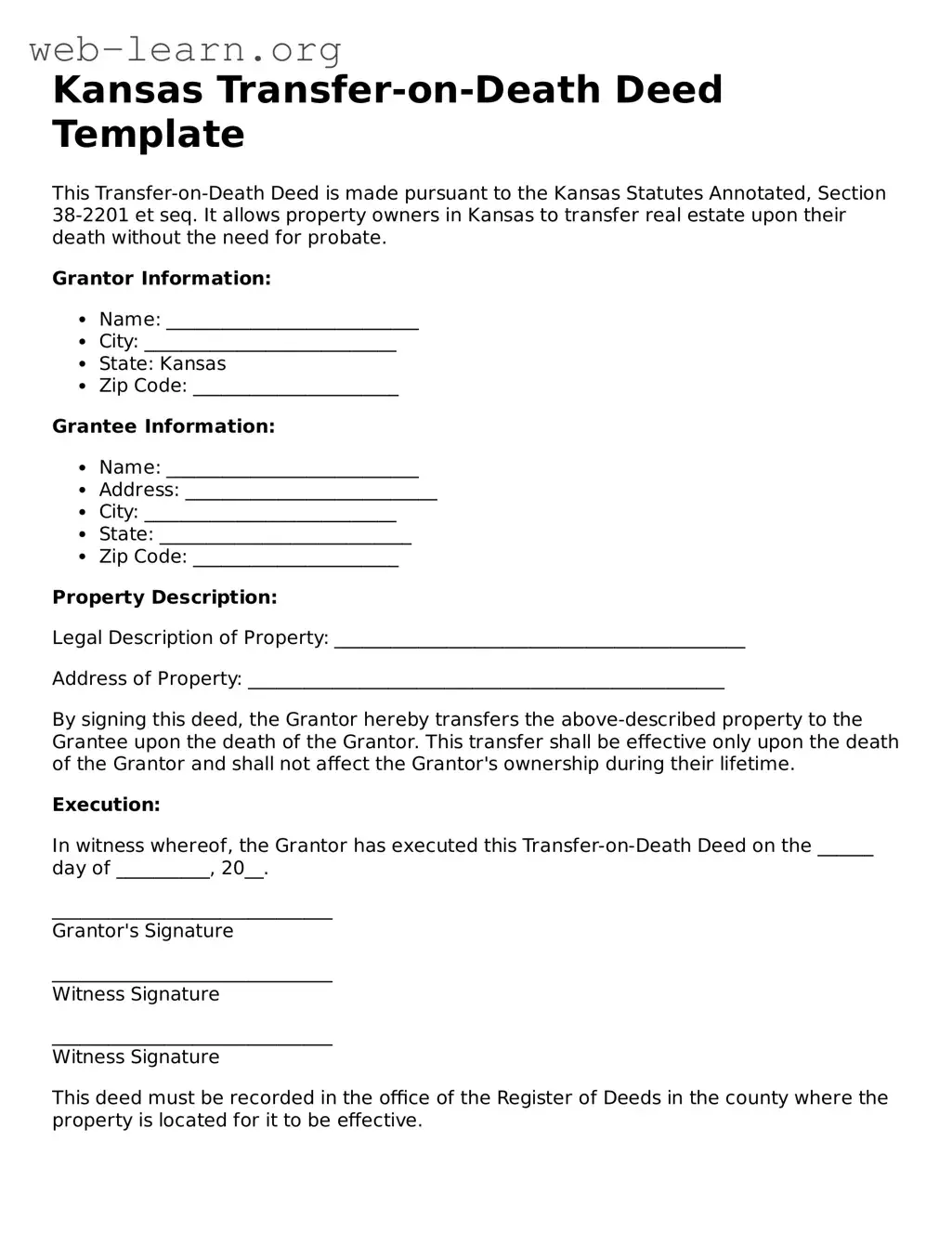
Kansas Transfer-on-Death Deed Template
This Transfer-on-Death Deed is made pursuant to the Kansas Statutes Annotated, Section 38-2201 et seq. It allows property owners in Kansas to transfer real estate upon their death without the need for probate.
Grantor Information:
Grantee Information:
Property Description:
Legal Description of Property: ____________________________________________
Address of Property: ___________________________________________________
By signing this deed, the Grantor hereby transfers the above-described property to the Grantee upon the death of the Grantor. This transfer shall be effective only upon the death of the Grantor and shall not affect the Grantor's ownership during their lifetime.
Execution:
In witness whereof, the Grantor has executed this Transfer-on-Death Deed on the ______ day of __________, 20__.
______________________________
Grantor's Signature
______________________________
Witness Signature
______________________________
Witness Signature
This deed must be recorded in the office of the Register of Deeds in the county where the property is located for it to be effective.
| Fact Name | Details |
|---|---|
| Definition | A Transfer-on-Death Deed allows property owners to transfer real estate to beneficiaries upon their death without going through probate. |
| Governing Law | The Kansas Transfer-on-Death Deed is governed by K.S.A. 58-6a101 et seq. |
| Eligibility | Any individual who holds title to real estate in Kansas can create a Transfer-on-Death Deed. |
| Execution Requirements | The deed must be signed by the property owner and notarized to be valid. |
| Revocation | Property owners can revoke the deed at any time before their death by executing a new deed or a written revocation. |
| Beneficiary Designation | Multiple beneficiaries can be named, and the owner can specify the share each beneficiary will receive. |
| Filing Requirement | The deed must be recorded with the county register of deeds in the county where the property is located. |
| Tax Implications | Transfer-on-Death Deeds do not trigger gift taxes, and the property receives a step-up in basis upon the owner's death. |
Once you have the Kansas Transfer-on-Death Deed form ready, it’s time to fill it out carefully. This document allows you to designate a beneficiary who will receive your property upon your passing, without going through probate. Follow the steps below to complete the form accurately.
After submitting the form, keep a copy for your records. It’s also wise to inform your beneficiaries about the deed and its implications, ensuring everyone is on the same page regarding your wishes.
What is a Transfer-on-Death Deed in Kansas?
A Transfer-on-Death Deed (TOD Deed) is a legal document that allows a property owner to transfer their real estate to a beneficiary upon their death. This deed allows the property to bypass probate, simplifying the transfer process for the heirs.
Who can use a Transfer-on-Death Deed?
Any individual who owns real estate in Kansas can use a Transfer-on-Death Deed. This includes homeowners, landowners, and those with a life estate in the property. However, the property must be solely owned by the person creating the deed.
How do I create a Transfer-on-Death Deed?
To create a TOD Deed, you must fill out the form with the required information, including your name, the name of the beneficiary, and a legal description of the property. After completing the form, you must sign it in front of a notary public and then file it with the appropriate county office.
Can I change or revoke a Transfer-on-Death Deed?
Yes, you can change or revoke a TOD Deed at any time during your lifetime. To do this, you must create a new deed that either names a different beneficiary or states that the previous deed is revoked. This new deed must also be signed, notarized, and filed with the county.
What happens if the beneficiary dies before me?
If the beneficiary named in your Transfer-on-Death Deed passes away before you, the deed will become ineffective. You may need to create a new deed to name a different beneficiary or address the situation according to your estate plan.
Is there a fee to file a Transfer-on-Death Deed?
Yes, there is typically a fee associated with filing a Transfer-on-Death Deed. The amount may vary by county, so it’s advisable to check with your local county clerk's office for specific details regarding fees.
Will I still have control over my property after creating a Transfer-on-Death Deed?
Absolutely. As the property owner, you retain full control over the property during your lifetime. You can sell, lease, or mortgage the property without any restrictions imposed by the TOD Deed.
Can a Transfer-on-Death Deed be contested?
Yes, like any legal document, a Transfer-on-Death Deed can be contested. This could happen if someone believes the deed was created under duress, fraud, or if the person creating the deed lacked the mental capacity to do so.
Do I need an attorney to create a Transfer-on-Death Deed?
While it is not legally required to have an attorney to create a Transfer-on-Death Deed, consulting one can be beneficial. An attorney can help ensure that the deed is filled out correctly and complies with all legal requirements, reducing the risk of complications in the future.
What types of properties can be transferred using a Transfer-on-Death Deed?
A Transfer-on-Death Deed can be used for various types of real estate, including residential homes, commercial properties, and vacant land. However, it cannot be used for personal property, such as vehicles or bank accounts.
When completing the Kansas Transfer-on-Death Deed form, individuals often make several common mistakes that can lead to complications. One frequent error is failing to include the legal description of the property. This description must be precise and should match the information on the property’s title. Without it, the deed may not be valid.
Another mistake involves not properly identifying the beneficiaries. It is essential to provide the full names and addresses of all beneficiaries. Omitting this information can create confusion and may result in delays in transferring the property after the owner’s death.
Many people overlook the requirement for the deed to be signed in the presence of a notary public. A signature that is not notarized can render the deed ineffective. Ensuring that the signature is witnessed and notarized is crucial for the document's validity.
Additionally, individuals sometimes forget to record the Transfer-on-Death Deed with the appropriate county office. Even if the deed is completed correctly, failing to file it can lead to the property being transferred through probate, which the deed is intended to avoid.
Another common error is not checking for existing liens or encumbrances on the property. If there are outstanding debts or claims against the property, these issues must be addressed before the transfer can take place. Ignoring these can complicate the transfer process.
Some individuals do not update their Transfer-on-Death Deed after significant life events, such as marriage, divorce, or the birth of a child. It is important to review and revise the deed to reflect current wishes and relationships.
Using vague language when describing the transfer can also lead to problems. The deed should clearly state the intent to transfer the property upon death. Ambiguous terms may lead to misinterpretation and disputes among beneficiaries.
Another mistake is failing to understand the implications of the deed regarding tax liabilities. The transfer of property may have tax consequences that need to be considered. Consulting with a tax professional can provide clarity on this matter.
Lastly, individuals sometimes rush through the process without fully understanding the form. Taking the time to read and comprehend each section can prevent errors that may arise from haste. A thorough review is essential for a successful transfer.
The Kansas Transfer-on-Death Deed form is an important document for transferring property upon death without going through probate. However, there are several other forms and documents that are often used in conjunction with it. Below is a list of these documents, along with a brief description of each.
Understanding these documents can help ensure a smooth transition of assets and make the process easier for loved ones. Each document serves a unique purpose and can be crucial in estate planning.
When filling out the Kansas Transfer-on-Death Deed form, it is essential to follow specific guidelines to ensure the document is valid and effective. Below are some recommendations on what to do and what to avoid.
Understanding the Kansas Transfer-on-Death Deed can be confusing. Here are six common misconceptions about this form, along with clarifications to help you navigate the process.
By clearing up these misconceptions, you can make more informed decisions about using the Kansas Transfer-on-Death Deed to manage your estate planning needs.
Filling out and using the Kansas Transfer-on-Death Deed form can be a straightforward process if you keep a few key points in mind. Here are some important takeaways to help you navigate this form effectively:
By keeping these points in mind, you can confidently fill out and utilize the Kansas Transfer-on-Death Deed form to secure your property for your loved ones.
Does a Beneficiary Deed Avoid Probate - It’s a proactive approach to estate planning that can prevent potential family conflicts.
Where Can I Get a Tod Form - It is a legal document that must meet specific requirements to be valid.
Beneficiary Deed Colorado - It is important to keep a copy of the deed in a safe place for reference.