Homepage Attorney-Approved Tractor Bill of Sale Document for the State of Kansas
Table of Contents

When buying or selling a tractor in Kansas, having a well-drafted bill of sale is essential for both parties involved. This document serves as a legal record of the transaction, providing crucial details that protect the interests of the buyer and the seller. A Kansas Tractor Bill of Sale typically includes information such as the names and addresses of both the buyer and seller, a description of the tractor including its make, model, and identification number, as well as the purchase price and the date of sale. Additionally, it may outline any warranties or conditions related to the sale, ensuring that both parties are clear on their rights and responsibilities. By documenting the transaction properly, the bill of sale can help prevent misunderstandings and disputes in the future, making it a vital component of any tractor sale in the state.

Sample - Kansas Tractor Bill of Sale Form

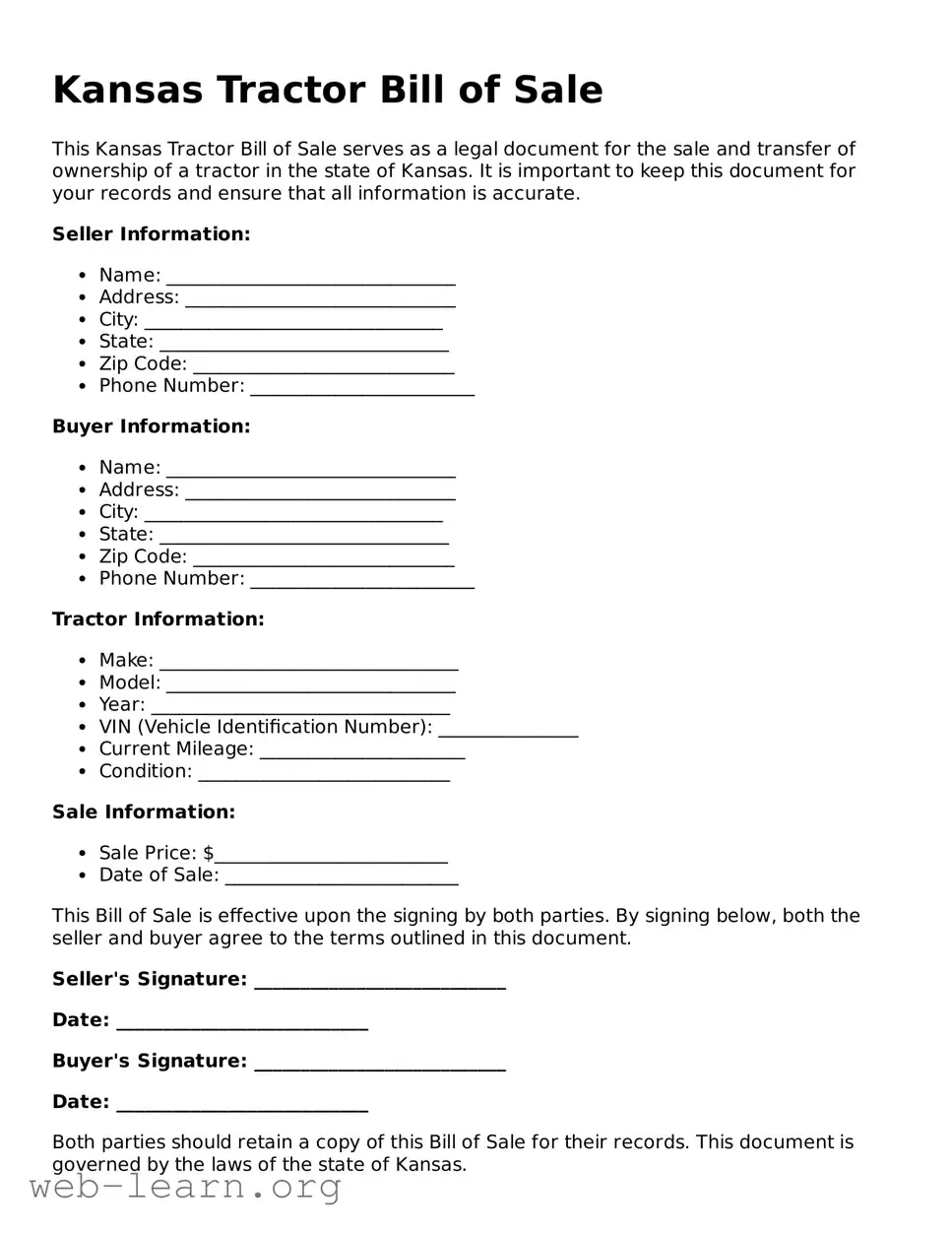
Kansas Tractor Bill of Sale

This Kansas Tractor Bill of Sale serves as a legal document for the sale and transfer of ownership of a tractor in the state of Kansas. It is important to keep this document for your records and ensure that all information is accurate.

Seller Information:

  • Name: _______________________________
  • Address: _____________________________
  • City: ________________________________
  • State: _______________________________
  • Zip Code: ____________________________
  • Phone Number: ________________________

Buyer Information:

  • Name: _______________________________
  • Address: _____________________________
  • City: ________________________________
  • State: _______________________________
  • Zip Code: ____________________________
  • Phone Number: ________________________

Tractor Information:

  • Make: ________________________________
  • Model: _______________________________
  • Year: ________________________________
  • VIN (Vehicle Identification Number): _______________
  • Current Mileage: ______________________
  • Condition: ___________________________

Sale Information:

  • Sale Price: $_________________________
  • Date of Sale: _________________________

This Bill of Sale is effective upon the signing by both parties. By signing below, both the seller and buyer agree to the terms outlined in this document.

Seller's Signature: ___________________________

Date: ___________________________

Buyer's Signature: ___________________________

Date: ___________________________

Both parties should retain a copy of this Bill of Sale for their records. This document is governed by the laws of the state of Kansas.

File Characteristics

Fact Name Description
Purpose The Kansas Tractor Bill of Sale form is used to document the sale of a tractor between a buyer and a seller.
Governing Law This form is governed by the Kansas Statutes Annotated, specifically under Title 8, Chapter 240.
Required Information Essential details include the buyer's and seller's names, addresses, and the tractor's make, model, and VIN.
Notarization While notarization is not mandatory, it is recommended for added legal protection and to verify identities.
Transfer of Ownership The bill of sale serves as proof of ownership transfer once both parties sign the document.
Record Keeping Both the buyer and seller should keep a copy of the signed bill of sale for their records.

Detailed Guide for Filling Out Kansas Tractor Bill of Sale

Once you have the Kansas Tractor Bill of Sale form in hand, you will need to complete it accurately to ensure a smooth transaction. After filling out the form, both the buyer and seller should keep a copy for their records.

  1. Begin by entering the date of the sale at the top of the form.
  2. Provide the full name and address of the seller in the designated fields.
  3. Enter the full name and address of the buyer in the appropriate section.
  4. Fill in the details of the tractor, including the make, model, year, and Vehicle Identification Number (VIN).
  5. Indicate the sale price of the tractor clearly.
  6. Include any additional terms of the sale, if applicable, in the specified area.
  7. Both the seller and buyer should sign and date the form at the bottom.

Obtain Answers on Kansas Tractor Bill of Sale

  1. What is a Kansas Tractor Bill of Sale?

    A Kansas Tractor Bill of Sale is a legal document that records the sale and transfer of ownership of a tractor between a seller and a buyer. This form serves as proof of the transaction and includes important details such as the tractor's make, model, year, and Vehicle Identification Number (VIN).

  2. Why is a Bill of Sale important?

    This document is crucial for several reasons:

    • It provides a record of the transaction, protecting both the buyer and the seller.
    • It helps establish legal ownership, which is particularly important for registration and insurance purposes.
    • In case of disputes, a Bill of Sale can serve as evidence in court.
  3. What information is required on the form?

    The Kansas Tractor Bill of Sale should include:

    • The names and addresses of both the buyer and seller.
    • The date of the sale.
    • A detailed description of the tractor, including make, model, year, and VIN.
    • The purchase price.
    • Any warranties or conditions of the sale.
  4. Is the Bill of Sale required for all tractor sales in Kansas?

    While it's not legally required to have a Bill of Sale for every tractor transaction, it is highly recommended. Having this document helps ensure clarity and protects the interests of both parties involved.

  5. Can I create my own Bill of Sale?

    Yes, you can create your own Bill of Sale as long as it contains all the necessary information. However, using a standardized form can simplify the process and ensure that you don’t miss any critical details.

  6. What should I do after completing the Bill of Sale?

    Once the Bill of Sale is completed and signed by both parties, make sure to keep a copy for your records. The buyer should also retain a copy for future reference, especially for registration or insurance purposes.

  7. Where can I obtain a Kansas Tractor Bill of Sale form?

    You can find a Kansas Tractor Bill of Sale form online through various legal and governmental websites. Additionally, local offices that deal with vehicle registration may also provide copies of the form.

Common mistakes

Filling out the Kansas Tractor Bill of Sale form can seem straightforward, but many individuals make common mistakes that can lead to complications. One frequent error is failing to provide accurate information about the tractor itself. Buyers and sellers should ensure that the make, model, year, and Vehicle Identification Number (VIN) are all correct. Any discrepancies can cause issues when registering the vehicle or transferring ownership.

Another mistake often seen is neglecting to include the sale price. This detail is crucial for both parties. The sale price not only establishes the value of the transaction but also may be necessary for tax purposes. Omitting this information can lead to misunderstandings or legal challenges down the line.

Many people also overlook the importance of signatures. Both the buyer and the seller must sign the form to validate the transaction. If one party forgets to sign, the document may be considered incomplete. This can complicate the transfer of ownership and create potential disputes between the parties involved.

Finally, individuals sometimes fail to make copies of the completed form. Keeping a copy for personal records is essential. This document serves as proof of the transaction and can be useful if any issues arise later. Without a copy, resolving disputes or verifying details can become more challenging.

Documents used along the form

When engaging in the sale or transfer of a tractor in Kansas, several important documents accompany the Kansas Tractor Bill of Sale. Each of these documents plays a crucial role in ensuring that the transaction is legally binding and properly recorded. Below is a list of commonly used forms that may be needed alongside the bill of sale.

  • Title Transfer Document: This document officially transfers ownership of the tractor from the seller to the buyer. It must be completed and submitted to the Kansas Department of Revenue to register the new owner.
  • Affidavit of Ownership: If the seller cannot provide a title, this affidavit serves as a sworn statement declaring ownership of the tractor. It provides a means to establish legitimacy in the absence of a traditional title.
  • Sales Tax Exemption Certificate: Buyers may use this certificate to claim an exemption from sales tax if the tractor qualifies under specific circumstances. This document must be filled out and presented at the time of sale.
  • Odometer Disclosure Statement: For certain vehicles, including tractors, this statement records the vehicle's mileage at the time of sale. It is important for ensuring transparency and preventing fraud in the transaction.

In summary, these accompanying documents are essential for a smooth and legally compliant transaction when selling or purchasing a tractor in Kansas. Proper attention to detail in completing these forms can help prevent future disputes and ensure that both parties are protected under the law.

Similar forms

  • Vehicle Bill of Sale: Similar to the Tractor Bill of Sale, this document transfers ownership of a motor vehicle. It includes details like the vehicle's make, model, and VIN, ensuring both parties have a clear record of the transaction.
  • Boat Bill of Sale: This document serves the same purpose for boats as the Tractor Bill of Sale does for tractors. It outlines the specifics of the boat, including its registration number and hull identification number, facilitating a smooth transfer of ownership.
  • Motorcycle Bill of Sale: Like the Tractor Bill of Sale, this form is used to document the sale of a motorcycle. It includes essential information such as the motorcycle's make, model, and VIN, protecting both the buyer and seller.
  • ATV Bill of Sale: This document is tailored for all-terrain vehicles. It includes details about the ATV, ensuring a legal transfer of ownership similar to that of a tractor.
  • Equipment Bill of Sale: This form applies to various types of equipment, including agricultural machinery. It specifies the equipment being sold and helps protect the interests of both parties involved in the transaction.
  • Real Estate Bill of Sale: While primarily used for property, this document can also include personal property such as tractors or equipment sold with real estate. It ensures that all items are accounted for during the sale.
  • Mobile Home Bill of Sale: This document is used for the sale of mobile homes, detailing the specifics of the home and ensuring that ownership is properly transferred, much like with a tractor.
  • Trailer Bill of Sale: This form is similar in function to the Tractor Bill of Sale, as it documents the sale of a trailer. It includes necessary details to ensure a clear transfer of ownership.
  • Livestock Bill of Sale: This document is used to transfer ownership of livestock. It provides details about the animals being sold, similar to how the Tractor Bill of Sale outlines the specifics of the tractor.

Dos and Don'ts

When filling out the Kansas Tractor Bill of Sale form, attention to detail is crucial. Here are five things you should and shouldn't do to ensure a smooth process.

  • Do provide accurate information about the tractor, including make, model, and VIN.
  • Do include the sale price clearly to avoid any misunderstandings.
  • Do sign and date the form to validate the transaction.
  • Don't leave any sections blank; incomplete forms can lead to delays.
  • Don't forget to keep a copy of the completed bill of sale for your records.

Misconceptions

When it comes to the Kansas Tractor Bill of Sale form, there are several misconceptions that can lead to confusion. Let's clear up some of these misunderstandings.

  • It’s only necessary for new tractors. Many people believe that a bill of sale is only needed when buying a brand-new tractor. In reality, whether the tractor is new or used, a bill of sale is essential for documenting the transaction.
  • A bill of sale is not legally binding. Some think that a bill of sale is just a casual agreement and holds no legal weight. In Kansas, a properly completed bill of sale is a legal document that can protect both the buyer and seller.
  • It’s not required for private sales. There’s a common belief that you don’t need a bill of sale for private transactions. However, having one is highly recommended, as it provides proof of the sale and can help resolve disputes.
  • Only the seller needs to sign it. Many assume that only the seller's signature is necessary. In fact, both the buyer and seller should sign the bill of sale to validate the transaction.
  • It doesn’t need to include specific details. Some think that a simple statement of sale is enough. In truth, the bill of sale should include detailed information about the tractor, such as the make, model, year, and VIN, to ensure clarity.
  • Once signed, it can’t be changed. There’s a misconception that once the bill of sale is signed, it’s set in stone. If both parties agree, they can amend the document, but it’s best to do so before signing.
  • It’s not necessary for tax purposes. Some individuals believe that a bill of sale has no relevance for taxes. However, it can be useful for tax records and may be required when registering the tractor.

Understanding these misconceptions can help you navigate the process of buying or selling a tractor in Kansas more effectively. Always consider consulting a legal professional if you have questions about your specific situation.

Key takeaways

When filling out and using the Kansas Tractor Bill of Sale form, several key points are important to consider. These takeaways can help ensure a smooth transaction.

  • Complete Information: Ensure all fields on the form are filled out accurately. This includes the names and addresses of both the buyer and seller, as well as details about the tractor.
  • Vehicle Identification: Include the tractor's Vehicle Identification Number (VIN) and any other identifying features. This information helps confirm the specific tractor being sold.
  • Purchase Price: Clearly state the purchase price of the tractor. This information is crucial for both parties and may be needed for tax purposes.
  • Signatures: Both the buyer and seller must sign the form. Signatures validate the transaction and indicate that both parties agree to the terms.
  • Keep Copies: After completing the form, both parties should keep a copy. This serves as a record of the transaction and can be useful in case of future disputes.
  • Check State Requirements: Verify any specific requirements that Kansas may have regarding the sale of tractors. Compliance with state laws is essential for a valid sale.

Understanding these key points can facilitate a successful sale and protect the interests of both the buyer and seller.