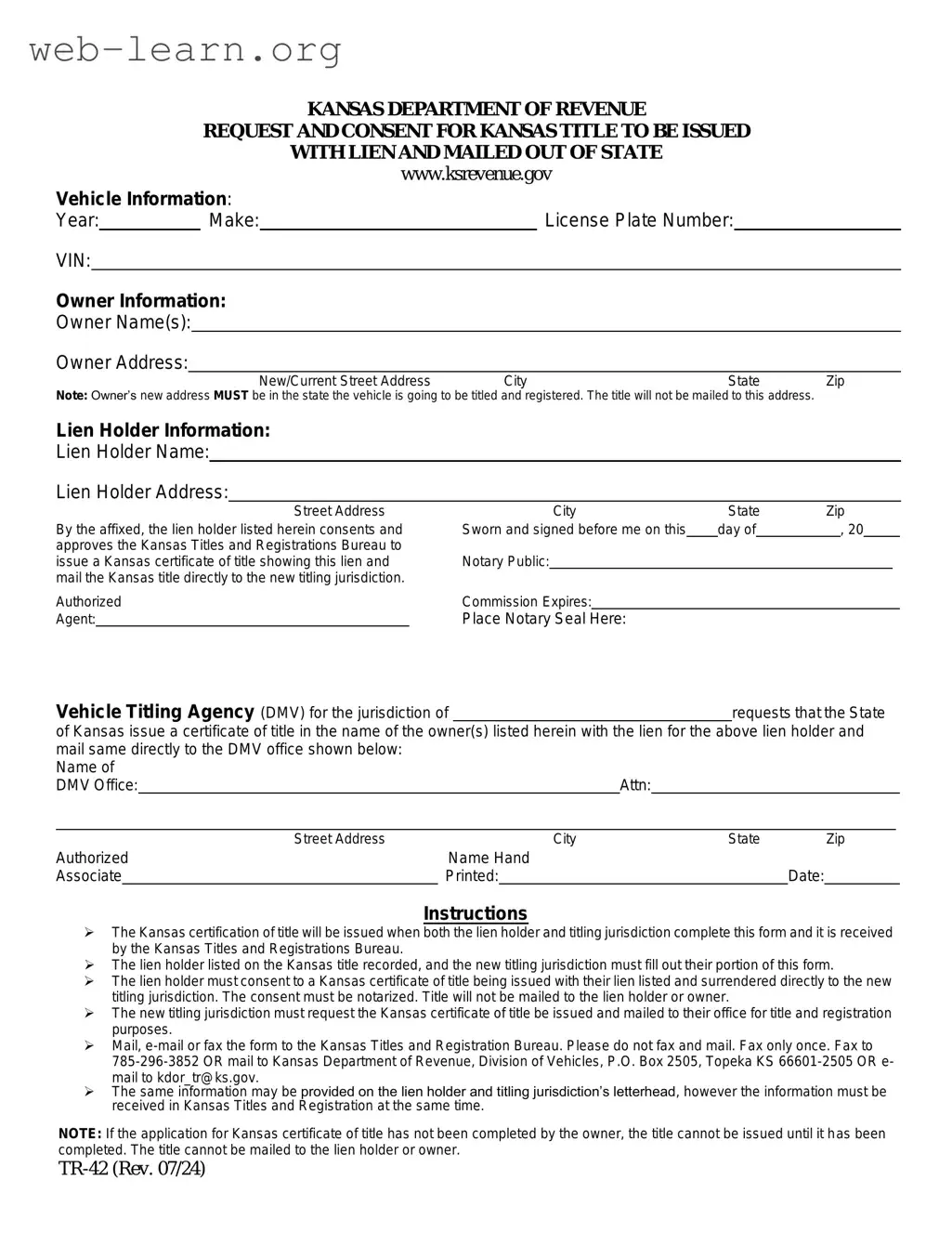
The Kansas Tr 42 form is an essential document used when a vehicle's title needs to be issued with a lien and sent to a jurisdiction outside of Kansas. This form facilitates the process by ensuring that both the lien holder and the new titling jurisdiction provide their necessary information and consent. It is crucial that the lien holder agrees to have the Kansas certificate of title issued with their lien listed and that this consent is notarized. The title cannot be sent to the lien holder or the vehicle owner; instead, it will be mailed directly to the new titling agency. To initiate this process, the completed form must be sent either by mail or fax to the Kansas Titles and Registrations Bureau, but not both. Vehicle owners must also ensure that their new address is outside of Kansas for the title to be processed correctly. The form includes sections for vehicle information, owner details, and lien holder consent, making it a comprehensive tool for vehicle titling across state lines.

KANSAS DEPARTMENT OF REVENUE
REQUEST AND CONSENT FOR KANSAS TITLE TO BE ISSUED
WITH LIEN AND MAILED OUT OF STATE
www.ksrevenue.gov
Vehicle Information: |
|
|
Year: |
Make: |
License Plate Number: |
VIN:
Owner Information:
Owner Name(s):
Owner Address:
New/Current Street Address |
City |
State |
Zip |
Note: Owner’s new address MUST be in the state the vehicle is going to be titled and registered. The title will not be mailed to this address.
Lien Holder Information:
Lien Holder Name:
Lien Holder Address:
|
Street Address |
|
City |
|
State |
Zip |
|||||
By the affixed, the lien holder listed herein consents and |
Sworn and signed before me on this |
|
day of |
, 20 |
|
||||||
approves the Kansas Titles and Registrations Bureau to |
|
|
|
|
|
|
|
|
|
|
|
issue a Kansas certificate of title showing this lien and |
Notary Public: |
|
|
|
|
|
|
|
|||
mail the Kansas title directly to the new titling jurisdiction. |
|
|
|
|
|
|
|
|
|
|
|
Authorized |
Commission Expires: |
|
|
|
|
|
|
|
|
||
Agent: |
|
Place Notary Seal Here: |
|
|
|
|
|
|
|
||
Vehicle Titling Agency (DMV) for the jurisdiction ofrequests that the State
of Kansas issue a certificate of title in the name of the owner(s) listed herein with the lien for the above lien holder and
mail same directly to the DMV office shown below: |
|
|
|
|
|
|
|
||
Name of |
|
|
|
|
|
|
|
||
DMV Office: |
|
|
Attn: |
|
|
|
|||
|
|
|
|
|
|
|
|
|
|
|
|
Street Address |
|
City |
|
State |
|
Zip |
|
Authorized |
Name Hand |
|
|
|
|
|
|||
Associate |
|
Printed: |
|
|
|
Date: |
|||
|
|
|
|
|
|
|
|
|
|
Instructions
➢The Kansas certification of title will be issued when both the lien holder and titling jurisdiction complete this form and it is received by the Kansas Titles and Registrations Bureau.
➢The lien holder listed on the Kansas title recorded, and the new titling jurisdiction must fill out their portion of this form.
➢The lien holder must consent to a Kansas certificate of title being issued with their lien listed and surrendered directly to the new titling jurisdiction. The consent must be notarized. Title will not be mailed to the lien holder or owner.
➢The new titling jurisdiction must request the Kansas certificate of title be issued and mailed to their office for title and registration purposes.
➢Mail,
➢The same information may be provided on the lien holder and titling jurisdiction’s letterhead, however the information must be received in Kansas Titles and Registration at the same time.
NOTE: If the application for Kansas certificate of title has not been completed by the owner, the title cannot be issued until it has been completed. The title cannot be mailed to the lien holder or owner.
| Fact Name | Description |
|---|---|
| Form Purpose | The Kansas TR 42 form is used to request a title for a vehicle with a lien to be issued and mailed to a jurisdiction outside of Kansas. |
| Notarization Requirement | The lien holder's consent must be notarized for the title to be issued, ensuring the authorization is valid. |
| Mailing Instructions | The completed form must be mailed or faxed to the Kansas Titles and Registrations Bureau, but not both. Only one method should be used. |
| Governing Law | This form is governed by Kansas state law regarding vehicle titling and registration. |
Follow these steps to complete the Kansas Tr 42 form accurately. Ensure that all required information is filled out correctly to avoid any delays in processing.
After submitting the form, monitor for any communications from the Kansas Titles and Registrations Bureau regarding the status of the title issuance. Ensure that the lien holder and the new titling jurisdiction have also submitted their required portions simultaneously to avoid processing delays.
What is the purpose of the Kansas TR 42 form?
The Kansas TR 42 form is used to request and consent for a Kansas title to be issued with a lien and mailed out of state. This form ensures that the title reflects the lien holder's interest in the vehicle while allowing the title to be sent directly to a new titling jurisdiction outside of Kansas.
Who needs to complete the Kansas TR 42 form?
Both the lien holder and the new titling jurisdiction must complete their respective sections of the form. The lien holder must consent to the issuance of a Kansas title that includes their lien, while the new titling jurisdiction must request that the title be mailed to their office for registration purposes.
What are the notarization requirements for the form?
The consent from the lien holder must be notarized. This means that a notary public must witness the signature of the lien holder and certify it. Without this notarization, the title cannot be issued.
How should the completed form be submitted?
The completed form can be submitted either by mail or fax, but not both. It should be sent to the Kansas Titles and Registrations Bureau. If faxing, ensure that it is sent only once to the designated fax number, 785-296-2383. If mailing, send it to the Kansas Department of Revenue at the specified address.
Can the title be mailed to the lien holder or vehicle owner?
No, the title will not be mailed to the lien holder or the vehicle owner. Instead, it will be sent directly to the new titling jurisdiction as specified in the form. This is a critical point to remember when completing the application.
What information is required on the form?
The form requires several pieces of information, including:
All this information must be accurate and complete for the form to be processed successfully.
Filling out the Kansas TR 42 form can be straightforward, but many people make common mistakes that can delay the process. One frequent error is failing to provide complete vehicle information. The form requires specific details such as the VIN, make, year, and license plate number. Omitting any of these can lead to a rejection of the application.
Another mistake is not ensuring that the owner’s new address is outside the state of Kansas. The instructions clearly state that the vehicle must be registered in another state. If the address provided is within Kansas, the application will not be processed.
People often forget to notarize the consent from the lien holder. This step is crucial, as the title cannot be issued without a notarized signature. Skipping this step can result in significant delays.
Some applicants mistakenly fax and mail the form simultaneously. The instructions specify that only one method should be used. This confusion can lead to processing issues, as the Kansas Titles and Registrations Bureau may receive duplicate requests.
Inaccurate or incomplete information from the lien holder is another common problem. The lien holder must complete their section of the form accurately. Any discrepancies can cause complications in issuing the title.
Failing to include the authorized agent’s information can also be problematic. The form requires the name and address of the agent who is acting on behalf of the lien holder. Omitting this detail can lead to confusion regarding who is responsible for the title request.
Applicants sometimes overlook the need for the DMV office's details. The form must include the name and address of the DMV office where the title should be sent. Without this information, the application cannot be processed.
Another mistake involves not using the correct form version. Ensure that the latest version of the TR 42 form is being used, as outdated forms may not be accepted.
Many people also neglect to double-check their contact information. Providing an incorrect phone number or email address can hinder communication and delay the process if any issues arise.
Finally, some applicants fail to read the instructions thoroughly. Understanding the requirements and following them closely is essential for a smooth application process. Taking the time to review the instructions can prevent many of these common mistakes.
The Kansas Tr 42 form is essential for requesting and consenting to the issuance of a Kansas title with a lien that will be mailed out of state. In addition to this form, several other documents may be required to ensure a smooth titling process. Below is a list of commonly used forms and documents that often accompany the Kansas Tr 42.
Having these documents ready can facilitate a more efficient process when dealing with vehicle titling in Kansas. It is always a good idea to check with the relevant authorities to confirm any additional requirements specific to your situation.
The Kansas Tr 42 form serves a specific purpose in the vehicle titling process, particularly concerning the issuance of titles with liens. Several other documents share similarities with this form in terms of their function and requirements. Here are four such documents:
When filling out the Kansas TR-42 form, attention to detail is crucial. This form is essential for ensuring that a vehicle title is issued correctly, especially when a lien is involved. Here are five important do's and don'ts to keep in mind:
Completing the Kansas TR-42 form accurately and promptly is essential for a smooth title transfer process. Follow these guidelines to ensure compliance and avoid unnecessary complications.
Understanding the Kansas Tr 42 form is essential for those involved in vehicle titling and registration. However, several misconceptions often arise. Here are four common misunderstandings:
Clarifying these misconceptions can help ensure a smoother process for obtaining a Kansas title with a lien. Proper understanding of the requirements is crucial for all parties involved.
Key Takeaways for Using the Kansas TR 42 Form: