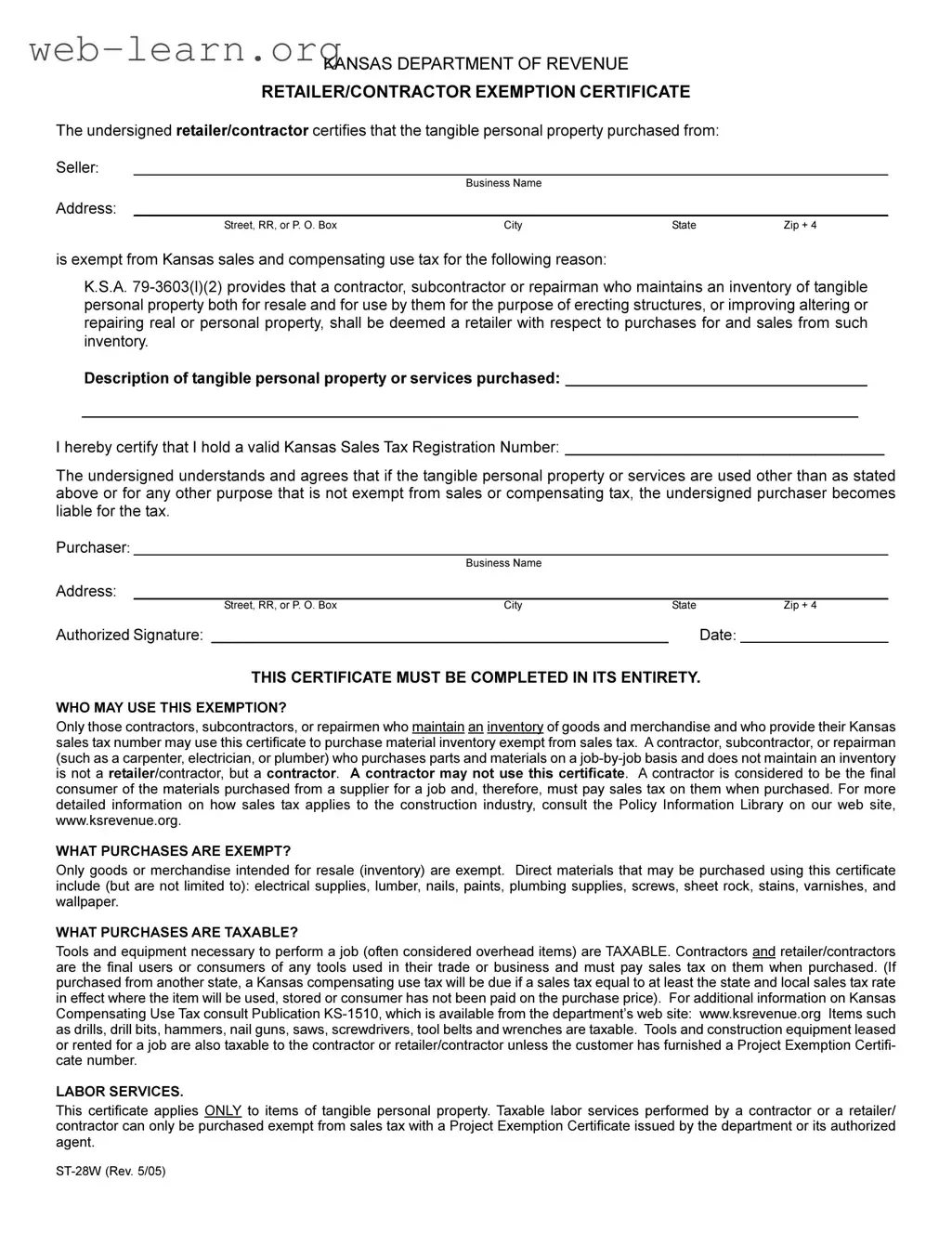
The Kansas St 28W form serves as a vital tool for contractors, subcontractors, and repairmen who maintain an inventory of tangible personal property. This form allows eligible businesses to purchase materials exempt from Kansas sales and compensating use tax, provided they meet certain criteria. To qualify, the business must hold a valid Kansas Sales Tax Registration Number and utilize the purchased items strictly for resale or specific exempt purposes. The form requires details about the seller and the tangible personal property being purchased. It’s important to note that only certain items, like electrical supplies and lumber, can be exempted under this certificate. Conversely, tools and equipment needed for job performance are taxable. Understanding these distinctions is crucial for anyone in the construction industry to avoid unexpected tax liabilities. Completing the Kansas St 28W form accurately ensures that businesses can take advantage of available tax exemptions while remaining compliant with state regulations.
KANSASDEPARTMENTOFREVENUE
RETAILER/CONTRACTOREXEMPTIONCERTIFICATE
Theundersignedretailer/contractorcertifiesthatthetangiblepersonalpropertypurchasedfrom:
Seller: |
_________________________________________________________________________________________________ |
|||
|
|
BusinessName |
|
|
Address: |
_________________________________________________________________________________________________ |
|||
|
Street,RR,orP.O.Box |
City |
State |
Zip+4 |
isexemptfromKansassalesandcompensatingusetaxforthefollowingreason:
K.S.A.
Descriptionoftangiblepersonalpropertyorservicespurchased: ___________________________________
__________________________________________________________________________________________
I hereby certify that I hold a valid Kansas SalesTaxRegistrationNumber: _____________________________________
The undersigned understands and agrees that if the tangible personal property or services are used other than as stated above or for any other purpose that is not exempt from sales or compensating tax, the undersigned purchaser becomes liable for the tax.
Purchaser:_________________________________________________________________________________________________
BusinessName
Address: _________________________________________________________________________________________________
Street,RR,orP.O.Box |
City |
State |
Zip+4 |
AuthorizedSignature: _____________________________________________________ |
|
Date: ___________________ |
|
THIS CERTIFICATE MUST BE COMPLETED IN ITS ENTIRETY.
WHOMAYUSE THISEXEMPTION?
Onlythosecontractors,subcontractors,orrepairmenwhomaintainaninventoryofgoodsandmerchandiseandwhoprovidetheirKansas salestaxnumbermayusethiscertificatetopurchasematerialinventoryexemptfromsalestax. Acontractor,subcontractor,orrepairman
WHATPURCHASESAREEXEMPT?
Only goods or merchandise intended for resale (inventory) are exempt. Direct materials that may be purchased using this certificate include (but are not limited to): electrical supplies, lumber, nails, paints, plumbing supplies, screws, sheet rock, stains, varnishes, and wallpaper.
WHATPURCHASESARETAXABLE?
Tools and equipment necessary to perform a job (often considered overhead items) are TAXABLE. Contractors and retailer/contractors are the final users or consumers of any tools used in their trade or business and must pay sales tax on them when purchased. (If purchasedfromanotherstate,aKansascompensatingusetaxwillbedueifasalestaxequaltoatleastthestateandlocalsalestaxrate ineffectwheretheitemwillbeused,storedorconsumerhasnotbeenpaidonthepurchaseprice). Foradditionalinformation onKansas
LABORSERVICES.
This certificate applies ONLY to items of tangible personal property. Taxable labor services performed by a contractor or a retailer/ contractor can only be purchased exempt from sales tax with a Project Exemption Certificate issued by the department or its authorized agent.
| Fact Name | Description |
|---|---|
| Form Title | Kansas Retailer/Contractor Exemption Certificate |
| Governing Law | K.S.A. 79-3603(l)(2) |
| Purpose | This form certifies that tangible personal property purchased is exempt from Kansas sales and compensating use tax. |
| Eligible Users | Only contractors, subcontractors, or repairmen maintaining an inventory of goods can use this certificate. |
| Exempt Purchases | Goods intended for resale, such as electrical supplies, lumber, and plumbing supplies, are exempt from sales tax. |
| Taxable Purchases | Tools and equipment used in the trade are taxable, including items like drills and saws. |
| Labor Services | This certificate applies only to tangible personal property. Taxable labor services require a Project Exemption Certificate. |
| Signature Requirement | The form must be signed by the purchaser to validate the exemption claim. |
| Registration Number | A valid Kansas Sales Tax Registration Number must be provided by the purchaser. |
| Consequences of Misuse | If the property is used for non-exempt purposes, the purchaser is liable for the tax. |
Filling out the Kansas St 28W form is an important step for contractors, subcontractors, and repairmen who maintain an inventory of tangible personal property. This form certifies that the items being purchased are exempt from Kansas sales and compensating use tax. Below are the steps to complete the form accurately.
Once the form is completed, it should be kept on file for your records. Ensure that it is presented to the seller at the time of purchase to confirm the tax exemption status.
What is the Kansas St 28W form?
The Kansas St 28W form is a Retailer/Contractor Exemption Certificate that allows qualified contractors, subcontractors, or repairmen to purchase tangible personal property exempt from Kansas sales and compensating use tax. This form certifies that the purchased items are intended for resale or for use in the construction, alteration, or repair of real or personal property.
Who is eligible to use the Kansas St 28W form?
Eligibility is limited to contractors, subcontractors, or repairmen who maintain an inventory of goods and merchandise. These individuals must also provide their Kansas sales tax registration number. If a contractor purchases materials on a job-by-job basis without maintaining an inventory, they cannot use this certificate and are considered the final consumer of the materials.
What types of purchases are exempt under this certificate?
Exempt purchases include tangible personal property intended for resale or as inventory. Examples of exempt items are:
What purchases are considered taxable?
Taxable purchases include tools and equipment necessary for performing jobs. These items are not eligible for exemption under the Kansas St 28W form. Contractors and retailer/contractors are the final users of tools and must pay sales tax on them at the time of purchase. Common taxable items include:
Are labor services exempt from sales tax under this certificate?
No, labor services are not covered by the Kansas St 28W form. This certificate applies only to tangible personal property. To purchase labor services exempt from sales tax, a Project Exemption Certificate issued by the Kansas Department of Revenue or its authorized agent must be obtained.
What happens if the purchased items are used for a non-exempt purpose?
If the tangible personal property or services are used in a manner not consistent with the exemption, the purchaser becomes liable for the sales tax. It is essential for the undersigned to understand the terms of the exemption and use the property accordingly to avoid incurring tax liabilities.
Filling out the Kansas St 28W form can be straightforward, but many people make common mistakes that can lead to issues down the line. One of the most frequent errors is failing to provide the seller's complete information. The form requires the seller's business name, address, and contact details. Omitting any of this information can invalidate the exemption.
Another common mistake involves misunderstanding the eligibility criteria for using the exemption certificate. Only contractors, subcontractors, or repairmen who maintain an inventory of goods can use this form. Those who purchase materials on a job-by-job basis do not qualify. Misclassifying oneself can lead to unexpected tax liabilities.
People often neglect to fill out the description of the tangible personal property or services purchased. This section must be completed accurately, as it specifies what items are exempt. Leaving this blank or providing vague descriptions can result in confusion and potential disputes with tax authorities.
Many individuals also forget to include their Kansas Sales Tax Registration Number. This number is crucial for validating the exemption. Without it, the form may be considered incomplete, and the exemption may not be honored.
Another mistake involves misunderstanding what purchases are exempt. Some people mistakenly believe that all materials used in construction are exempt. However, tools and equipment are generally taxable. This misconception can lead to significant financial repercussions if taxes are owed later.
In addition, failing to sign and date the form is a common oversight. The authorized signature is a declaration of understanding the terms and conditions of the exemption. Without a signature and date, the form lacks validity and may be rejected.
Another area where errors occur is in the understanding of labor services. Many people think that all labor costs can be exempted with this certificate. However, only certain tangible personal property qualifies. Taxable labor services require a different type of exemption certificate.
Finally, not reading the instructions thoroughly can lead to multiple mistakes. The Kansas Department of Revenue provides specific guidelines on how to complete the form correctly. Skipping this step can result in incomplete or incorrect submissions.
The Kansas St 28W form is a Retailer/Contractor Exemption Certificate used by contractors, subcontractors, or repairmen to purchase tangible personal property exempt from sales tax. However, several other forms and documents are often utilized in conjunction with this certificate to ensure compliance with Kansas tax laws. Here’s a brief overview of some of these related documents.
Understanding these forms and documents is essential for contractors and businesses operating in Kansas. By using the appropriate certificates and applications, they can ensure compliance while maximizing their tax benefits. Proper documentation helps avoid misunderstandings with tax authorities and streamlines the purchasing process.
The Kansas St 28W form serves as a Retailer/Contractor Exemption Certificate, allowing certain contractors to purchase materials without paying sales tax. Several other documents share similarities with this form, each serving specific purposes related to tax exemptions and purchases. Here’s a breakdown of seven documents that are comparable to the Kansas St 28W form:
Understanding these documents can help businesses navigate the complexities of tax exemptions and ensure compliance with state regulations.
When filling out the Kansas ST-28W form, there are important guidelines to follow. Here are four things you should and shouldn't do:
Misconceptions about the Kansas St 28W form can lead to confusion regarding tax exemptions for contractors and retailers. Here are seven common misunderstandings:
Understanding these misconceptions can help contractors and retailers navigate their tax obligations more effectively, ensuring compliance with Kansas tax laws.
When filling out and using the Kansas ST 28W form, keep these key points in mind:
By keeping these takeaways in mind, you can effectively navigate the process of using the Kansas ST 28W form for your business needs.