In Kansas, settling the estate of a deceased individual can be streamlined through the use of the Small Estate Affidavit form, a practical tool designed for estates that fall below a certain value threshold. This form allows heirs to bypass the lengthy and often costly probate process, enabling them to claim assets directly. To qualify, the total value of the estate must not exceed $40,000, excluding real estate. The affidavit must be completed and signed by the heirs, affirming their relationship to the deceased and their entitlement to the assets. It is essential to gather necessary documentation, such as the death certificate and a list of assets, to support the claims made in the affidavit. Properly filing this form can expedite the transfer of assets, providing heirs with timely access to their inheritance while minimizing legal complexities.
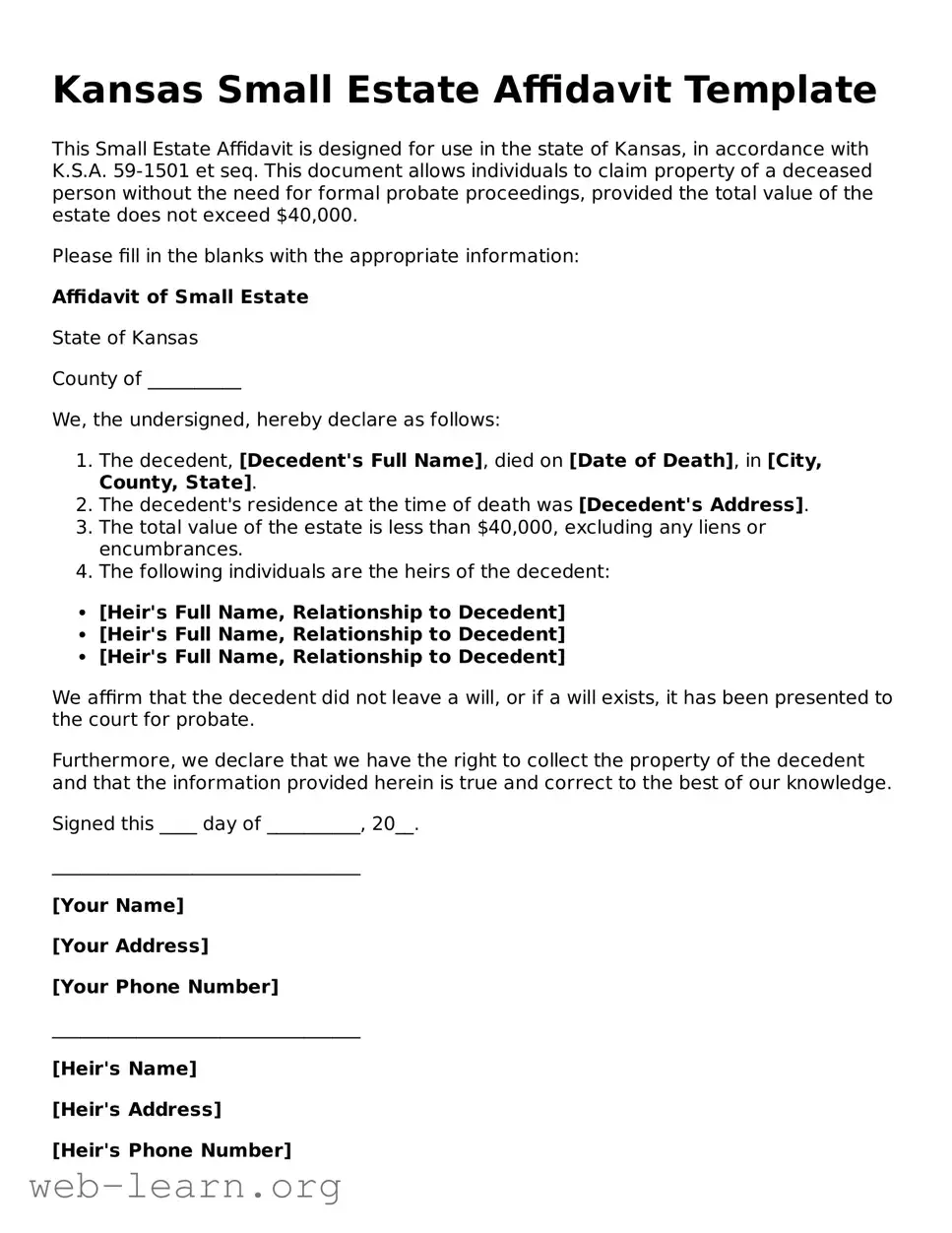
Kansas Small Estate Affidavit Template
This Small Estate Affidavit is designed for use in the state of Kansas, in accordance with K.S.A. 59-1501 et seq. This document allows individuals to claim property of a deceased person without the need for formal probate proceedings, provided the total value of the estate does not exceed $40,000.
Please fill in the blanks with the appropriate information:
Affidavit of Small Estate
State of Kansas
County of __________
We, the undersigned, hereby declare as follows:
We affirm that the decedent did not leave a will, or if a will exists, it has been presented to the court for probate.
Furthermore, we declare that we have the right to collect the property of the decedent and that the information provided herein is true and correct to the best of our knowledge.
Signed this ____ day of __________, 20__.
_________________________________
[Your Name]
[Your Address]
[Your Phone Number]
_________________________________
[Heir's Name]
[Heir's Address]
[Heir's Phone Number]
Notarization:
State of Kansas
County of __________
Subscribed and sworn to before me this ____ day of __________, 20__.
_________________________________
Notary Public
My commission expires: __________
| Fact Name | Description |
|---|---|
| Purpose | The Kansas Small Estate Affidavit allows heirs to claim assets of a deceased person without going through the full probate process. |
| Eligibility | This form can be used when the total value of the estate is $40,000 or less for individuals or $100,000 or less for a couple. |
| Governing Law | The Kansas Small Estate Affidavit is governed by Kansas Statutes Annotated (K.S.A.) 59-1501 through 59-1506. |
| Required Information | The affidavit must include details about the deceased, the heirs, and a list of the assets being claimed. |
| Filing Process | The completed affidavit must be filed with the appropriate county court to initiate the transfer of assets. |
| Signature Requirement | The affidavit must be signed by the affiant, who is typically an heir or a designated representative of the estate. |
| Notarization | The affidavit needs to be notarized to confirm the identity of the signer and the authenticity of the document. |
| Limitations | This form cannot be used for real estate or certain types of property, such as vehicles, which may require different procedures. |
Filling out the Kansas Small Estate Affidavit form is an important step for individuals managing a small estate. After completing the form, you will need to file it with the appropriate court to proceed with the estate settlement process.
What is a Kansas Small Estate Affidavit?
The Kansas Small Estate Affidavit is a legal document that allows individuals to settle the estate of a deceased person without going through the full probate process. This form is typically used when the value of the estate is below a certain threshold, which is currently set at $40,000 for individuals and $100,000 for married couples.
Who can use the Small Estate Affidavit?
Any person who is entitled to inherit from the deceased can use the Small Estate Affidavit. This includes heirs such as children, spouses, or other relatives. It’s important that the total value of the estate meets the criteria for a small estate.
What assets can be included in the Small Estate Affidavit?
Generally, you can include personal property, bank accounts, and other assets that belong to the deceased. However, real estate is usually excluded from this process. If there is real estate involved, a different legal process may be necessary.
How do I fill out the Small Estate Affidavit?
To fill out the Small Estate Affidavit, you will need to provide information about the deceased, including their name, date of death, and details about the assets. You will also need to declare that the total value of the estate falls below the specified limit. It’s advisable to consult with a legal professional if you have questions while completing the form.
Do I need witnesses or notarization?
Yes, the Small Estate Affidavit must be signed in front of a notary public. Some counties may also require witnesses. This adds a layer of verification to ensure that the affidavit is legitimate.
Where do I submit the Small Estate Affidavit?
You should submit the completed Small Estate Affidavit to the court in the county where the deceased lived. This is typically done in the probate court. Make sure to keep copies for your records.
What happens after I submit the affidavit?
After you submit the affidavit, the court will review it. If everything is in order, the court will issue an order allowing you to collect the assets listed in the affidavit. This process is usually quicker than formal probate.
Can I use the Small Estate Affidavit if there is a will?
Yes, you can use the Small Estate Affidavit even if the deceased left a will. However, the will must not require formal probate. If the will names an executor, that person may need to handle the estate in a different manner.
What if the estate is worth more than the limit?
If the estate exceeds the $40,000 limit for individuals or $100,000 for married couples, you will need to go through the formal probate process. This involves filing a petition with the court and may require more extensive documentation and legal assistance.
Can I get help with the Small Estate Affidavit?
Absolutely! Many resources are available to help you. You can consult with an attorney who specializes in estate planning, or you may find helpful guides and templates online. Local legal aid organizations can also provide assistance if you need it.
When completing the Kansas Small Estate Affidavit form, individuals often encounter several common mistakes that can complicate the process. Understanding these pitfalls can help ensure a smoother experience. One frequent error is failing to provide accurate information about the deceased. This includes the full name, date of death, and last known address. Inaccuracies can lead to delays or even rejections of the affidavit.
Another mistake arises from not properly identifying the assets involved. The form requires a clear listing of the deceased’s assets that fall within the small estate threshold. Individuals sometimes overlook certain assets or fail to include them altogether. This omission can create issues, as all relevant assets must be disclosed to ensure compliance with state law.
Additionally, people often neglect to have the affidavit notarized. A notarization is a crucial step in the process, as it verifies the identity of the affiant and adds a layer of authenticity to the document. Without this step, the affidavit may not be accepted by financial institutions or other entities that require it for asset transfer.
Lastly, many individuals forget to sign the affidavit. While this may seem obvious, it is a common oversight. The signature is essential for the affidavit to be valid. If the form is submitted without a signature, it will be considered incomplete, leading to further complications in settling the estate.
The Kansas Small Estate Affidavit is a useful document for settling an estate with limited assets. When using this form, there are several other documents that may be necessary to ensure a smooth process. Below is a list of related forms and documents commonly utilized in conjunction with the Kansas Small Estate Affidavit.
Gathering these documents can help streamline the process of settling a small estate in Kansas. Each document plays a specific role in ensuring that the estate is handled according to the law and the deceased's wishes.
When filling out the Kansas Small Estate Affidavit form, it's important to follow certain guidelines to ensure the process goes smoothly. Here are five things you should and shouldn't do:
Understanding the Kansas Small Estate Affidavit form is crucial for those dealing with the estate of a deceased person. However, several misconceptions can lead to confusion. Here are six common misunderstandings:
This is not true. The Small Estate Affidavit is specifically designed for estates with a value below a certain threshold, making it accessible for smaller estates.
In reality, the Small Estate Affidavit is limited to specific types of assets, such as personal property and certain bank accounts. Real estate typically requires a different process.
While it is advisable to have consensus among heirs, it is not legally required. The affidavit can be filed even if not all heirs are in agreement.
Filing a Small Estate Affidavit does simplify the process, but it does not completely eliminate the probate process for all assets. Some assets may still require probate.
Many people find the form straightforward. It requires basic information about the deceased and the heirs, making it manageable for most individuals.
This is a misconception. Interested parties can still contest the affidavit in court if they believe there are valid reasons to do so.
Clarifying these misconceptions can help individuals navigate the process more effectively and ensure that they understand their rights and responsibilities when dealing with a small estate in Kansas.
When dealing with the Kansas Small Estate Affidavit, it's important to understand the key aspects to ensure a smooth process. Here are some essential takeaways:
Using the Kansas Small Estate Affidavit can simplify the process of settling an estate, but careful attention to detail is crucial.