When it comes to transferring property ownership in Kansas, the Quitclaim Deed form stands out as a straightforward yet powerful tool. This legal document allows individuals to relinquish any interest they may have in a property without making any guarantees about the title's validity. Whether you are gifting property to a family member, resolving a divorce settlement, or simply transferring ownership to a trust, understanding how to properly execute a Quitclaim Deed is crucial. The form requires specific information, including the names of the parties involved, a clear description of the property, and the signature of the grantor. Notably, while this deed is often favored for its simplicity, it’s essential to recognize that it does not provide the same level of protection as other types of deeds, such as warranty deeds. Therefore, those involved in the transaction should consider the implications of using a Quitclaim Deed and ensure that all necessary steps are taken to protect their interests.
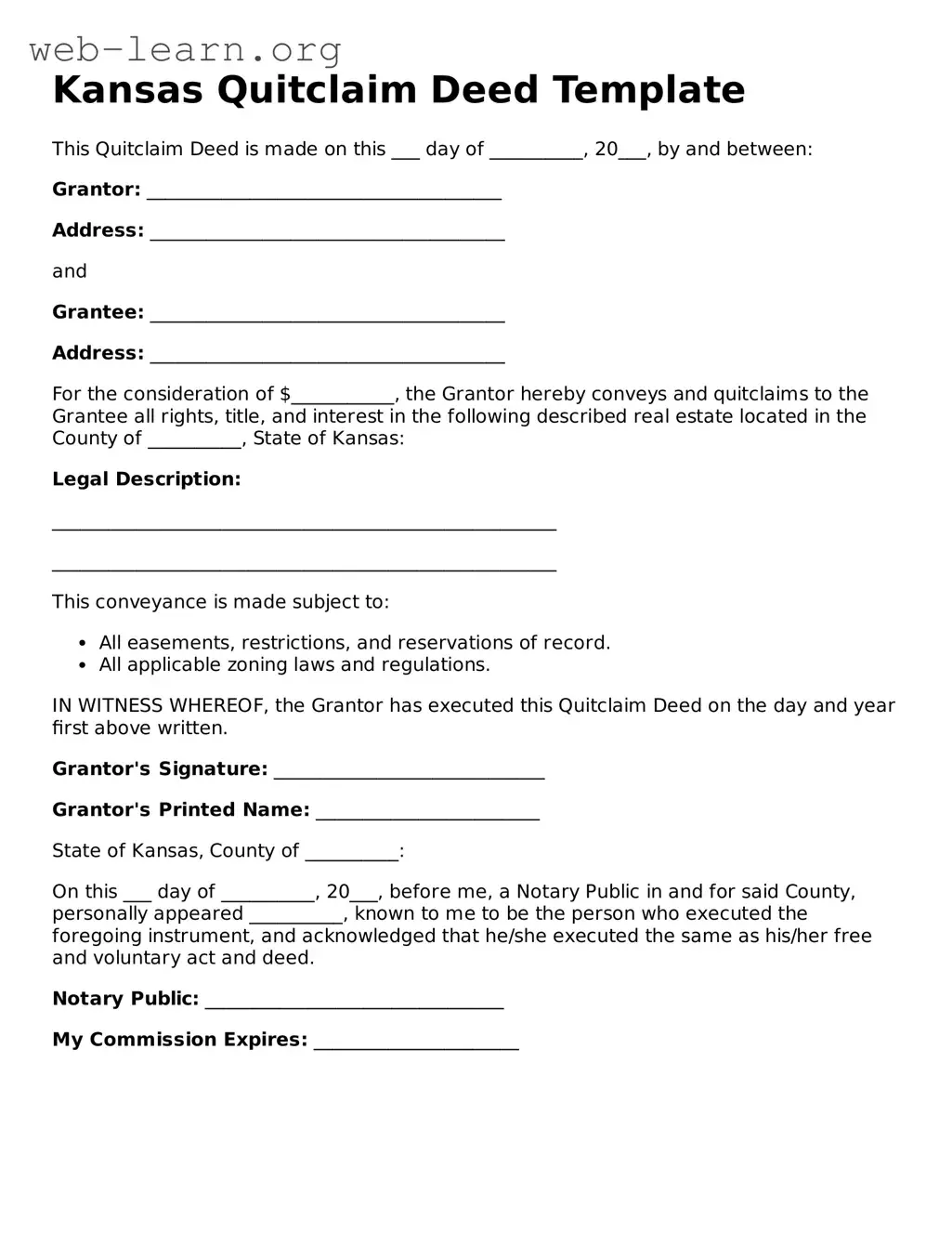
Kansas Quitclaim Deed Template
This Quitclaim Deed is made on this ___ day of __________, 20___, by and between:
Grantor: ______________________________________
Address: ______________________________________
and
Grantee: ______________________________________
Address: ______________________________________
For the consideration of $___________, the Grantor hereby conveys and quitclaims to the Grantee all rights, title, and interest in the following described real estate located in the County of __________, State of Kansas:
Legal Description:
______________________________________________________
______________________________________________________
This conveyance is made subject to:
IN WITNESS WHEREOF, the Grantor has executed this Quitclaim Deed on the day and year first above written.
Grantor's Signature: _____________________________
Grantor's Printed Name: ________________________
State of Kansas, County of __________:
On this ___ day of __________, 20___, before me, a Notary Public in and for said County, personally appeared __________, known to me to be the person who executed the foregoing instrument, and acknowledged that he/she executed the same as his/her free and voluntary act and deed.
Notary Public: ________________________________
My Commission Expires: ______________________
| Fact Name | Description |
|---|---|
| Definition | A Kansas Quitclaim Deed transfers ownership of property without guaranteeing the title. |
| Governing Law | The Kansas Quitclaim Deed is governed by Kansas Statutes Annotated (K.S.A.) 58-2201 et seq. |
| Usage | This deed is commonly used among family members or to clear up title issues. |
| Signature Requirements | The grantor must sign the deed in the presence of a notary public for it to be valid. |
| Recording | The deed must be recorded with the county register of deeds to provide public notice of the transfer. |
Once you have the Kansas Quitclaim Deed form in front of you, it’s time to start filling it out. This form is essential for transferring property ownership, and completing it accurately is crucial. Below are the steps you need to follow to ensure everything is filled out correctly.
After completing these steps, your Quitclaim Deed will be ready for submission. Make sure to keep a copy for your records. This process is straightforward, and taking the time to fill out the form correctly will help ensure a smooth transfer of property ownership.
What is a Kansas Quitclaim Deed?
A Kansas Quitclaim Deed is a legal document used to transfer ownership of real estate from one person to another. Unlike other types of deeds, a quitclaim deed does not guarantee that the person transferring the property has clear title to it. Instead, it simply conveys whatever interest the seller has in the property, if any. This type of deed is often used among family members or in situations where the parties know each other well.
When should I use a Quitclaim Deed?
Quitclaim deeds are commonly used in various situations, including:
However, it’s important to note that because a quitclaim deed does not provide any warranties, it may not be suitable for all situations, especially those involving significant financial investments.
How do I complete a Kansas Quitclaim Deed?
Completing a Kansas Quitclaim Deed involves several key steps:
It may be beneficial to consult with a legal professional to ensure that the deed is completed correctly and that all necessary information is included.
Are there any fees associated with filing a Quitclaim Deed in Kansas?
Yes, there are typically fees associated with filing a Quitclaim Deed in Kansas. These fees can vary by county but generally include:
It is advisable to check with the local county Register of Deeds for the exact fee schedule and any additional costs that may apply.
What are the risks of using a Quitclaim Deed?
While a Quitclaim Deed can be a straightforward way to transfer property, it does come with certain risks:
For these reasons, it is important to conduct thorough research and possibly seek legal advice before proceeding with a quitclaim deed transfer.
Filling out a Kansas Quitclaim Deed form can be straightforward, but there are common mistakes that individuals often make. One frequent error is not providing complete information about the property. The form requires specific details, such as the legal description of the property. Omitting this information can lead to confusion and potential disputes in the future.
Another mistake is failing to include the names of all parties involved. The grantor and grantee must be clearly identified. If one party's name is misspelled or omitted, it may invalidate the deed. It's crucial to double-check names against official documents to ensure accuracy.
Some individuals overlook the importance of notarization. A Quitclaim Deed must be signed in front of a notary public to be legally binding. Without this step, the deed may not be recognized by the county or other entities. Notarization adds a layer of authenticity and can prevent future legal issues.
In addition, people sometimes forget to consider the date of the transfer. The date should be clearly stated on the form. Without it, there could be complications regarding the timing of the property transfer, which may affect taxes or ownership rights.
Another common mistake is neglecting to check local recording requirements. Each county in Kansas may have specific rules about how a Quitclaim Deed should be submitted. Failing to adhere to these guidelines can result in the deed not being recorded properly, leading to potential ownership disputes.
Some individuals also make the mistake of not understanding the implications of a Quitclaim Deed. This type of deed does not guarantee that the grantor has clear title to the property. It merely transfers whatever interest the grantor may have. Misunderstanding this can lead to unexpected issues down the line.
Moreover, people may incorrectly assume that a Quitclaim Deed is the same as a warranty deed. While both serve to transfer property, a warranty deed offers more protection to the buyer. It's important to understand these differences when deciding which type of deed to use.
Another error involves the payment of any associated fees. Some individuals forget to include necessary fees for recording the deed. Each county may have different fee structures, and neglecting to pay these can delay the recording process.
Lastly, individuals sometimes fail to keep copies of the completed deed. After the Quitclaim Deed is filled out and submitted, retaining a copy for personal records is essential. This can provide proof of ownership and help resolve any future disputes regarding the property.
When preparing to execute a Kansas Quitclaim Deed, several additional documents may be necessary to ensure a smooth transfer of property. Each of these documents serves a specific purpose and can help clarify ownership, establish rights, or fulfill legal requirements. Below is a list of commonly used forms and documents that often accompany a Quitclaim Deed.
Gathering these documents ahead of time can streamline the property transfer process and help avoid potential legal complications. It is advisable to consult with a legal professional to ensure that all necessary forms are completed accurately and in compliance with Kansas law.
A Quitclaim Deed is a legal document used to transfer ownership of property. It is similar to several other documents that also deal with property rights. Here are seven documents that share similarities with a Quitclaim Deed:
When filling out the Kansas Quitclaim Deed form, it is essential to approach the task with care and attention to detail. This document is used to transfer property ownership, and any mistakes can lead to complications. Below is a list of things you should and shouldn't do while completing the form.
By following these guidelines, individuals can help ensure a smooth and successful property transfer process in Kansas.
Misconceptions about the Kansas Quitclaim Deed form can lead to confusion and potential legal issues. Here are six common misconceptions, along with clarifications:
Understanding these misconceptions is crucial for anyone considering using a quitclaim deed in Kansas. Proper knowledge can help avoid potential pitfalls and ensure a smoother transaction.
When filling out and using the Kansas Quitclaim Deed form, there are several important considerations to keep in mind. Below are key takeaways that can help ensure the process is completed correctly.
Quick Claim Deed Form Connecticut - This form can be filed with the county recorder's office.
Quick Deed Process - This form can help in simplifying the transfer of inherited property.
New York Quitclaim Deed - This deed is ideal for transferring property in a friendly manner.