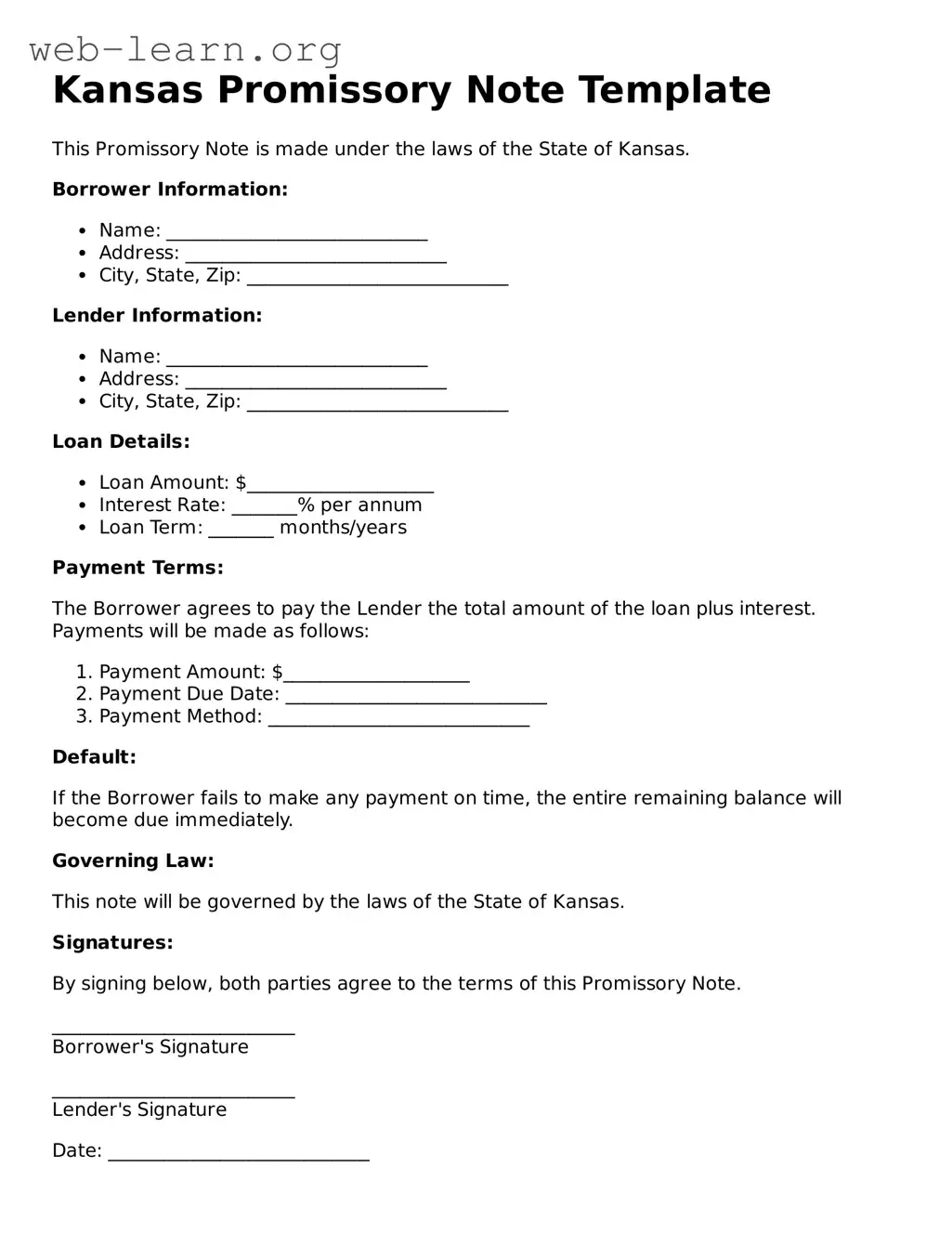
The Kansas Promissory Note form serves as a vital financial instrument that outlines the agreement between a borrower and a lender. This document details the specific terms under which money is borrowed, including the principal amount, interest rate, and repayment schedule. It establishes the obligations of the borrower to repay the loan within a designated timeframe, while also protecting the lender's rights in the event of default. The form may include provisions for late fees, prepayment options, and other conditions that can affect the loan's terms. Understanding the nuances of this form is essential for both parties, as it ensures clarity and accountability throughout the borrowing process. By formalizing the agreement, the Kansas Promissory Note helps to foster trust and transparency, making it an indispensable tool in personal and business finance.
Kansas Promissory Note Template
This Promissory Note is made under the laws of the State of Kansas.
Borrower Information:
Lender Information:
Loan Details:
Payment Terms:
The Borrower agrees to pay the Lender the total amount of the loan plus interest. Payments will be made as follows:
Default:
If the Borrower fails to make any payment on time, the entire remaining balance will become due immediately.
Governing Law:
This note will be governed by the laws of the State of Kansas.
Signatures:
By signing below, both parties agree to the terms of this Promissory Note.
__________________________
Borrower's Signature
__________________________
Lender's Signature
Date: ____________________________
| Fact Name | Details |
|---|---|
| Definition | A promissory note is a written promise to pay a specified amount of money to a designated person or entity at a specified time. |
| Governing Law | The Kansas Uniform Commercial Code (UCC) governs promissory notes in the state of Kansas. |
| Parties Involved | The note involves two primary parties: the maker (the person promising to pay) and the payee (the person to whom the payment is owed). |
| Interest Rate | The interest rate on the note can be fixed or variable, but it must be clearly stated within the document. |
| Legal Enforceability | For a promissory note to be legally enforceable, it must contain essential elements such as a clear promise to pay, the amount, and the terms of payment. |
| Default Consequences | If the maker defaults on the note, the payee may have the right to take legal action to recover the owed amount. |
Once you have the Kansas Promissory Note form in front of you, it's time to fill it out carefully. Make sure to have all necessary information ready before you begin. This will help ensure the process goes smoothly.
After completing the form, review all entries for accuracy. Make sure all parties involved understand the terms before proceeding. Keep a copy for your records and provide the original to the lender.
A Kansas Promissory Note is a written agreement in which one party promises to pay a specific amount of money to another party at a designated time. This document outlines the terms of the loan, including the interest rate, payment schedule, and any penalties for late payments.
Both individuals and businesses use Promissory Notes. For example, a person might use it when lending money to a friend or family member. Similarly, a business may issue a note to secure a loan from a financial institution.
A typical Promissory Note includes:
Yes, a Promissory Note is a legally binding document. Once both parties sign it, they are obligated to follow the terms outlined in the note. If either party fails to meet their obligations, the other party may take legal action.
Yes, you can modify a Promissory Note, but both parties must agree to the changes. It is best to document any modifications in writing and have both parties sign the amended note to ensure clarity and enforceability.
If the borrower defaults, the lender has the right to take legal action to recover the owed amount. This may include filing a lawsuit or seeking a judgment against the borrower. It’s essential for lenders to keep records of all communications and payments related to the loan.
No, you do not need a lawyer to create a Promissory Note. However, it is advisable to ensure that the document is clear and meets all legal requirements. Using a template or a reliable service can help in drafting a valid note.
To enforce a Promissory Note, the lender may need to provide evidence of the agreement and any missed payments. If the borrower does not respond to requests for payment, the lender may need to file a lawsuit in court to collect the debt.
Templates for Kansas Promissory Notes can be found online through legal document services, or you can consult local legal resources. Make sure the template complies with Kansas laws and includes all necessary information.
Filling out a Kansas Promissory Note form can be straightforward, but many individuals make common mistakes that can lead to complications. One frequent error is failing to include all necessary parties. Both the borrower and the lender must be clearly identified. If one party is omitted or incorrectly named, it can create issues in enforcing the note.
Another mistake often seen is neglecting to specify the loan amount. This figure should be clearly stated in both numerical and written form. Ambiguity in the amount can lead to disputes down the line, making it essential to get this right.
People also tend to overlook the interest rate. It is crucial to define whether the loan carries an interest rate and, if so, what that rate is. Leaving this blank or using vague language can result in misunderstandings regarding repayment obligations.
Additionally, many individuals fail to outline the repayment terms. This includes the schedule for payments, whether they are monthly, quarterly, or otherwise. A lack of clarity can lead to confusion about when payments are due and how they should be made.
Another common mistake is not including a default clause. This clause outlines the consequences if the borrower fails to repay the loan. Without this provision, the lender may have limited options if the borrower defaults.
Signatures are also a critical component. Both parties must sign the document, and it’s important to ensure that the signatures are dated. An unsigned or undated note may not hold up in court, should a dispute arise.
Lastly, failing to keep a copy of the completed Promissory Note is a significant oversight. Both parties should retain a signed copy for their records. This ensures that everyone has access to the agreed terms and can refer back to them if necessary.
When dealing with a Kansas Promissory Note, several other forms and documents can help clarify the terms of the loan and protect the interests of both parties. Understanding these documents can make the borrowing and lending process smoother and more transparent.
Having these documents in place can significantly enhance the clarity and security of a lending arrangement. They help ensure that both borrowers and lenders understand their rights and responsibilities, ultimately leading to a more successful transaction.
When filling out the Kansas Promissory Note form, it is important to follow certain guidelines to ensure accuracy and compliance. Here are some things to do and avoid:
Understanding the Kansas Promissory Note form can be challenging, and several misconceptions often arise. Here are eight common misunderstandings:
By understanding these misconceptions, individuals can better navigate the complexities of promissory notes in Kansas and ensure they are using the forms correctly.
When filling out and using the Kansas Promissory Note form, it is essential to understand the following key points:
Understanding these elements will help ensure that the Promissory Note is valid and enforceable under Kansas law.
Arkansas Promissory Note Download - These notes can be tailored to fit specific situations and needs.
Idaho Promissory Note Download - Some promissory notes may include a conversion clause, allowing the lender to convert the debt into equity.
Promissory Note Friendly Loan Agreement Format - Promissory notes can be a simple way to formalize a loan without extensive legal fees.