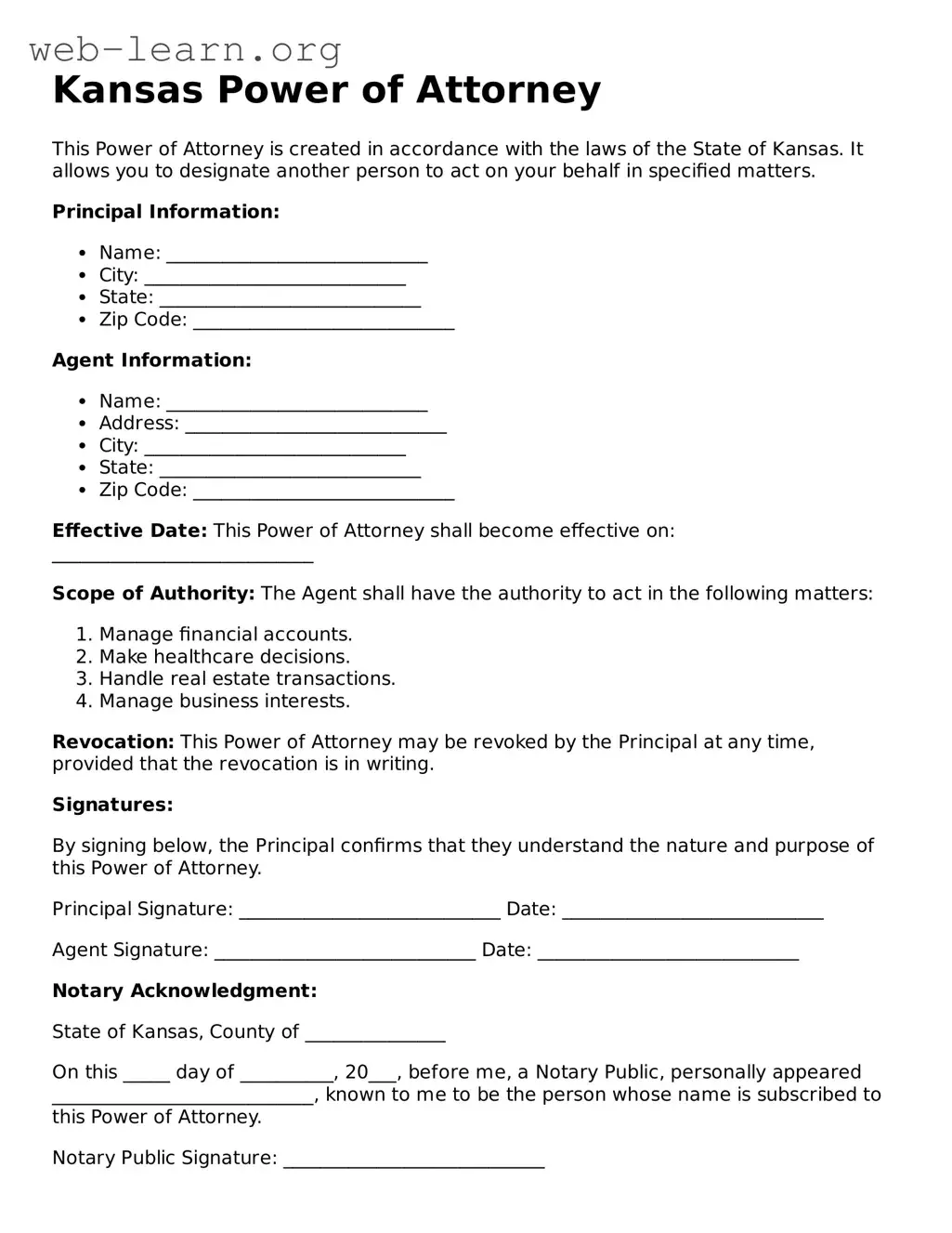
The Kansas Power of Attorney form serves as a crucial legal document that allows individuals to designate another person, known as an agent, to make decisions on their behalf. This form is particularly important for managing financial matters, healthcare decisions, and other personal affairs when one becomes unable to do so themselves. It outlines the specific powers granted to the agent, which can range from handling bank transactions to making medical decisions. Importantly, the form can be tailored to meet individual needs, whether it’s a durable power of attorney that remains effective even if the principal becomes incapacitated or a limited power of attorney that restricts the agent’s authority to specific tasks or time frames. Furthermore, understanding the requirements for signing and witnessing the document is essential, as these steps ensure its legality and enforceability. In Kansas, the Power of Attorney form must comply with state laws to be valid, making it imperative for individuals to familiarize themselves with the necessary provisions and options available to them.
Kansas Power of Attorney
This Power of Attorney is created in accordance with the laws of the State of Kansas. It allows you to designate another person to act on your behalf in specified matters.
Principal Information:
Agent Information:
Effective Date: This Power of Attorney shall become effective on: ____________________________
Scope of Authority: The Agent shall have the authority to act in the following matters:
Revocation: This Power of Attorney may be revoked by the Principal at any time, provided that the revocation is in writing.
Signatures:
By signing below, the Principal confirms that they understand the nature and purpose of this Power of Attorney.
Principal Signature: ____________________________ Date: ____________________________
Agent Signature: ____________________________ Date: ____________________________
Notary Acknowledgment:
State of Kansas, County of _______________
On this _____ day of __________, 20___, before me, a Notary Public, personally appeared ____________________________, known to me to be the person whose name is subscribed to this Power of Attorney.
Notary Public Signature: ____________________________
My Commission Expires: ____________________________
| Fact Name | Description |
|---|---|
| Purpose | The Kansas Power of Attorney form allows you to appoint someone to make decisions on your behalf if you become unable to do so. |
| Governing Law | This form is governed by the Kansas Statutes Annotated, Chapter 58, Article 6. |
| Durability | The Power of Attorney can be durable, meaning it remains effective even if you become incapacitated. |
| Revocation | You can revoke the Power of Attorney at any time as long as you are mentally competent. |
After obtaining the Kansas Power of Attorney form, it is essential to fill it out accurately to ensure it meets your needs. Follow these steps carefully to complete the form properly.
What is a Power of Attorney in Kansas?
A Power of Attorney (POA) is a legal document that allows one person (the principal) to grant another person (the agent or attorney-in-fact) the authority to act on their behalf. This authority can cover a wide range of decisions, including financial, medical, and legal matters. In Kansas, a POA can be tailored to meet specific needs and can be effective immediately or become effective upon a certain event, such as the principal's incapacity.
What types of Power of Attorney are available in Kansas?
In Kansas, there are several types of Power of Attorney forms:
How do I create a Power of Attorney in Kansas?
To create a Power of Attorney in Kansas, follow these steps:
Do I need to have my Power of Attorney notarized?
Yes, in Kansas, a Power of Attorney must be signed in the presence of a notary public or two witnesses. Notarization helps ensure the authenticity of the document and can prevent potential disputes regarding its validity.
Can I revoke a Power of Attorney in Kansas?
Yes, you can revoke a Power of Attorney at any time as long as you are mentally competent. To revoke, you should create a written revocation document, notify your agent, and inform any institutions or individuals who may have relied on the original Power of Attorney.
What happens if I become incapacitated and have a Power of Attorney?
If you become incapacitated and have a Durable Power of Attorney in place, your agent can begin making decisions on your behalf as specified in the document. This can include managing your finances, paying bills, or making medical decisions, depending on the powers granted.
Is there a specific form I must use for a Power of Attorney in Kansas?
While Kansas does not require a specific form, it is advisable to use a form that complies with state laws and clearly outlines the powers granted to the agent. Many resources, including legal websites and local attorneys, provide templates that can be tailored to your needs.
Can my agent be held liable for their actions under a Power of Attorney?
Your agent has a fiduciary duty to act in your best interest. If they fail to do so or act outside the scope of their authority, they may be held liable for any damages caused by their actions. It is essential to choose an agent you trust and who understands their responsibilities.
What should I consider before granting someone Power of Attorney?
Before granting Power of Attorney, consider the following:
Taking the time to carefully consider these factors can help ensure that your wishes are respected and that your interests are protected.
Filling out a Power of Attorney (POA) form in Kansas can seem straightforward, yet many individuals encounter pitfalls that can lead to complications down the line. One common mistake is failing to specify the powers granted. A vague description can leave room for interpretation, which might lead to disputes or confusion about what the agent is allowed to do. It's essential to be clear and specific about the authority being granted to ensure that the agent can act in accordance with your wishes.
Another frequent error involves not naming a successor agent. Life is unpredictable, and the person you initially choose to act on your behalf may not always be available when needed. By neglecting to name a backup, you risk leaving your affairs unmanaged in the event that your primary agent cannot serve. Including a successor agent ensures continuity and provides peace of mind.
Many people also overlook the importance of having the document properly signed and witnessed. In Kansas, a POA must be signed in the presence of a notary public. Failing to do so can render the document invalid. It's not just about signing; the presence of a notary adds a layer of authenticity and can help prevent future challenges to the document's legitimacy.
Another mistake is assuming that a POA is a one-time task. Some individuals fill out the form and think it will remain valid indefinitely. However, circumstances change. Life events such as marriage, divorce, or the birth of a child can alter your needs. Regularly reviewing and updating the POA ensures it reflects your current situation and intentions.
Additionally, many people forget to communicate their plans with the designated agent. A Power of Attorney is not just a piece of paper; it represents a relationship of trust. If the agent is unaware of their responsibilities or your wishes, they may struggle to act in your best interest. Open communication can help clarify expectations and ensure everyone is on the same page.
Finally, individuals sometimes neglect to consider the implications of granting power to someone they trust without fully understanding their capabilities. While it is essential to choose someone reliable, it is equally important to assess their ability to handle the responsibilities. A poorly chosen agent can lead to mismanagement of your affairs, which can have lasting consequences. Take the time to evaluate your options carefully.
When considering the establishment of a Power of Attorney in Kansas, it is important to be aware of other documents that may complement this legal tool. Each of these forms serves a specific purpose and can help ensure that your wishes are honored and your affairs are managed effectively. Below is a list of commonly used documents alongside the Kansas Power of Attorney form.
Understanding these documents can help you create a comprehensive plan for your future. Each serves a unique role in managing your health, finances, and legacy. Consulting with a legal professional can provide further clarity and ensure that your choices align with your personal circumstances and goals.
The Power of Attorney (POA) form allows one person to make decisions on behalf of another. Several other documents serve similar purposes, granting authority or designating responsibilities. Here are five documents that share similarities with the Power of Attorney:
Understanding these documents can help you make informed decisions about who will manage your affairs when you cannot. Each serves a unique function but shares the common theme of delegation and trust.
When filling out the Kansas Power of Attorney form, it's essential to approach the task with care. Here are some important do's and don'ts to keep in mind:
When it comes to the Kansas Power of Attorney form, many people have misunderstandings. Here are ten common misconceptions:
Understanding these misconceptions can help you make informed decisions about creating a Power of Attorney in Kansas.
Filling out and using the Kansas Power of Attorney form requires careful attention to detail. Here are key takeaways to consider:
These takeaways can help ensure that the Kansas Power of Attorney form is filled out and used effectively.
Indiana Power of Attorney Pdf - Power of Attorney can be a safeguard against potential exploitation.
New York Power of Attorney - This form can simplify the process of managing your finances if you are incapacitated.
Ca Poa - This form can help streamline decision-making in critical situations.