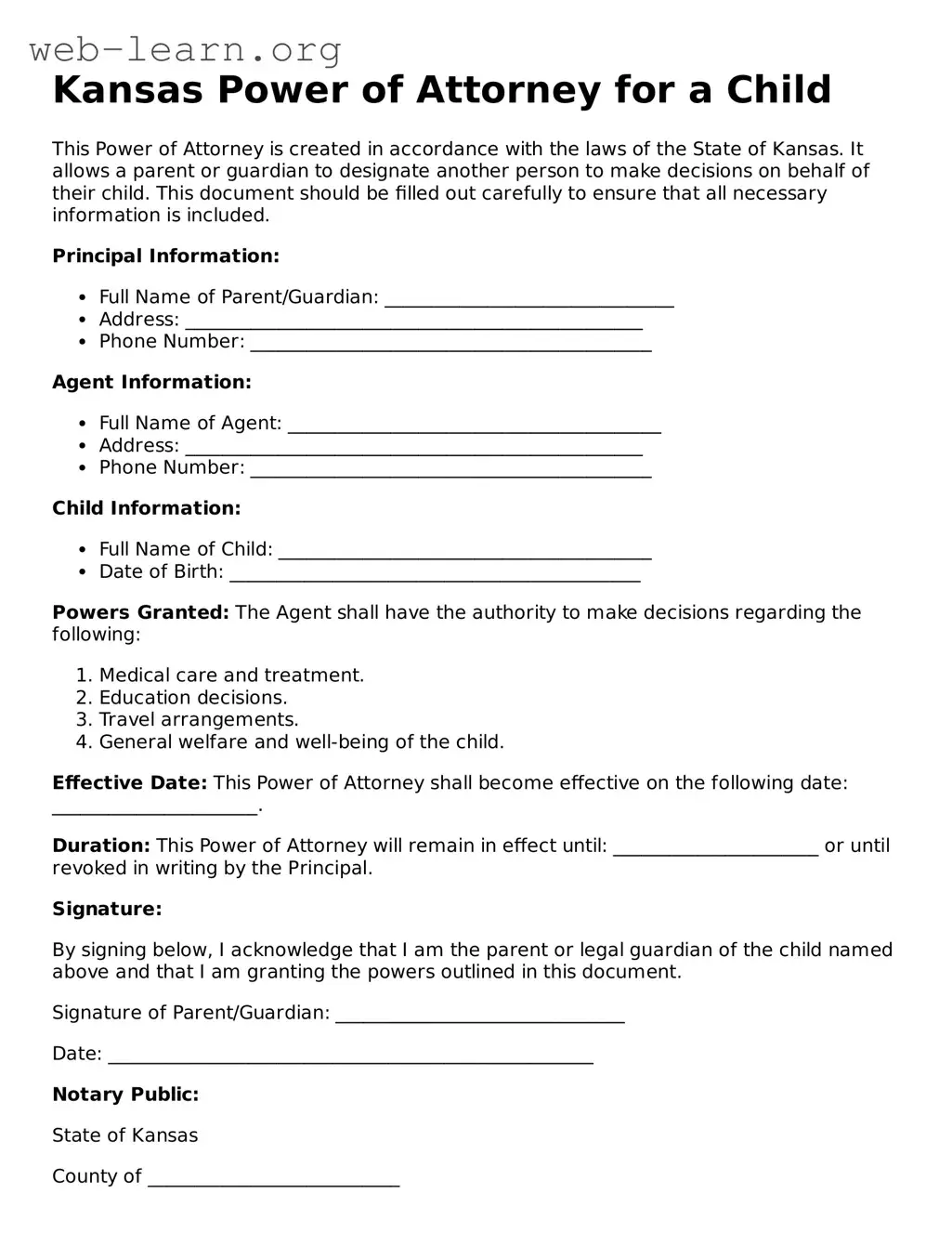
In Kansas, the Power of Attorney for a Child form serves as a vital legal tool for parents and guardians seeking to delegate authority over their child's care to another trusted adult. This form is particularly useful in various situations, such as when parents are traveling, facing medical emergencies, or simply need assistance in managing their child's daily needs. By completing this form, parents can specify the powers granted to the designated agent, which may include making decisions about education, healthcare, and general welfare. The form ensures that the child's best interests are prioritized while providing clear guidelines on the scope of authority. It is important to note that this power can be temporary or more long-term, depending on the family's needs. Additionally, the form requires signatures from both the parent and the agent, along with a witness or notary, to validate the arrangement. Understanding the implications and responsibilities associated with this form can help families navigate challenging situations with confidence and clarity.
Kansas Power of Attorney for a Child
This Power of Attorney is created in accordance with the laws of the State of Kansas. It allows a parent or guardian to designate another person to make decisions on behalf of their child. This document should be filled out carefully to ensure that all necessary information is included.
Principal Information:
Agent Information:
Child Information:
Powers Granted: The Agent shall have the authority to make decisions regarding the following:
Effective Date: This Power of Attorney shall become effective on the following date: ______________________.
Duration: This Power of Attorney will remain in effect until: ______________________ or until revoked in writing by the Principal.
Signature:
By signing below, I acknowledge that I am the parent or legal guardian of the child named above and that I am granting the powers outlined in this document.
Signature of Parent/Guardian: _______________________________
Date: ____________________________________________________
Notary Public:
State of Kansas
County of ___________________________
Subscribed and sworn to before me this _____ day of ______________, 20__.
Notary Public Signature: ______________________________________
My commission expires: ______________________________________
| Fact Name | Description |
|---|---|
| Purpose | The Kansas Power of Attorney for a Child form allows a parent or guardian to designate another adult to make decisions for their child in their absence. |
| Duration | This power of attorney can be effective for a specific period or until revoked by the parent or guardian. |
| Governing Law | The form is governed by Kansas Statutes Annotated, Chapter 58, Article 6. |
| Requirements | The form must be signed by the parent or guardian and may need to be notarized to be legally binding. |
Filling out the Kansas Power of Attorney for a Child form is an important step in ensuring that your child's needs are met when you are unable to be present. Carefully follow the steps below to complete the form accurately.
After completing these steps, keep a copy of the form for your records. Provide the original to the designated individual, ensuring they understand their responsibilities. This will help facilitate any necessary decisions regarding your child's care.
What is a Power of Attorney for a Child in Kansas?
A Power of Attorney for a Child in Kansas is a legal document that allows a parent or legal guardian to appoint another adult to make decisions on behalf of their child. This can include decisions related to education, healthcare, and general welfare. It is useful in situations where the parent or guardian cannot be present for an extended period.
Who can be appointed as an agent?
The agent can be any responsible adult, such as a relative, family friend, or neighbor. However, it is important to choose someone who is trustworthy and capable of making decisions in the best interest of the child.
What powers can be granted through this form?
The form can grant a variety of powers, including:
Parents can specify which powers they want to grant and can limit the scope if desired.
How long does the Power of Attorney for a Child last?
The duration of the Power of Attorney can vary. It can be set for a specific period or remain in effect until revoked by the parent or guardian. If no end date is specified, it generally lasts until the child turns 18.
Do I need to have the form notarized?
Yes, in Kansas, the Power of Attorney for a Child must be signed in the presence of a notary public. This helps ensure that the document is legally valid and that the signatures are authentic.
Can the Power of Attorney be revoked?
Yes, the parent or legal guardian can revoke the Power of Attorney at any time. To do this, a written notice should be provided to the agent and any institutions that were relying on the Power of Attorney.
Is there a specific form I must use?
While Kansas does not require a specific form, it is advisable to use a template that meets state requirements. This ensures that all necessary information is included and that the document is properly formatted.
What should I do if I have more questions?
If you have additional questions, consider consulting with a legal professional. They can provide personalized guidance based on your specific situation and ensure that your Power of Attorney for a Child meets all legal requirements.
Filling out the Kansas Power of Attorney for a Child form can be straightforward, but many individuals make common mistakes that can lead to complications. One frequent error is failing to provide complete information about the child. The form requires specific details such as the child's full name, date of birth, and address. Omitting any of this information can result in delays or legal challenges later on.
Another mistake is not clearly identifying the agent. The person designated to act on behalf of the child must be named explicitly. Some people simply write “my friend” or “a relative” without giving a full name or relationship. This lack of clarity can create confusion and may even invalidate the document.
People often overlook the need for signatures. Both the parent or legal guardian and the agent must sign the form. Failing to include one or both signatures can render the Power of Attorney ineffective. Additionally, some individuals forget to date the document, which is crucial for establishing when the authority begins.
Not understanding the scope of authority granted is another common error. The form allows for specific powers to be assigned to the agent, such as making medical decisions or handling educational matters. Some individuals either grant too broad a power or too narrow a one, leading to potential conflicts in decision-making.
Lastly, many people neglect to keep copies of the completed form. After filling it out, it is essential to provide copies to the agent and retain one for personal records. Without copies, there can be disputes about the authority granted, and it may be difficult to prove the agent's rights when needed.
When establishing a Power of Attorney for a Child in Kansas, it is important to consider additional forms and documents that may be necessary. These documents can help clarify responsibilities and provide further legal support. Below are some commonly used forms that accompany the Power of Attorney for a Child.
Having these documents in place can streamline processes and protect the child’s well-being. It is essential to ensure that all necessary forms are completed and properly executed to avoid complications in the future.
When filling out the Kansas Power of Attorney for a Child form, it is important to follow specific guidelines to ensure the document is valid and effective. Here are ten things you should and shouldn't do:
Understanding the Kansas Power of Attorney for a Child form is essential for parents and guardians. However, several misconceptions can lead to confusion. Here are nine common myths about this important legal document:
By clarifying these misconceptions, parents and guardians can better navigate the process and make informed decisions regarding their children's care.
When filling out and using the Kansas Power of Attorney for a Child form, keep these key takeaways in mind:
By following these guidelines, you can ensure that the Power of Attorney for a Child form serves its intended purpose effectively.
How to Get Power of Attorney in Hawaii - This form can help avoid legal complications if immediate decisions are required for the child's well-being.
How to Become Power of Attorney for My Mother - It can be helpful for parents who are traveling or need someone to oversee their child’s needs.