The Kansas Operating Agreement form serves as a foundational document for limited liability companies (LLCs) operating within the state, outlining the essential governance structure and operational guidelines that members agree upon. This agreement is crucial in delineating the roles and responsibilities of each member, establishing the distribution of profits and losses, and providing a framework for decision-making processes. Additionally, it often addresses the procedures for adding new members, transferring ownership interests, and resolving disputes, ensuring that all parties are aligned and aware of their rights and obligations. By clearly articulating these aspects, the Operating Agreement not only fosters transparency among members but also serves to protect the integrity of the LLC against potential conflicts. Whether a business is just starting out or has been established for years, having a well-drafted Operating Agreement can significantly enhance operational efficiency and legal compliance in Kansas.
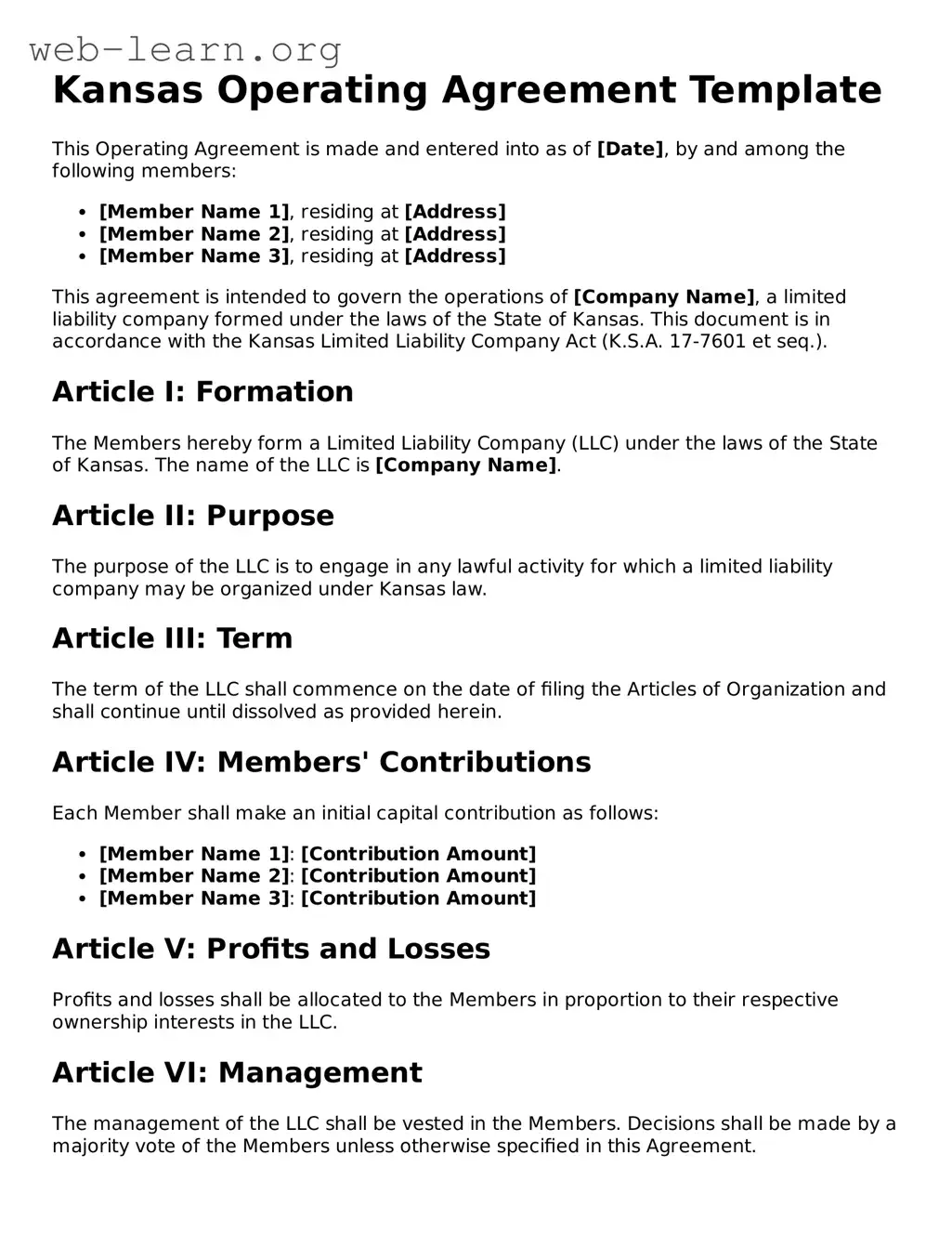
Kansas Operating Agreement Template
This Operating Agreement is made and entered into as of [Date], by and among the following members:
This agreement is intended to govern the operations of [Company Name], a limited liability company formed under the laws of the State of Kansas. This document is in accordance with the Kansas Limited Liability Company Act (K.S.A. 17-7601 et seq.).
Article I: Formation
The Members hereby form a Limited Liability Company (LLC) under the laws of the State of Kansas. The name of the LLC is [Company Name].
Article II: Purpose
The purpose of the LLC is to engage in any lawful activity for which a limited liability company may be organized under Kansas law.
Article III: Term
The term of the LLC shall commence on the date of filing the Articles of Organization and shall continue until dissolved as provided herein.
Article IV: Members' Contributions
Each Member shall make an initial capital contribution as follows:
Article V: Profits and Losses
Profits and losses shall be allocated to the Members in proportion to their respective ownership interests in the LLC.
Article VI: Management
The management of the LLC shall be vested in the Members. Decisions shall be made by a majority vote of the Members unless otherwise specified in this Agreement.
Article VII: Indemnification
The LLC shall indemnify any Member or Manager for any act performed on behalf of the LLC, provided such act was not the result of gross negligence or willful misconduct.
Article VIII: Amendments
This Operating Agreement may be amended only by a written agreement signed by all Members.
Article IX: Governing Law
This Agreement shall be governed by and construed in accordance with the laws of the State of Kansas.
IN WITNESS WHEREOF, the Members have executed this Operating Agreement as of the date first above written.
_____________________________ [Member Name 1]
_____________________________ [Member Name 2]
_____________________________ [Member Name 3]
| Fact Name | Description |
|---|---|
| Purpose | The Kansas Operating Agreement outlines the management structure and operating procedures for a limited liability company (LLC) in Kansas. |
| Governing Law | This agreement is governed by the Kansas Limited Liability Company Act. |
| Members | All members of the LLC must sign the operating agreement to ensure mutual understanding and commitment. |
| Management Structure | The agreement can specify whether the LLC is member-managed or manager-managed, affecting decision-making processes. |
| Capital Contributions | It details each member's initial capital contributions and outlines how additional contributions will be handled. |
| Profit Distribution | The operating agreement specifies how profits and losses will be allocated among members, which can differ from ownership percentages. |
| Amendments | Procedures for amending the operating agreement are typically included, ensuring flexibility as the business evolves. |
| Dispute Resolution | It may include provisions for resolving disputes among members, such as mediation or arbitration methods. |
| Compliance | Having a well-drafted operating agreement helps ensure compliance with state regulations and protects member interests. |
Filling out the Kansas Operating Agreement form is a straightforward process. Once completed, you will have a clear understanding of the structure and management of your business. Follow these steps to ensure you fill out the form correctly.
What is a Kansas Operating Agreement?
A Kansas Operating Agreement is a legal document that outlines the management structure and operational guidelines for a limited liability company (LLC) in Kansas. It serves as an internal document that details the rights and responsibilities of the members and managers, as well as how the company will be run.
Is an Operating Agreement required in Kansas?
While Kansas law does not mandate that LLCs have an Operating Agreement, it is highly recommended. Having an Operating Agreement can help prevent misunderstandings among members and provide clarity on how the business should operate. It also offers protection for the members’ limited liability status.
What should be included in a Kansas Operating Agreement?
A comprehensive Operating Agreement typically includes the following elements:
How do I create a Kansas Operating Agreement?
Creating an Operating Agreement can be straightforward. Start by gathering all members to discuss the terms and conditions that everyone agrees upon. Draft the document, ensuring all necessary elements are included. It may be beneficial to consult with a legal professional to ensure compliance with state laws and to address any specific needs of the LLC.
Do I need to file the Operating Agreement with the state?
No, the Kansas Operating Agreement does not need to be filed with the state. It is an internal document that should be kept on file with the LLC’s records. However, all members should have access to it, and it should be updated as necessary.
Can the Operating Agreement be amended?
Yes, the Operating Agreement can be amended. The process for making amendments should be outlined in the original agreement. Typically, all members must agree to the changes, and the amendments should be documented in writing to ensure clarity and legal validity.
What happens if there is no Operating Agreement?
If an LLC does not have an Operating Agreement, it will be governed by the default rules set forth in Kansas LLC law. This can lead to complications, as these default rules may not reflect the members' intentions or needs. Disputes among members may arise more easily without a clear framework for operations.
Where can I find a template for a Kansas Operating Agreement?
Templates for Kansas Operating Agreements can be found online through legal websites or business formation services. Many of these templates can be customized to fit the specific needs of your LLC. However, it is advisable to consult with a legal professional to ensure that the template meets all legal requirements and adequately protects the interests of all members.
Filling out the Kansas Operating Agreement form is an important step for any business entity, yet many individuals make common mistakes that can lead to complications. One frequent error is failing to include all members' names and addresses. Each member’s information should be clearly stated to ensure that the agreement reflects the actual ownership structure.
Another mistake is neglecting to specify the management structure of the business. The agreement should outline whether the business will be managed by members or by appointed managers. This clarity is essential for establishing roles and responsibilities within the organization.
Omitting the purpose of the business is also a common oversight. The Operating Agreement should clearly state the business's purpose, as this helps define the scope of operations and can be important for legal and tax purposes.
Many people also forget to include provisions for handling disputes among members. It is crucial to outline the process for resolving conflicts to prevent misunderstandings and potential legal issues down the road.
Another area where mistakes often occur is in detailing the capital contributions of each member. The agreement should specify how much each member is contributing, whether in cash, property, or services. This ensures that all members are on the same page regarding their financial commitments.
Additionally, failing to address the distribution of profits and losses can lead to confusion. The Operating Agreement should clearly outline how profits and losses will be shared among members, which is vital for financial planning and expectations.
Some individuals neglect to include provisions for adding new members or handling the departure of existing ones. It is important to have a clear process for these situations to maintain stability within the business.
Finally, not reviewing the document for accuracy and completeness is a significant mistake. Before finalizing the Operating Agreement, it is advisable to double-check all entries for errors. This step can prevent future disputes and ensure that the agreement serves its intended purpose.
When forming a business in Kansas, particularly a limited liability company (LLC), the Operating Agreement is a crucial document. However, several other forms and documents complement the Operating Agreement, ensuring that your business is set up properly and operates smoothly. Below is a list of these essential documents.
Having these documents in place, along with the Operating Agreement, can help establish a solid foundation for your LLC. This preparation fosters clarity and organization, making it easier to navigate the complexities of running a business.
When filling out the Kansas Operating Agreement form, it's important to follow specific guidelines to ensure accuracy and compliance. Here are ten things you should and shouldn't do:
When it comes to the Kansas Operating Agreement form, several misconceptions can lead to confusion. Here’s a breakdown of some common misunderstandings:
This is not true. Small businesses and even single-member LLCs can benefit from having an Operating Agreement. It helps clarify ownership and management roles.
In Kansas, Operating Agreements are internal documents. They do not need to be filed with the state, but keeping a copy on hand is a good practice.
Operating Agreements can be amended. As your business evolves, you can update the agreement to reflect new circumstances or changes in management.
These are different documents. The Articles of Organization are filed with the state to form your LLC, while the Operating Agreement outlines the internal workings of the business.
While it is best practice for all members to sign, Kansas law does not require signatures for the agreement to be valid. However, having signatures can help prevent disputes.
Even single-member LLCs benefit from having an Operating Agreement. It provides clarity on management and can help establish the business as a separate entity.
While they do serve a legal function, Operating Agreements also help in defining roles, responsibilities, and procedures, which can improve business operations.
While it’s possible to create one without legal help, consulting an attorney can ensure that the agreement complies with state laws and meets your specific needs.
This is a misconception. Regularly reviewing and updating the Operating Agreement is important to reflect changes in the business or its members.
Filling out and using the Kansas Operating Agreement form is an important step for any business operating as an LLC in the state. Here are some key takeaways to keep in mind:
By carefully considering these aspects, you can create a comprehensive and effective Operating Agreement that serves your LLC well.
Llc Operating Agreement Arizona - This agreement details the roles and responsibilities of members within the LLC.
Llc Operating Agreement Arkansas - The Operating Agreement is an essential part of establishing a strong foundation for your LLC.