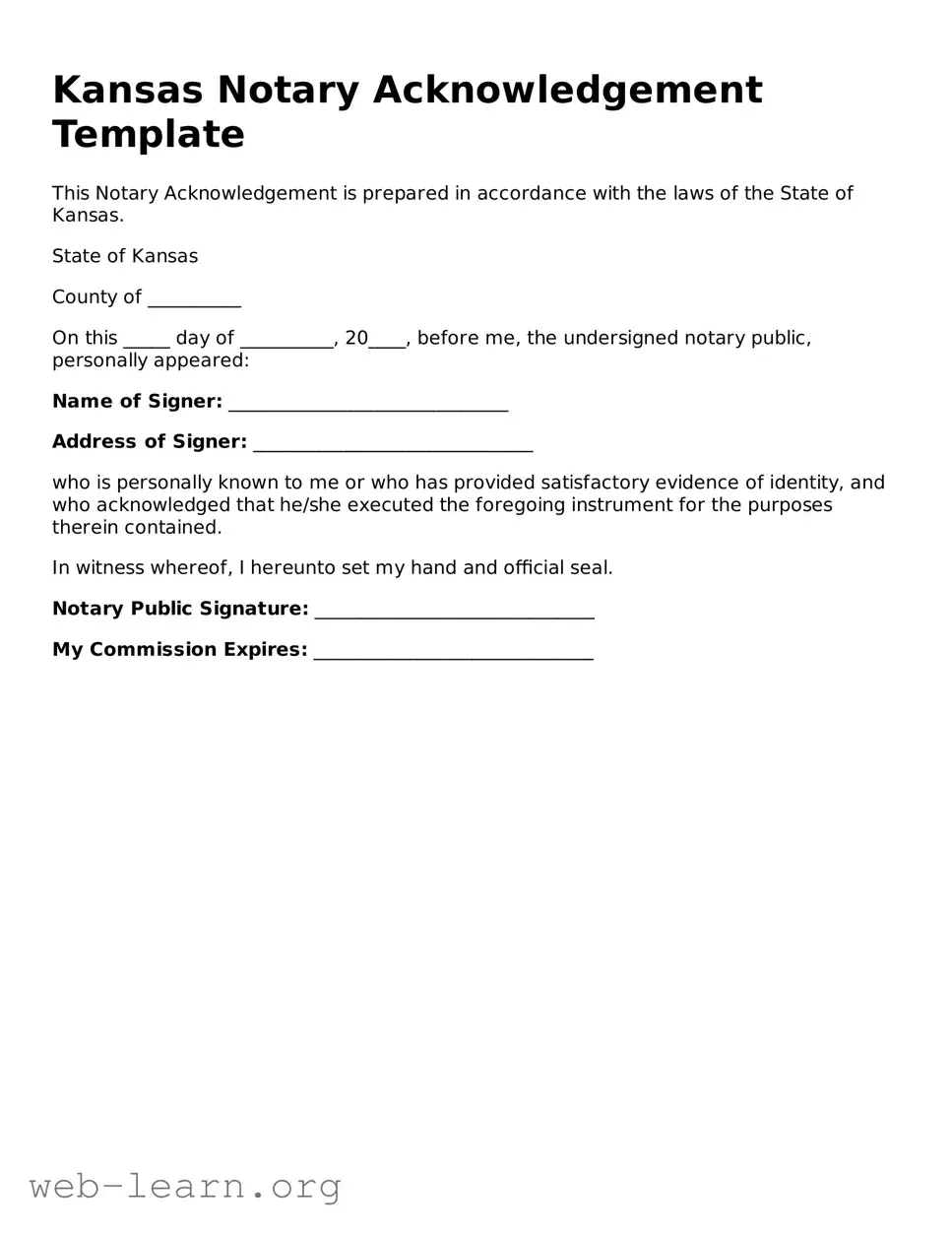
The Kansas Notary Acknowledgement form serves a crucial role in the notarization process, ensuring that signatures on legal documents are verified and authentic. This form is typically used when individuals need to confirm their identity and willingness to sign a document in front of a notary public. It includes essential details such as the name of the signer, the date of the acknowledgment, and the notary's signature and seal. By completing this form, the notary affirms that the signer appeared before them and provided satisfactory identification. This process helps prevent fraud and protects all parties involved in a transaction. Understanding the components and purpose of the Kansas Notary Acknowledgement form is important for anyone engaged in legal agreements or transactions requiring notarization.
Kansas Notary Acknowledgement Template
This Notary Acknowledgement is prepared in accordance with the laws of the State of Kansas.
State of Kansas
County of __________
On this _____ day of __________, 20____, before me, the undersigned notary public, personally appeared:
Name of Signer: ______________________________
Address of Signer: ______________________________
who is personally known to me or who has provided satisfactory evidence of identity, and who acknowledged that he/she executed the foregoing instrument for the purposes therein contained.
In witness whereof, I hereunto set my hand and official seal.
Notary Public Signature: ______________________________
My Commission Expires: ______________________________
| Fact Name | Description |
|---|---|
| Purpose | The Kansas Notary Acknowledgment form is used to verify the identity of the signer and confirm their willingness to sign a document. |
| Governing Law | This form is governed by the Kansas Statutes Annotated, specifically K.S.A. 53-601 et seq. |
| Signature Requirement | The signer must personally appear before the notary public to sign the document in their presence. |
| Notary's Role | The notary public must complete the acknowledgment by signing and affixing their seal to the form. |
| Validity | The acknowledgment is valid only if completed in accordance with Kansas law and must be attached to the document being notarized. |
After you have gathered the necessary information, you are ready to fill out the Kansas Notary Acknowledgement form. This process is straightforward, but it is important to complete each section accurately to ensure that the document is valid.
Once you have filled out the form completely, it is important to keep a copy for your records. The completed form will serve as a legal acknowledgment of the signature and can be used as needed in future transactions.
What is a Kansas Notary Acknowledgement form?
The Kansas Notary Acknowledgement form is a legal document used to verify the identity of a signer. It confirms that the person signing a document has done so willingly and is who they claim to be. This form is often required for various legal documents, including contracts, deeds, and affidavits.
When do I need to use a Notary Acknowledgement form?
You will need to use a Notary Acknowledgement form when you are signing important documents that require notarization. Common situations include real estate transactions, powers of attorney, and other legal agreements. The form ensures that the signature is valid and legally binding.
Who can act as a notary in Kansas?
In Kansas, a notary public must be at least 18 years old, a resident of the state, and able to read and write English. They must also complete a training course and pass an exam. After meeting these requirements, they can apply for a notary commission through the Secretary of State's office.
What information is required on the Notary Acknowledgement form?
The Notary Acknowledgement form typically includes:
This information helps to provide a clear record of the notarization process.
Is there a fee for notarization in Kansas?
Yes, notaries in Kansas are allowed to charge a fee for their services. The maximum fee a notary can charge is set by state law. Typically, this fee ranges from $5 to $10 per signature, but it can vary depending on the notary and the complexity of the document being notarized. Always confirm the fee beforehand.
Filling out the Kansas Notary Acknowledgement form can be straightforward, but many people make common mistakes that can lead to delays or even rejections. One frequent error is forgetting to include the date. The date is essential for establishing when the acknowledgment took place. Without it, the document may not be considered valid.
Another mistake involves omitting the notary's signature. The notary's signature is a crucial part of the form, as it authenticates the acknowledgment. If this signature is missing, the document lacks the necessary verification and may not hold up in legal situations.
People also often fail to provide the correct name of the person whose signature is being acknowledged. It’s vital to ensure that the name matches the identification presented. Any discrepancies can raise questions about the authenticity of the acknowledgment.
In addition, some individuals neglect to fill out the notary's commission expiration date. This information is important because it indicates the notary's authority to perform the acknowledgment. Leaving this blank can lead to complications regarding the validity of the document.
Another common error is using the wrong type of identification for the signer. The notary must verify the identity of the signer through acceptable forms of ID. If the identification does not meet the requirements, the acknowledgment may be deemed invalid.
Sometimes, people forget to include the notary's seal. The seal is a critical element that signifies the notary’s official capacity. Without it, the acknowledgment may not be recognized as legitimate.
Inaccurate information about the location where the acknowledgment took place is another mistake. The form requires the county and state where the notary performed the acknowledgment. Failing to provide this information can create confusion and invalidate the document.
Lastly, individuals may rush through the process and fail to review the completed form for errors. Taking the time to double-check all entries can prevent mistakes that lead to complications down the road. Ensuring accuracy is key to a smooth acknowledgment process.
When working with the Kansas Notary Acknowledgement form, several other documents may be necessary to ensure proper legal compliance and verification. Below is a list of commonly used forms and documents that often accompany this acknowledgment.
These documents play crucial roles in various legal processes. When used alongside the Kansas Notary Acknowledgement form, they help establish clear, enforceable agreements and protect the interests of all parties involved.
The Notary Acknowledgement form serves a specific purpose in verifying the identity of individuals signing a document. Several other documents share similar functions or features. Below is a list of six documents that are comparable to the Notary Acknowledgement form:
When filling out the Kansas Notary Acknowledgment form, it's important to ensure accuracy and compliance with state requirements. Here’s a list of things you should and shouldn't do:
By following these guidelines, you can help ensure that your Notary Acknowledgment form is properly completed and accepted.
Understanding the Kansas Notary Acknowledgment form is essential for anyone needing to notarize documents in the state. However, several misconceptions often arise. Here are seven common misunderstandings:
Many people believe that notaries can notarize any type of document. In reality, notaries are limited to certain types of documents, and they cannot notarize documents in which they have a personal interest.
Notaries may seem similar, but they can differ significantly in their training and expertise. Some may specialize in specific areas, such as real estate or legal documents, while others may offer general services.
While a notary's signature adds credibility, it does not guarantee the document's validity. The content must also comply with legal requirements.
Notaries are not authorized to give legal advice. Their role is to verify identities and witness signatures, not to interpret the law or advise on legal matters.
Notarization and legalization are distinct processes. Legalization is often required for documents used in foreign countries, while notarization is a domestic process for verifying signatures.
While notaries have the right to refuse service, they cannot do so arbitrarily. They must have valid reasons, such as concerns about the signer's identity or the document's legality.
Each state has its own rules and requirements for notarization. What may be acceptable in one state might not be valid in another, so it's crucial to understand Kansas-specific laws.
By clearing up these misconceptions, you can navigate the notarization process with greater confidence and ensure that your documents are properly executed.
Filling out and using the Kansas Notary Acknowledgement form is an important process for ensuring that documents are properly verified. Here are some key takeaways to keep in mind:
By following these guidelines, you can ensure that the notarization process is smooth and effective.