Homepage Attorney-Approved Non-disclosure Agreement Document for the State of Kansas
Table of Contents

In the world of business, protecting sensitive information is crucial. A Kansas Non-disclosure Agreement (NDA) serves as a vital tool for individuals and companies looking to safeguard their confidential data. This legal document outlines the terms under which one party agrees not to disclose certain information shared by another party. It typically includes key elements such as the definition of what constitutes confidential information, the obligations of the parties involved, and the duration of the confidentiality obligation. Furthermore, it may address the consequences of breaching the agreement, providing a clear framework for both parties to understand their rights and responsibilities. Whether you're a startup sharing your innovative ideas or an established business protecting trade secrets, a well-crafted NDA can help ensure that your valuable information remains secure.

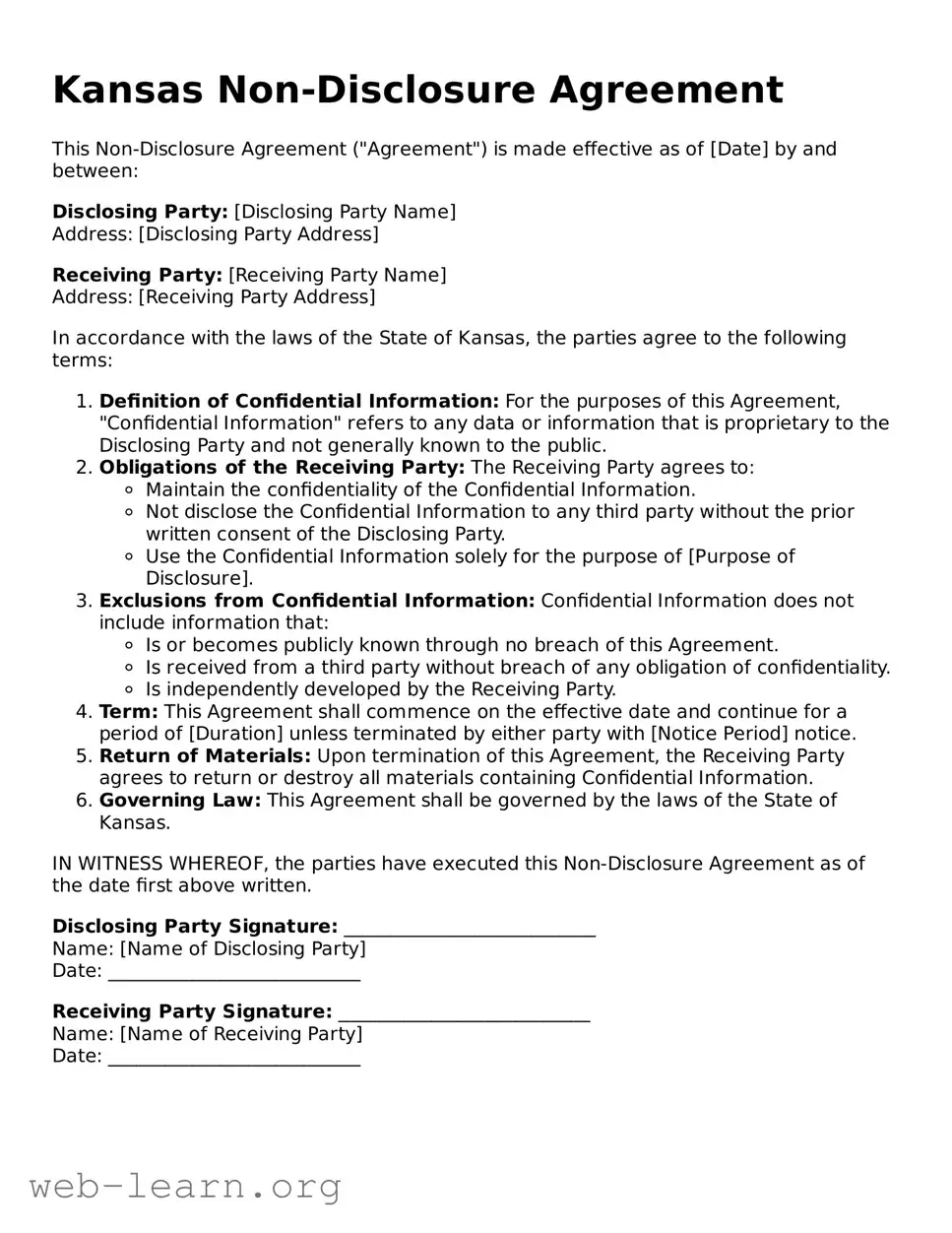
Sample - Kansas Non-disclosure Agreement Form

Kansas Non-Disclosure Agreement

This Non-Disclosure Agreement ("Agreement") is made effective as of [Date] by and between:

Disclosing Party: [Disclosing Party Name]
Address: [Disclosing Party Address]

Receiving Party: [Receiving Party Name]
Address: [Receiving Party Address]

In accordance with the laws of the State of Kansas, the parties agree to the following terms:

  1. Definition of Confidential Information: For the purposes of this Agreement, "Confidential Information" refers to any data or information that is proprietary to the Disclosing Party and not generally known to the public.
  2. Obligations of the Receiving Party: The Receiving Party agrees to:
    • Maintain the confidentiality of the Confidential Information.
    • Not disclose the Confidential Information to any third party without the prior written consent of the Disclosing Party.
    • Use the Confidential Information solely for the purpose of [Purpose of Disclosure].
  3. Exclusions from Confidential Information: Confidential Information does not include information that:
    • Is or becomes publicly known through no breach of this Agreement.
    • Is received from a third party without breach of any obligation of confidentiality.
    • Is independently developed by the Receiving Party.
  4. Term: This Agreement shall commence on the effective date and continue for a period of [Duration] unless terminated by either party with [Notice Period] notice.
  5. Return of Materials: Upon termination of this Agreement, the Receiving Party agrees to return or destroy all materials containing Confidential Information.
  6. Governing Law: This Agreement shall be governed by the laws of the State of Kansas.

IN WITNESS WHEREOF, the parties have executed this Non-Disclosure Agreement as of the date first above written.

Disclosing Party Signature: ___________________________
Name: [Name of Disclosing Party]
Date: ___________________________

Receiving Party Signature: ___________________________
Name: [Name of Receiving Party]
Date: ___________________________

File Characteristics

Fact Name Description
Purpose A Kansas Non-disclosure Agreement (NDA) is used to protect confidential information shared between parties.
Parties Involved The agreement typically involves a disclosing party and a receiving party, both of whom must agree to the terms.
Governing Law The NDA is governed by the laws of the state of Kansas.
Duration The duration of confidentiality can vary, but it is often specified within the agreement.
Enforceability For the NDA to be enforceable, it must be clear, reasonable, and not overly broad in scope.
Exclusions Common exclusions include information that is publicly available or already known to the receiving party.
Signature Requirement Both parties must sign the NDA for it to be legally binding.
Use Cases NDAs are often used in business negotiations, employment relationships, and partnerships to safeguard sensitive information.

Detailed Guide for Filling Out Kansas Non-disclosure Agreement

After obtaining the Kansas Non-disclosure Agreement form, you will need to complete it carefully to ensure all necessary information is provided. Following these steps will help guide you through the process.

  1. Read the Instructions: Before filling out the form, review any accompanying instructions to understand the requirements.
  2. Enter the Date: At the top of the form, write the date on which the agreement is being executed.
  3. Identify the Parties: Fill in the names and addresses of the parties involved in the agreement. This typically includes the disclosing party and the receiving party.
  4. Define Confidential Information: Clearly describe the information that will be considered confidential. Be specific to avoid ambiguity.
  5. Specify the Purpose: State the purpose for which the confidential information will be shared. This could be for a business relationship, project, or other specific reasons.
  6. Include Terms of Disclosure: Outline the terms under which the information will be disclosed, including any limitations or obligations on the receiving party.
  7. Signatures: Ensure that all parties sign and date the agreement. Each party should retain a copy for their records.

Once the form is completed and signed by all parties, it becomes a binding document. It is advisable to keep copies for future reference and to ensure compliance with the terms outlined in the agreement.

Obtain Answers on Kansas Non-disclosure Agreement

  1. What is a Non-disclosure Agreement (NDA)?

    A Non-disclosure Agreement, commonly referred to as an NDA, is a legally binding contract that establishes a confidential relationship between parties. It ensures that sensitive information shared between them remains private and is not disclosed to unauthorized individuals or entities.

  2. Why is an NDA important in Kansas?

    In Kansas, as in other states, an NDA is crucial for protecting intellectual property, trade secrets, and proprietary information. Businesses often rely on NDAs to safeguard their competitive edge and maintain confidentiality when discussing sensitive matters with employees, partners, or potential investors.

  3. Who can enter into an NDA?

    Any individual or business entity can enter into a Non-disclosure Agreement. This includes employers and employees, business partners, and contractors. It is important that all parties involved understand their obligations under the agreement before signing.

  4. What should be included in a Kansas NDA?

    A well-drafted NDA typically includes the following elements:

    • The definition of confidential information.
    • The obligations of the receiving party to protect the information.
    • The duration of the confidentiality obligation.
    • Any exclusions from confidentiality.
    • Consequences for breach of the agreement.
  5. How long does the confidentiality obligation last?

    The duration of confidentiality obligations can vary based on the agreement. In many cases, it lasts for a specified number of years after the information is disclosed. However, some NDAs may impose indefinite confidentiality obligations, particularly for trade secrets.

  6. Can an NDA be enforced in Kansas?

    Yes, NDAs can be enforced in Kansas courts as long as they meet legal requirements. The agreement must be reasonable in scope and duration, and it should not impose unfair restrictions on the parties involved. If a breach occurs, the injured party may seek legal remedies, including damages or injunctions.

  7. What happens if someone breaches an NDA?

    If a party breaches an NDA, the other party may pursue legal action. This could involve seeking monetary damages for losses incurred due to the breach or requesting a court order to prevent further disclosure of the confidential information. The specific consequences will depend on the terms outlined in the NDA and the nature of the breach.

Common mistakes

Filling out a Kansas Non-disclosure Agreement (NDA) can be a straightforward process, but many individuals make common mistakes that can lead to complications down the line. One of the most frequent errors is failing to identify all parties involved clearly. It is essential to include the full legal names of all individuals or entities bound by the agreement. Omitting a party or using incorrect names can render the agreement unenforceable.

Another common mistake is not specifying the confidential information adequately. Vague descriptions can lead to misunderstandings. A well-defined scope of what constitutes confidential information is crucial. Without this clarity, parties may inadvertently disclose information they believed was covered under the agreement.

Many people overlook the importance of including a time frame for the non-disclosure obligations. Without a specified duration, the agreement may be open-ended, leading to confusion about how long the confidentiality must be maintained. This can result in disputes in the future, as parties may have different interpretations of their obligations.

Additionally, individuals often forget to include the consequences of breaching the NDA. Clearly outlining the repercussions of violating the agreement serves as a deterrent against potential breaches. It also provides a clear path for recourse should a breach occur, which is vital for protecting sensitive information.

Another mistake is neglecting to review the entire document before signing. Rushing through the process can lead to misunderstandings or overlooked clauses. Each party should take the time to read the agreement thoroughly to ensure that all terms are acceptable and understood.

In some cases, individuals may not seek legal advice when drafting or signing an NDA. While it may seem unnecessary, consulting with a legal professional can provide valuable insights. An attorney can help ensure that the agreement meets legal standards and adequately protects the interests of all parties involved.

Lastly, people sometimes fail to keep a copy of the signed agreement. Retaining a copy is essential for reference and enforcement purposes. Without documentation, proving the existence of the NDA can become problematic if disputes arise later. Keeping a record helps ensure that all parties are aware of their obligations and can refer back to the agreement as needed.

Documents used along the form

When entering into a Non-disclosure Agreement (NDA) in Kansas, it's important to consider other documents that may complement or support the NDA. These documents help clarify the terms of the agreement, outline responsibilities, and provide additional legal protections. Here’s a list of forms and documents that are often used alongside the Kansas NDA:

  • Confidentiality Agreement: Similar to an NDA, this document specifically outlines what information must remain confidential and the obligations of the parties involved.
  • Mutual Non-disclosure Agreement: This agreement is used when both parties share sensitive information. It ensures that both sides are equally protected.
  • Employment Agreement: This document outlines the terms of employment, including confidentiality obligations, which may reference the NDA for clarity on sensitive information handling.
  • Non-compete Agreement: Often included in employment contracts, this document restricts an employee from competing with the employer for a certain period after leaving the company.
  • Intellectual Property Assignment Agreement: This agreement ensures that any intellectual property created during the course of a business relationship is owned by the appropriate party.
  • Service Agreement: This outlines the terms under which services are provided, often including clauses that reference confidentiality and the handling of proprietary information.
  • Letter of Intent: A preliminary agreement that outlines the basic terms of a potential deal, including confidentiality provisions to protect sensitive discussions.
  • Business Partnership Agreement: This document defines the terms of a partnership, including how confidential information will be managed and protected between partners.

Using these documents in conjunction with a Kansas Non-disclosure Agreement can provide a more comprehensive approach to protecting sensitive information and ensuring all parties understand their rights and responsibilities. It’s always wise to consult with a legal professional to tailor these documents to your specific situation.

Similar forms

  • Confidentiality Agreement: This document serves a similar purpose by protecting sensitive information shared between parties. Both agreements restrict the disclosure of proprietary information.
  • Non-Compete Agreement: While primarily focused on preventing competition, this document may also include clauses that protect confidential information. It restricts individuals from engaging in similar business activities for a specified time.
  • Mutual Non-Disclosure Agreement: This is a reciprocal form where both parties agree to protect each other's confidential information. It emphasizes shared responsibilities in maintaining secrecy.
  • Service Agreement: Often includes confidentiality clauses to safeguard information exchanged during the provision of services. It outlines the terms of service while also protecting sensitive data.
  • Employment Agreement: Typically contains confidentiality provisions to protect an employer’s trade secrets and sensitive information shared with employees during their tenure.
  • Partnership Agreement: This document may include confidentiality clauses to ensure that partners do not disclose sensitive business information to outside parties.
  • Licensing Agreement: Often includes terms that protect proprietary information shared between the licensor and licensee. It governs the use of intellectual property while safeguarding confidential details.

Dos and Don'ts

When filling out the Kansas Non-disclosure Agreement form, there are important guidelines to follow. Here are five things you should and shouldn't do:

  • Do read the entire agreement carefully before signing.
  • Don't leave any sections blank; fill in all required fields.
  • Do provide accurate and truthful information.
  • Don't rush through the process; take your time to ensure clarity.
  • Do keep a copy of the signed agreement for your records.

Misconceptions

When it comes to the Kansas Non-disclosure Agreement (NDA), several misconceptions can lead to confusion. Understanding these common misunderstandings is crucial for anyone considering entering into such an agreement.

  • NDAs are only for businesses. Many believe that NDAs are exclusively for companies. In reality, individuals can also use them to protect personal information, such as trade secrets or sensitive data.
  • All NDAs are the same. Not all NDAs are created equal. Each agreement can be tailored to fit specific needs and situations, making it essential to customize the document appropriately.
  • Signing an NDA means you can't talk to anyone. While NDAs restrict the sharing of certain information, they don't completely silence individuals. Communication about non-confidential matters is still allowed.
  • NDAs are enforceable in all situations. Some believe that NDAs are ironclad. However, courts may not enforce an NDA if it is deemed overly broad or if it violates public policy.
  • Only written NDAs are valid. While written agreements are the most common, verbal NDAs can also be enforceable. However, proving the terms of a verbal agreement can be challenging.
  • NDAs are permanent. Many think that once an NDA is signed, it lasts forever. In truth, most NDAs have a defined duration, after which the obligations may no longer apply.
  • NDAs protect all types of information. Not every piece of information is protected under an NDA. Only specific confidential information outlined in the agreement is covered.
  • NDAs can’t be negotiated. Some assume that NDAs are take-it-or-leave-it documents. In reality, parties can negotiate terms to ensure they are fair and reasonable for both sides.
  • Once signed, you can't change your mind. While an NDA is a binding agreement, parties can mutually agree to amend or terminate the agreement under certain circumstances.

By addressing these misconceptions, individuals and businesses can better navigate the complexities of Kansas NDAs and protect their interests effectively.

Key takeaways

When filling out and using the Kansas Non-disclosure Agreement (NDA) form, consider these key takeaways:

  • Understand the purpose: An NDA protects confidential information shared between parties. It ensures that sensitive data remains private.
  • Identify the parties: Clearly state the names and roles of all parties involved. This includes the disclosing party and the receiving party.
  • Define confidential information: Specify what constitutes confidential information. This can include trade secrets, business plans, and proprietary data.
  • Set the duration: Indicate how long the confidentiality obligation lasts. This timeframe can vary based on the nature of the information.
  • Include exceptions: Outline any exceptions to the confidentiality obligations. For instance, information that becomes public or is independently developed should be noted.
  • Review for compliance: Ensure the NDA complies with Kansas laws. It’s wise to consult a legal professional if unsure about any clauses.