In the state of Kansas, the Non-compete Agreement form serves as a crucial tool for employers and employees alike, establishing the terms under which an employee agrees not to engage in competitive activities after leaving a job. This form outlines key components, such as the duration of the non-compete period, the geographical scope of the restrictions, and the specific activities that are prohibited. Employers often utilize this agreement to protect their business interests, trade secrets, and client relationships. Conversely, employees should carefully consider the implications of signing such an agreement, as it can significantly impact their future employment opportunities. The form must adhere to state laws to be enforceable, which means it should be reasonable in scope and duration. Understanding the nuances of the Kansas Non-compete Agreement is essential for both parties to navigate the balance between protecting business interests and ensuring fair employment practices.
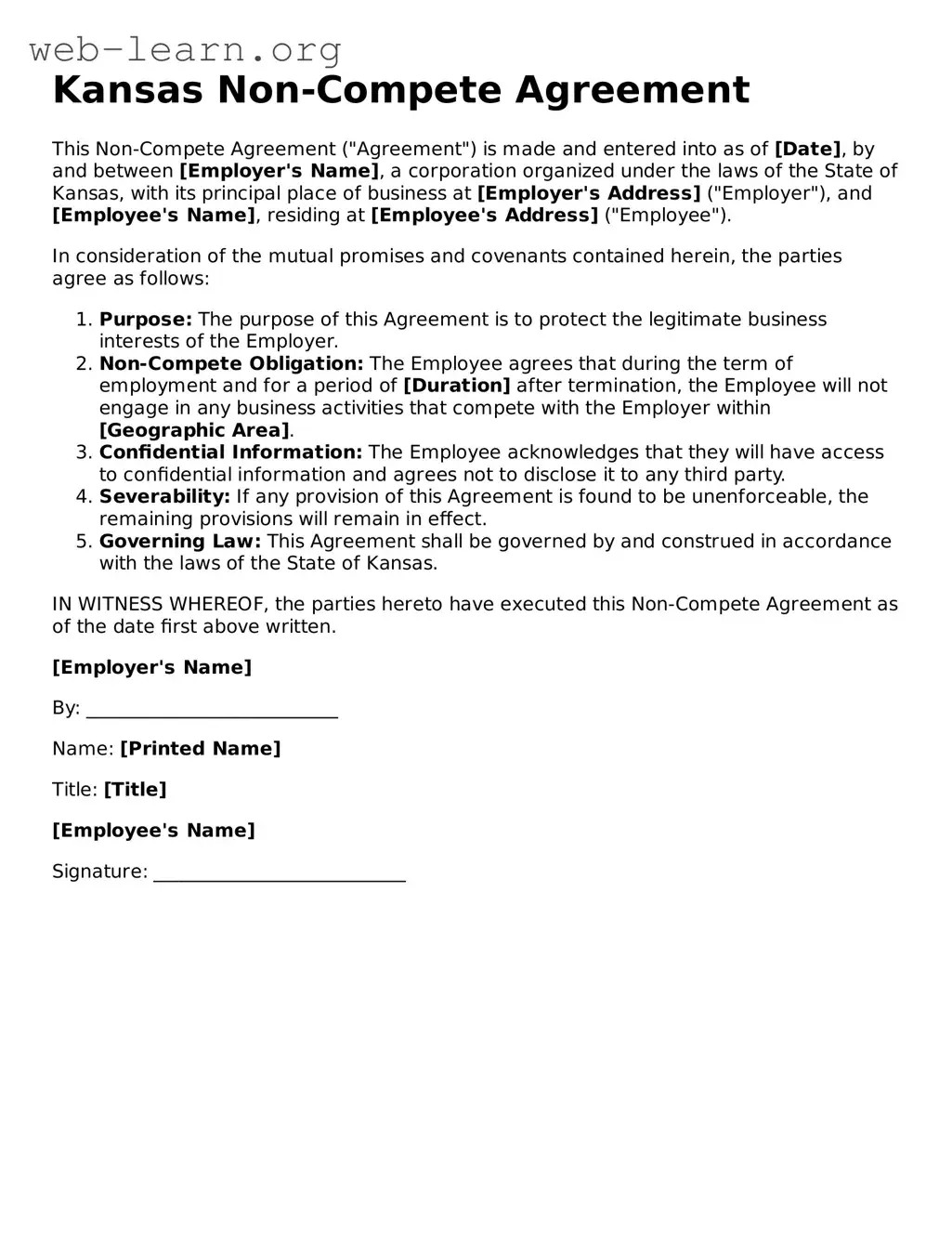
Kansas Non-Compete Agreement
This Non-Compete Agreement ("Agreement") is made and entered into as of [Date], by and between [Employer's Name], a corporation organized under the laws of the State of Kansas, with its principal place of business at [Employer's Address] ("Employer"), and [Employee's Name], residing at [Employee's Address] ("Employee").
In consideration of the mutual promises and covenants contained herein, the parties agree as follows:
IN WITNESS WHEREOF, the parties hereto have executed this Non-Compete Agreement as of the date first above written.
[Employer's Name]
By: ___________________________
Name: [Printed Name]
Title: [Title]
[Employee's Name]
Signature: ___________________________
| Fact Name | Details |
|---|---|
| Governing Law | Kansas Statutes, specifically K.S.A. 50-112. |
| Enforceability | Non-compete agreements are enforceable in Kansas if they are reasonable in scope and duration. |
| Reasonable Duration | A typical duration for enforcement is generally one to two years. |
| Geographic Scope | The agreement must have a defined geographic area where restrictions apply. |
| Consideration | There must be adequate consideration for the agreement to be valid, such as employment or access to trade secrets. |
| Employee Rights | Employees retain the right to pursue their profession, and agreements cannot be overly broad. |
| Judicial Scrutiny | Kansas courts may modify overly broad non-compete agreements to make them enforceable. |
| Exceptions | Certain professions, such as physicians, may have additional restrictions or considerations. |
Filling out the Kansas Non-compete Agreement form is an important step in formalizing the terms of a non-compete arrangement between an employer and an employee. Once completed, this document can help protect business interests and clarify expectations. Follow these steps to ensure that the form is filled out correctly.
What is a Kansas Non-compete Agreement?
A Kansas Non-compete Agreement is a legal contract between an employer and an employee. This document restricts the employee from working for competitors or starting a competing business for a certain period after leaving the company. The purpose of this agreement is to protect the employer's business interests, trade secrets, and proprietary information.
Are Non-compete Agreements enforceable in Kansas?
Yes, Non-compete Agreements can be enforceable in Kansas, but they must meet certain criteria. The agreement should be reasonable in scope, duration, and geographic area. Courts will typically evaluate whether the restrictions are necessary to protect the employer's legitimate business interests without unduly restricting the employee's ability to find work.
What factors determine the reasonableness of a Non-compete Agreement?
Several factors influence the reasonableness of a Non-compete Agreement in Kansas:
Can an employee negotiate the terms of a Non-compete Agreement?
Absolutely! Employees have the right to negotiate the terms of a Non-compete Agreement before signing it. It is advisable to discuss any concerns or desired changes with the employer. A mutual agreement can lead to a more favorable and balanced contract for both parties.
What happens if a Non-compete Agreement is violated?
If an employee violates a Non-compete Agreement, the employer may take legal action. This could involve seeking an injunction to prevent the employee from continuing to work for a competitor or pursuing damages for any losses incurred due to the violation. Legal outcomes can vary based on the specifics of the case and the enforceability of the agreement.
How can an employee protect themselves before signing a Non-compete Agreement?
To protect themselves, employees should:
Taking these steps can help ensure that the agreement is fair and reasonable.
Filling out the Kansas Non-compete Agreement form can be a straightforward process, but mistakes can happen. One common error is not providing accurate information. It's crucial to double-check all details, including names and addresses. Incorrect information can lead to complications down the line.
Another mistake people often make is overlooking the terms of the agreement. Many individuals rush through the document without fully understanding the implications. It’s important to read each section carefully to grasp what rights you may be giving up.
Some people fail to consider the duration of the non-compete clause. The length of time you agree to refrain from certain activities can significantly impact your future job opportunities. Make sure the duration is reasonable and aligns with your career goals.
Additionally, individuals sometimes neglect to consult with an attorney. While it may seem unnecessary, legal advice can provide clarity and ensure that the agreement is fair. An attorney can help identify any potential pitfalls that you might not see.
Another frequent oversight is not discussing the agreement with your employer. Open communication can prevent misunderstandings. If you have questions or concerns, it's best to address them before signing the document.
People also mistakenly assume that all non-compete agreements are the same. Each agreement can vary in terms and conditions. Take the time to compare it with other agreements you may have encountered to understand its uniqueness.
Finally, some individuals forget to keep a copy of the signed agreement. It’s essential to have your own records for future reference. This can help you if any disputes arise later on.
When entering into a Kansas Non-compete Agreement, several other forms and documents may be necessary to ensure clarity and compliance. These documents help outline the terms of employment, protect business interests, and provide a comprehensive understanding of the agreement's implications.
Each of these documents plays a vital role in the employment relationship. They help protect both the employer's interests and the employee's rights. Ensuring that all necessary forms are completed can lead to a smoother process and clearer understanding for all parties involved.
When filling out the Kansas Non-compete Agreement form, it's important to follow certain guidelines to ensure the process goes smoothly. Here are seven things to keep in mind:
Non-compete agreements can be confusing, and many people hold misconceptions about them. Here are seven common misunderstandings about the Kansas Non-compete Agreement form:
This is not true. In Kansas, non-compete agreements must meet certain criteria to be enforceable, including being reasonable in scope and duration.
Not every employee is required to sign one. Typically, non-compete agreements are more common for higher-level employees or those with access to sensitive information.
In Kansas, the duration of a non-compete agreement must be reasonable. Courts may not enforce agreements that last too long.
This is a misconception. A well-drafted non-compete may limit your ability to work for a specific employer or in a certain area, but it does not prohibit you from working in your field entirely.
These are different legal documents. A non-disclosure agreement focuses on protecting confidential information, while a non-compete restricts where and for whom you can work after leaving a job.
In fact, many employers are open to negotiation. If you feel the terms are too restrictive, it’s worth discussing with your employer before signing.
Small businesses can also use non-compete agreements to protect their interests. It’s a common misconception that only large corporations utilize them.
Understanding these misconceptions can help you navigate the complexities of non-compete agreements in Kansas more effectively.
When dealing with a Non-compete Agreement in Kansas, it is essential to understand its implications and how to fill it out correctly. Here are some key takeaways to consider:
By keeping these points in mind, individuals can navigate the complexities of the Kansas Non-compete Agreement more effectively.
Non Compete Agreement Hawaii - Non-compete Agreements can have long-term implications on professional mobility.
How to Get Out of a Non Compete Agreement - The agreement may include clauses that specify penalties for violation of its terms.
Are Non Competes Enforceable in Louisiana - Employers should ensure that their Non-compete Agreements are reasonable and enforceable.