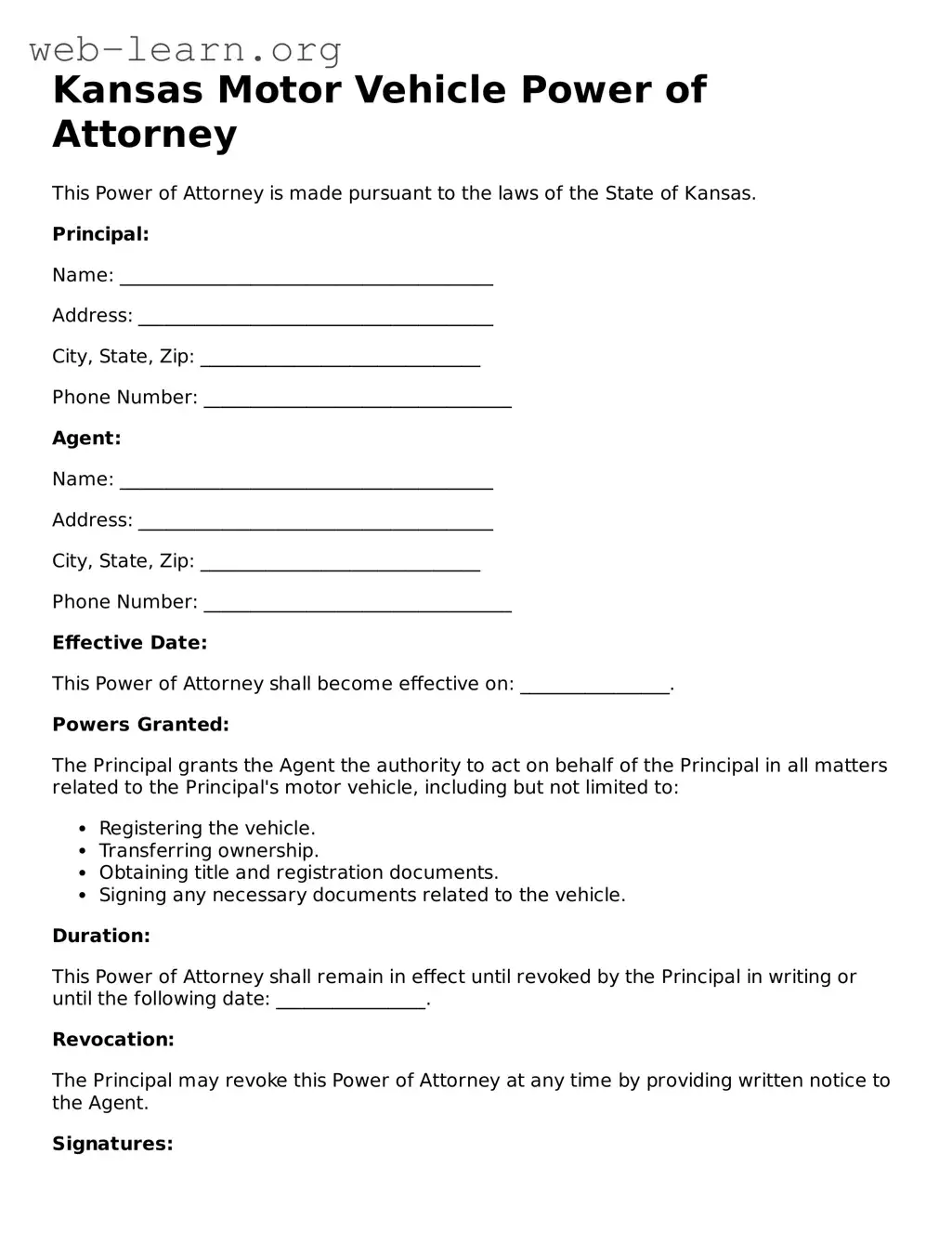
The Kansas Motor Vehicle Power of Attorney form serves as a crucial legal document that empowers individuals to designate another person to act on their behalf in matters related to motor vehicle transactions. This form is particularly useful when the vehicle owner is unable to be present for the transaction, whether due to time constraints, health issues, or other obligations. By completing this document, the vehicle owner grants specific authority to the designated agent, allowing them to perform actions such as signing titles, registering vehicles, or handling the sale of a car. It is important to note that this form must be signed by the vehicle owner and may require notarization to ensure its validity. Additionally, the form typically outlines the scope of the powers granted, which can be tailored to meet the specific needs of the owner. Understanding the importance of this document can help vehicle owners navigate the complexities of motor vehicle transactions with greater ease and confidence.
Kansas Motor Vehicle Power of Attorney
This Power of Attorney is made pursuant to the laws of the State of Kansas.
Principal:
Name: ________________________________________
Address: ______________________________________
City, State, Zip: ______________________________
Phone Number: _________________________________
Agent:
Name: ________________________________________
Address: ______________________________________
City, State, Zip: ______________________________
Phone Number: _________________________________
Effective Date:
This Power of Attorney shall become effective on: ________________.
Powers Granted:
The Principal grants the Agent the authority to act on behalf of the Principal in all matters related to the Principal's motor vehicle, including but not limited to:
Duration:
This Power of Attorney shall remain in effect until revoked by the Principal in writing or until the following date: ________________.
Revocation:
The Principal may revoke this Power of Attorney at any time by providing written notice to the Agent.
Signatures:
By signing below, the Principal acknowledges that they understand the contents of this document and grant the Agent the powers described herein.
Principal's Signature: ___________________________ Date: ________________
Agent's Signature: ______________________________ Date: ________________
Witness Signature: ______________________________ Date: ________________
Witness Signature: ______________________________ Date: ________________
| Fact Name | Description |
|---|---|
| Purpose | The Kansas Motor Vehicle Power of Attorney form allows an individual to designate another person to act on their behalf in matters related to motor vehicles. |
| Governing Law | This form is governed by Kansas Statutes Annotated, Chapter 58, Article 6. |
| Eligibility | Any adult resident of Kansas can create a Power of Attorney for motor vehicle matters. |
| Notarization | The form must be signed in the presence of a notary public to be considered valid. |
| Revocation | Individuals can revoke the Power of Attorney at any time, provided they do so in writing. |
| Duration | This Power of Attorney remains in effect until revoked or until the specified task is completed. |
| Use Cases | Common uses include transferring vehicle titles, registering vehicles, and handling other motor vehicle-related transactions. |
| Limitations | The form does not grant authority for matters unrelated to motor vehicles, such as real estate transactions. |
Filling out the Kansas Motor Vehicle Power of Attorney form is a straightforward process. After completing the form, you will be able to authorize someone else to act on your behalf regarding your vehicle. Follow the steps below to ensure everything is filled out correctly.
What is a Kansas Motor Vehicle Power of Attorney form?
The Kansas Motor Vehicle Power of Attorney form allows an individual (the principal) to authorize another person (the agent) to act on their behalf in matters related to motor vehicle transactions. This can include buying, selling, or transferring vehicle titles, as well as registering vehicles.
Who can be designated as an agent?
Any competent adult can be designated as an agent. This could be a family member, friend, or even a professional, such as an attorney. It is crucial that the agent is trustworthy, as they will have the authority to make significant decisions regarding your vehicle.
What specific powers can I grant to my agent?
You can grant your agent various powers, including:
Is the form required to be notarized?
Yes, the Kansas Motor Vehicle Power of Attorney form must be notarized to be considered valid. This step helps ensure that the identity of the principal is verified and that they are willingly granting authority to the agent.
How long does the Power of Attorney remain in effect?
The Power of Attorney remains in effect until you revoke it or until the specified task is completed. It is essential to communicate any changes to your agent and ensure that all parties involved are aware of the revocation.
Can I revoke the Power of Attorney?
Yes, you can revoke the Power of Attorney at any time. To do this, you should create a written revocation notice and provide it to your agent. It’s also advisable to inform any institutions or individuals who may have relied on the original Power of Attorney.
Are there any fees associated with filing this form?
While there is no fee specifically for the Power of Attorney form itself, there may be fees associated with the transactions your agent conducts on your behalf, such as title transfers or registration fees. Always check with the Kansas Department of Revenue for any applicable fees.
Can I use this form for vehicles registered in other states?
The Kansas Motor Vehicle Power of Attorney form is specifically designed for vehicles registered in Kansas. If you need to manage vehicles registered in another state, you should check that state’s requirements for a Power of Attorney.
What should I do if my agent misuses their authority?
If you suspect that your agent is misusing their authority, it is crucial to act quickly. You can revoke the Power of Attorney and seek legal advice if necessary. Document any instances of misuse, as this information may be important if legal action becomes necessary.
Where can I obtain the Kansas Motor Vehicle Power of Attorney form?
You can obtain the Kansas Motor Vehicle Power of Attorney form from the Kansas Department of Revenue’s website or at local DMV offices. Ensure you have the most current version of the form to avoid any issues during the process.
Filling out the Kansas Motor Vehicle Power of Attorney form can be a straightforward process, but several common mistakes can lead to complications. One frequent error occurs when individuals fail to provide the correct names of both the principal and the agent. The principal is the person granting authority, while the agent is the individual who will act on behalf of the principal. If either name is misspelled or incomplete, it can render the document invalid.
Another mistake involves neglecting to specify the powers granted to the agent. The form allows for a range of actions, such as signing documents related to vehicle registration or transferring ownership. If the powers are not clearly defined, the agent may not have the authority to perform necessary tasks, which could lead to delays or legal issues.
Additionally, individuals often overlook the requirement for signatures. Both the principal and the agent must sign the form for it to be legally binding. Without these signatures, the document lacks the necessary authorization. Furthermore, failing to date the form can lead to questions about its validity, especially if disputes arise regarding the timing of the authority granted.
Lastly, individuals sometimes forget to have the form notarized. In Kansas, notarization is often a necessary step to ensure that the document is recognized by the Department of Motor Vehicles and other entities. Without a notary's signature, the form may not be accepted, causing further complications in the process of transferring vehicle ownership or managing vehicle-related affairs.
When dealing with vehicle transactions in Kansas, several forms and documents often accompany the Motor Vehicle Power of Attorney. These documents help ensure a smooth process when transferring ownership or managing vehicle-related matters.
Each of these documents plays a critical role in ensuring that vehicle transactions are handled legally and efficiently. Having the right forms ready can save time and prevent complications down the road.
When filling out the Kansas Motor Vehicle Power of Attorney form, there are important steps to follow and common mistakes to avoid. Here are four key points to consider:
The Kansas Motor Vehicle Power of Attorney form is often misunderstood. Below are six common misconceptions along with clarifications.
Understanding these misconceptions can help individuals navigate the process more effectively and utilize the Kansas Motor Vehicle Power of Attorney form as intended.
Filling out and using the Kansas Motor Vehicle Power of Attorney form can seem daunting at first, but understanding its key aspects can simplify the process. Here are some important takeaways to keep in mind:
By keeping these points in mind, you can navigate the Kansas Motor Vehicle Power of Attorney form with confidence and ease.
Arkansas Dept of Motor Vehicles - This form can facilitate smoother interactions with the Department of Motor Vehicles (DMV).
Louisiana Dmv Power of Attorney - It allows you to appoint someone who understands your preferences regarding your vehicle management.