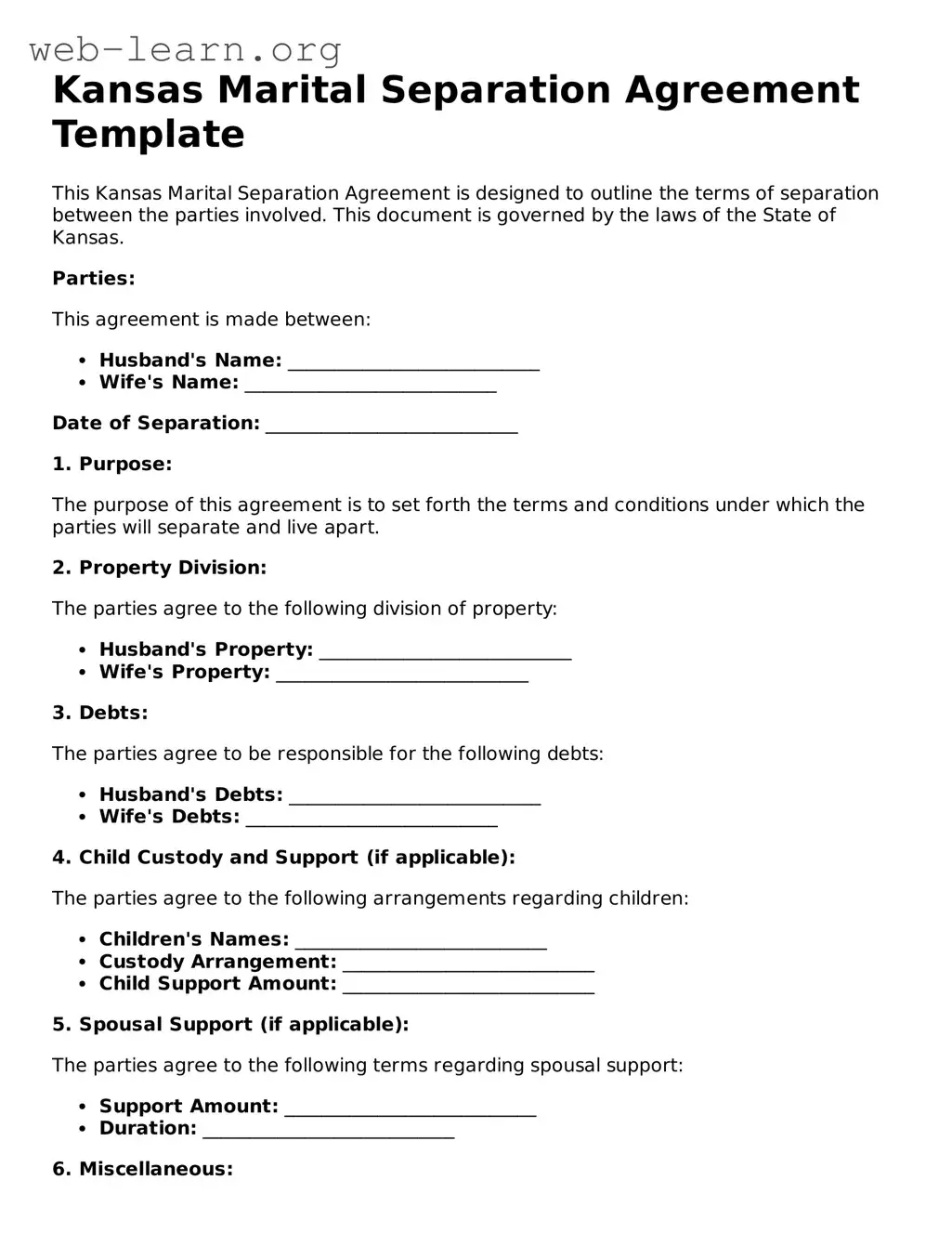
When navigating the complexities of marital separation in Kansas, a Marital Separation Agreement serves as a crucial tool for couples. This document outlines the terms and conditions under which the parties will live apart, addressing key aspects such as property division, spousal support, and child custody arrangements. By clearly defining each partner's rights and responsibilities, the agreement aims to minimize potential conflicts and provide a structured approach to separation. It is essential for both parties to understand that this form not only facilitates an amicable separation but also lays the groundwork for future legal proceedings, should they arise. Additionally, the agreement can be tailored to fit the unique circumstances of each couple, ensuring that individual needs and preferences are respected. In this article, we will delve into the important components of the Kansas Marital Separation Agreement form, emphasizing its significance in promoting clarity and stability during a challenging time.
Kansas Marital Separation Agreement Template
This Kansas Marital Separation Agreement is designed to outline the terms of separation between the parties involved. This document is governed by the laws of the State of Kansas.
Parties:
This agreement is made between:
Date of Separation: ___________________________
1. Purpose:
The purpose of this agreement is to set forth the terms and conditions under which the parties will separate and live apart.
2. Property Division:
The parties agree to the following division of property:
3. Debts:
The parties agree to be responsible for the following debts:
4. Child Custody and Support (if applicable):
The parties agree to the following arrangements regarding children:
5. Spousal Support (if applicable):
The parties agree to the following terms regarding spousal support:
6. Miscellaneous:
Additional terms and conditions:
7. Signatures:
By signing below, both parties agree to the terms outlined in this Kansas Marital Separation Agreement.
Husband's Signature: ___________________________
Date: ___________________________
Wife's Signature: ___________________________
Date: ___________________________
This agreement is intended to be a legally binding document. Each party should seek independent legal advice before signing.
| Fact Name | Details |
|---|---|
| Purpose | The Kansas Marital Separation Agreement outlines the terms of separation between spouses. |
| Governing Law | This agreement is governed by Kansas state law, specifically K.S.A. 60-1601 et seq. |
| Voluntary Agreement | Both parties must voluntarily agree to the terms laid out in the document. |
| Property Division | The agreement addresses how property and debts will be divided between spouses. |
| Child Custody | If children are involved, the agreement can include custody and visitation arrangements. |
| Child Support | Provisions for child support payments can also be included in the agreement. |
| Spousal Support | Spousal support or alimony terms may be negotiated and documented in the agreement. |
| Legal Representation | It is advisable for both parties to seek legal representation before signing. |
| Enforceability | The agreement can be enforced in court if both parties adhere to its terms. |
After completing the Kansas Marital Separation Agreement form, you will be ready to file it with the appropriate court. Ensure you have all necessary documents and understand the next steps in your separation process.
What is a Kansas Marital Separation Agreement?
A Kansas Marital Separation Agreement is a legal document that outlines the terms under which a couple agrees to live separately while remaining legally married. This agreement typically addresses issues such as property division, debt allocation, child custody, and support obligations. It serves as a framework for both parties to follow during their separation and can help prevent disputes later on.
Why should I create a Marital Separation Agreement?
Creating a Marital Separation Agreement can provide clarity and structure during a challenging time. By detailing the rights and responsibilities of each spouse, the agreement can help minimize misunderstandings and conflicts. Furthermore, having a written document can be beneficial if either party decides to pursue divorce in the future, as it can serve as a reference point for negotiations and legal proceedings.
What should be included in a Kansas Marital Separation Agreement?
While each agreement can be tailored to the couple's specific situation, several key elements are typically included:
It is essential for both parties to fully disclose their assets and liabilities to ensure a fair agreement.
Do I need a lawyer to draft a Marital Separation Agreement?
While it is not legally required to have a lawyer draft a Marital Separation Agreement, it is highly advisable. A legal professional can provide guidance tailored to your situation, ensuring that the agreement complies with Kansas laws and adequately protects your rights. Additionally, a lawyer can help facilitate discussions between both parties, which can be particularly beneficial if emotions run high.
Filling out the Kansas Marital Separation Agreement form can be a complex task. Many individuals make common mistakes that can lead to complications down the line. One frequent error is failing to provide complete and accurate information. Each section of the form requires specific details about the parties involved, their assets, and any children. Omitting even minor information can create misunderstandings or disputes later.
Another mistake is not understanding the legal implications of the agreement. People often overlook the importance of clearly defining terms such as "marital property" and "separate property." These definitions can significantly affect the division of assets. If the terms are vague or poorly defined, it may lead to confusion and conflict in the future.
Additionally, individuals sometimes neglect to include all relevant assets and debts. It is essential to list not only major items like homes and vehicles but also less obvious assets such as retirement accounts and personal belongings. Failing to account for all financial obligations can create an imbalance and lead to disputes over what was agreed upon.
Another common error involves the lack of proper signatures and dates. A Marital Separation Agreement must be signed by both parties to be legally binding. If the signatures are missing or if the date is not clearly indicated, the agreement may not hold up in court. This oversight can result in the entire agreement being challenged.
People also often underestimate the importance of consulting with a legal professional. While it may seem cost-effective to fill out the form independently, legal advice can help ensure that the agreement meets all necessary legal requirements. A lawyer can provide insights that individuals may not consider, potentially saving time and resources in the long run.
Finally, individuals may rush through the process without thoroughly reviewing the completed form. Taking the time to double-check for errors or inconsistencies is crucial. A careful review can prevent misunderstandings and ensure that both parties are on the same page regarding their rights and responsibilities.
A Kansas Marital Separation Agreement is an important document for couples who decide to live apart but are not yet ready to divorce. This agreement outlines the terms of the separation, including issues related to property division, child custody, and support. Along with this form, several other documents may be necessary to ensure a comprehensive approach to the separation process.
These documents, when used in conjunction with the Kansas Marital Separation Agreement, help clarify the terms of separation and provide a framework for resolving disputes. They play a crucial role in facilitating a smoother transition for both parties involved.
A Marital Separation Agreement is a crucial document for couples who decide to live apart but are not ready to divorce. This agreement outlines the terms of the separation, including financial responsibilities and child custody arrangements. Several other documents share similarities with the Marital Separation Agreement, each serving specific purposes in the context of family law. Below are eight such documents:
Understanding these documents can help individuals navigate the complexities of separation and ensure that their rights and responsibilities are clearly defined.
When filling out the Kansas Marital Separation Agreement form, it's essential to approach it carefully. Here are some important dos and don'ts to keep in mind:
Following these guidelines can help make the process smoother and ensure that your agreement is valid and enforceable.
Understanding the Kansas Marital Separation Agreement form can be challenging. Here are ten common misconceptions about this document, along with clarifications to help you navigate the process.
A marital separation agreement is not a divorce decree. It outlines the terms of separation, while a divorce decree finalizes the dissolution of marriage.
This agreement is applicable to any couple seeking separation, regardless of whether children are involved.
While legal advice is beneficial, couples can draft their own agreement as long as it meets legal requirements.
The agreement becomes legally binding only after it is approved by the court.
While it addresses many issues, it may not cover every possible future dispute, and modifications can be made later.
While mutual agreement is ideal, mediation can help resolve disputes if both parties cannot agree on all terms.
Changes can be made through mutual consent and must be documented in writing.
A separation agreement can be beneficial even if both spouses remain in the same home but wish to live separately.
Each agreement should be tailored to the specific needs and circumstances of the couple.
Even amicable separations benefit from a formal agreement to clarify expectations and responsibilities.
When filling out and using the Kansas Marital Separation Agreement form, it is essential to consider several key factors. Below are important takeaways to keep in mind:
By following these guidelines, individuals can navigate the separation process more effectively and with greater peace of mind.
Grounds for Divorce in Idaho - A Marital Separation Agreement can be an essential step in the separation process.
Legal Separation Florida - The agreement may outline how to handle pets or shared property.