In Kansas, a Living Will is an essential document that allows individuals to express their healthcare preferences in the event they become unable to communicate their wishes. This legal form primarily addresses end-of-life decisions, guiding medical professionals and loved ones on how to proceed with treatment when a person is terminally ill or in a persistent vegetative state. By outlining specific desires regarding life-sustaining treatments, such as resuscitation efforts, artificial nutrition, and hydration, the Living Will ensures that a person's values and choices are respected even when they cannot voice them. Completing this form requires careful consideration and a clear understanding of one’s personal beliefs about medical care. It is crucial to discuss these wishes with family members and healthcare providers to facilitate informed decisions during difficult times. Additionally, the Living Will should be signed and witnessed according to Kansas law to ensure its validity, making it a vital part of any comprehensive estate planning strategy.
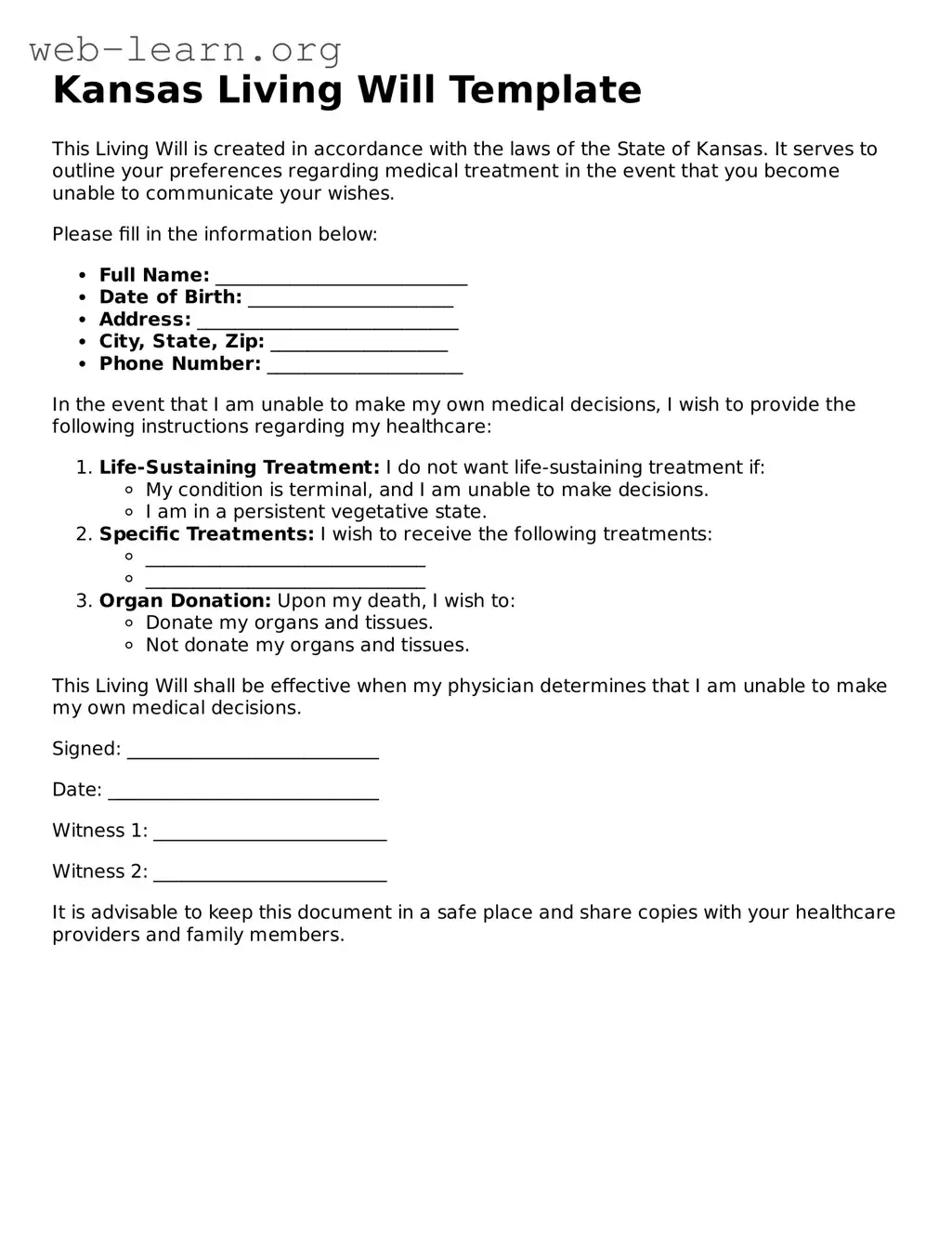
Kansas Living Will Template
This Living Will is created in accordance with the laws of the State of Kansas. It serves to outline your preferences regarding medical treatment in the event that you become unable to communicate your wishes.
Please fill in the information below:
In the event that I am unable to make my own medical decisions, I wish to provide the following instructions regarding my healthcare:
This Living Will shall be effective when my physician determines that I am unable to make my own medical decisions.
Signed: ___________________________
Date: _____________________________
Witness 1: _________________________
Witness 2: _________________________
It is advisable to keep this document in a safe place and share copies with your healthcare providers and family members.
| Fact Name | Details |
|---|---|
| Purpose | A Kansas Living Will allows individuals to express their wishes regarding medical treatment in the event they become incapacitated. |
| Governing Law | The Kansas Living Will is governed by the Kansas Statutes Annotated, specifically K.S.A. 65-28,101 et seq. |
| Signing Requirements | The form must be signed by the individual and witnessed by at least two adults, who are not related to the individual or entitled to any portion of the estate. |
| Revocation | A Living Will can be revoked at any time by the individual, either verbally or in writing, as long as they are competent to do so. |
| Healthcare Proxy | While a Living Will specifies treatment preferences, it does not appoint a healthcare proxy. Individuals may need a separate document for that purpose. |
Filling out the Kansas Living Will form is an important step in expressing your healthcare preferences. Once completed, you will need to sign the document and ensure it is stored in a safe place. Consider discussing your wishes with family members or healthcare providers to ensure they understand your intentions.
What is a Kansas Living Will?
A Kansas Living Will is a legal document that allows individuals to outline their preferences for medical treatment in the event they become unable to communicate their wishes. This document specifically addresses end-of-life care and helps ensure that a person's healthcare decisions are respected.
Who can create a Living Will in Kansas?
Any adult who is at least 18 years old and of sound mind can create a Living Will in Kansas. This includes individuals who are facing serious health issues or simply wish to plan ahead for their future medical care.
What should be included in a Living Will?
A Living Will should include:
It may also be helpful to discuss your wishes with family members and healthcare providers.
How do I make my Living Will legally binding?
To make your Living Will legally binding in Kansas, you must sign the document in the presence of two witnesses. These witnesses cannot be related to you, entitled to your estate, or involved in your healthcare. Alternatively, you can have the document notarized.
Can I change or revoke my Living Will?
Yes, you can change or revoke your Living Will at any time as long as you are of sound mind. To revoke it, you can destroy the document or create a new one that states your current wishes. It is advisable to inform your healthcare providers and family members of any changes you make.
Is a Living Will the same as a Power of Attorney for Healthcare?
No, a Living Will and a Power of Attorney for Healthcare are not the same. A Living Will specifies your wishes regarding medical treatment, while a Power of Attorney for Healthcare designates someone to make healthcare decisions on your behalf if you are unable to do so. Both documents can work together to ensure your healthcare preferences are honored.
When does my Living Will take effect?
Your Living Will takes effect when you are unable to communicate your wishes regarding medical treatment. This typically occurs in situations where you are terminally ill, in a persistent vegetative state, or otherwise unable to make decisions about your care.
Where should I keep my Living Will?
Keep your Living Will in a safe place where it can be easily accessed. Inform your family members, healthcare providers, and anyone else involved in your care about its location. It is also a good idea to carry a copy with you, especially when traveling or during hospital visits.
Can I use a Living Will from another state in Kansas?
A Living Will from another state may be honored in Kansas, but it is advisable to check the specific requirements of Kansas law. To ensure that your wishes are clearly understood and legally binding, it is recommended to complete a Kansas-specific Living Will.
Filling out a Kansas Living Will form is an important step in ensuring that your healthcare wishes are honored. However, many individuals make common mistakes that can lead to confusion or invalidation of their directives. Awareness of these pitfalls can help you navigate the process more effectively.
One frequent error is failing to specify the conditions under which the Living Will takes effect. A clear understanding of when you want your directives to apply is essential. Without this clarity, healthcare providers may struggle to interpret your wishes during critical moments.
Another mistake is neglecting to sign the document properly. In Kansas, your signature must be present for the Living Will to be valid. If you forget to sign or if someone else signs on your behalf without proper authorization, your intentions may not be honored.
Additionally, many people overlook the importance of witnessing their Living Will. Kansas law requires that the document be signed in the presence of two witnesses. These witnesses must not be related to you or entitled to any portion of your estate. Failing to meet these criteria can render the document invalid.
Some individuals also make the mistake of using vague language. Clear and specific instructions are crucial for ensuring that your healthcare providers understand your wishes. Ambiguities can lead to misinterpretation, which can ultimately affect the care you receive.
Moreover, forgetting to update the Living Will can create issues. Life circumstances change, and so do personal beliefs and preferences regarding medical treatment. Regularly reviewing and updating your Living Will ensures that it accurately reflects your current wishes.
Another common error is not discussing the Living Will with family members or healthcare proxies. Open communication can prevent misunderstandings and ensure that your loved ones are aware of your wishes. This discussion can also provide them with the confidence to advocate for your preferences if necessary.
Finally, some individuals fail to store the Living Will in a safe yet accessible location. It is essential to keep the document where it can be easily found by your healthcare providers or family members in an emergency. A misplaced or hidden Living Will can lead to delays in receiving the care you desire.
A Kansas Living Will form is an important document that outlines an individual's wishes regarding medical treatment in the event they become incapacitated. However, several other forms and documents often accompany it to ensure comprehensive planning for healthcare and legal matters. Below is a list of related documents that may be useful.
Using these documents in conjunction with a Kansas Living Will can help ensure that an individual's healthcare and legal preferences are respected. It is advisable to consult with a legal professional to ensure all forms are completed correctly and meet state requirements.
A Living Will is a legal document that outlines an individual's preferences for medical treatment in case they become unable to communicate their wishes. Several other documents serve similar purposes, often addressing different aspects of healthcare decisions. Below are nine documents that share similarities with a Living Will:
Filling out the Kansas Living Will form is an important step in ensuring your healthcare wishes are honored. Here are ten essential dos and don'ts to keep in mind.
Understanding the Kansas Living Will form is crucial for making informed decisions about end-of-life care. However, several misconceptions can lead to confusion. Here are nine common misunderstandings:
This is not true. Anyone, regardless of age, can create a Living Will to express their healthcare preferences in case they become unable to communicate.
While both documents deal with end-of-life decisions, a Living Will outlines broader healthcare preferences, whereas a DNR specifically addresses resuscitation efforts.
Each state has its own laws regarding Living Wills. The Kansas Living Will is valid only in Kansas and may not hold the same weight in other states.
This is a misconception. Individuals can revise or revoke their Living Will at any time as long as they are mentally competent.
While healthcare providers are generally obligated to respect a Living Will, there may be exceptions based on specific circumstances or legal challenges.
A Living Will can address various medical situations, not just terminal illnesses. It can specify preferences for any condition that leaves a person unable to make decisions.
While consulting a lawyer can be helpful, it is not necessary. Kansas provides a standard form that individuals can fill out without legal assistance.
A Living Will is a type of advance directive, but advance directives can also include other documents like a healthcare proxy or power of attorney.
People can change their Living Will as their preferences or circumstances evolve. Regularly reviewing and updating the document is a good practice.
By clarifying these misconceptions, individuals can better navigate their options and ensure their wishes are honored in healthcare decisions.
When considering a Kansas Living Will, it's important to understand how to fill it out and use it effectively. Here are some key takeaways:
Free Colorado Living Will Form - A Living Will is a straightforward way to communicate your healthcare wishes.
Can I Write My Own Will in New York State - A Living Will can be a valuable tool in ensuring that your end-of-life care reflects your personal beliefs and values.
Living Will Free Forms - It can be a valuable tool for discussing end-of-life issues with family.