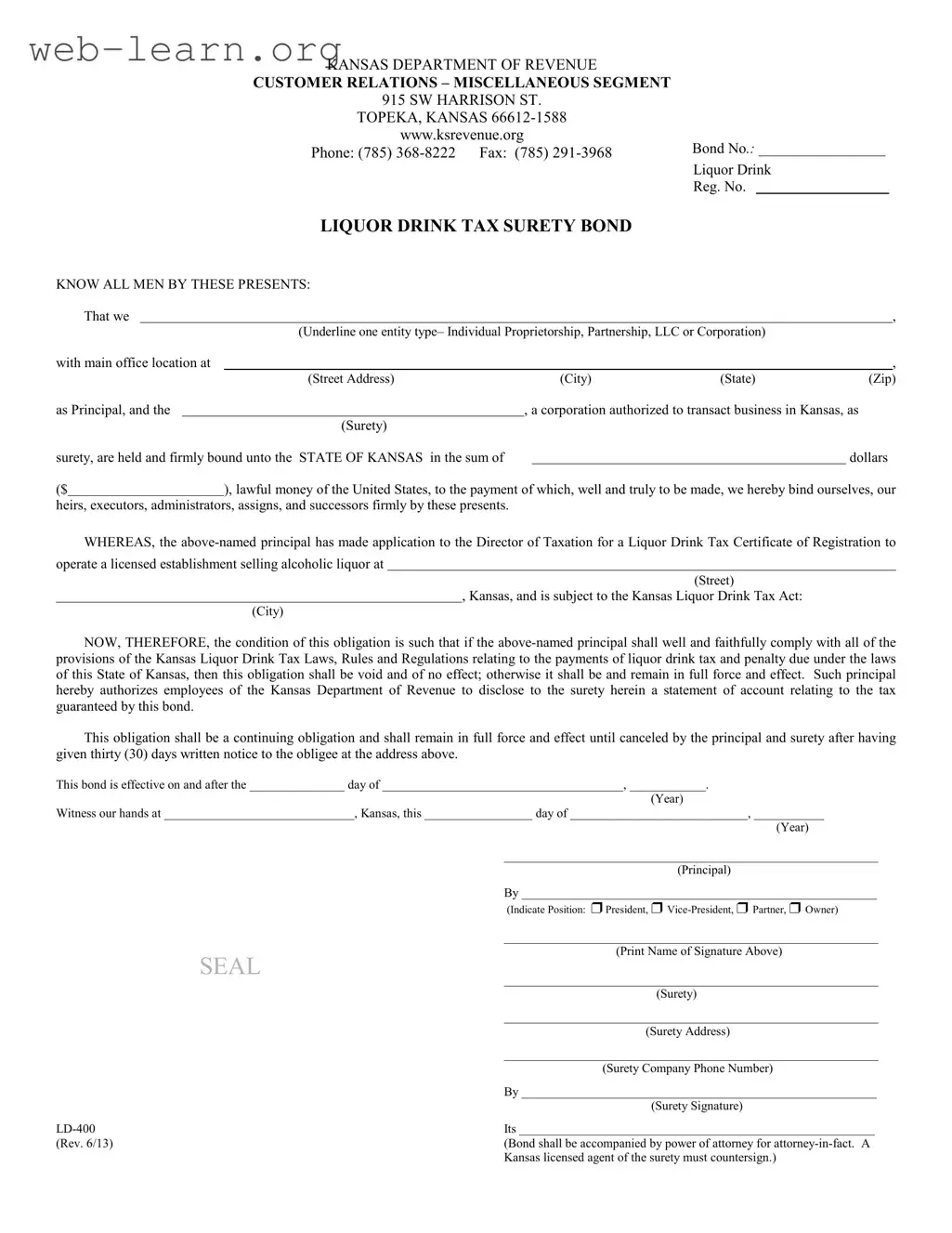
The Kansas LD 400 form, officially titled the Liquor Drink Tax Surety Bond, serves as a crucial document for establishments engaged in the sale of alcoholic beverages within the state. This form is required for various entities, including drinking establishments, Class A and B clubs, caterers, public venues, and hotels, all of which must comply with the Kansas Liquor Drink Tax Act. The bond ensures that the principal, the entity applying for or holding a liquor license, will adhere to all relevant tax laws and regulations. It establishes a financial guarantee to the state, binding the principal and their surety to pay any taxes or penalties that may arise. Key elements of the form include the identification of the principal and surety, the bond amount, and the effective date of coverage. Furthermore, the LD 400 mandates the completion of specific fields, such as the legal name of the entity and the exact location of the business, which must align with the liquor tax application. Proper execution of the form is essential, as any errors may render the bond invalid. The Kansas Department of Revenue oversees the submission and compliance processes, providing guidance and support for applicants to ensure adherence to the state's regulatory framework.

KANSAS DEPARTMENT OF REVENUE
CUSTOMER RELATIONS – MISCELLANEOUS SEGMENT
915 SW HARRISON ST.
TOPEKA, KANSAS
www.ksrevenue.org
Phone: (785) |
Fax: (785) |
Bond No.: _________________ |
|
|
|
||
|
|
Liquor Drink |
|
|
|
Reg. No. |
|
LIQUOR DRINK TAX SURETY BOND
KNOW ALL MEN BY THESE PRESENTS:
That we |
|
, |
(Underline one entity type– Individual Proprietorship, Partnership, LLC or Corporation)
with main office location at |
|
|
|
|
|
, |
||
|
|
|
(Street Address) |
|
(City) |
(State) |
(Zip) |
|
as Principal, and the |
|
, a corporation authorized to transact business in Kansas, as |
||||||
|
|
|
(Surety) |
|
|
|
|
|
surety, are held and firmly bound unto the STATE OF KANSAS in the sum of |
|
|
|
dollars |
||||
($ |
|
|
), lawful money of the United States, to the payment of which, well and truly to be made, we hereby bind ourselves, our |
|||||
heirs, executors, administrators, assigns, and successors firmly by these presents. |
|
|
|
|
|
|||
WHEREAS, the
operate a licensed establishment selling alcoholic liquor at
(Street)
, Kansas, and is subject to the Kansas Liquor Drink Tax Act:
(City)
NOW, THEREFORE, the condition of this obligation is such that if the
This obligation shall be a continuing obligation and shall remain in full force and effect until canceled by the principal and surety after having given thirty (30) days written notice to the obligee at the address above.
This bond is effective on and after the _______________ day of ______________________________________, ____________.
|
(Year) |
Witness our hands at ______________________________, Kansas, this _________________ day of ____________________________, ___________ |
|
|
(Year) |
|
___________________________________________________________ |
|
(Principal) |
|
By ________________________________________________________ |
|
(Indicate Position: r President, r |
|
___________________________________________________________ |
|
(Print Name of Signature Above) |
|
SEAL |
|
___________________________________________________________ |
|
(Surety) |
|
___________________________________________________________ |
|
(Surety Address) |
|
___________________________________________________________ |
|
(Surety Company Phone Number) |
|
By ________________________________________________________ |
|
(Surety Signature) |
Its ________________________________________________________ |
|
(Rev. 6/13) |
(Bond shall be accompanied by power of attorney for |
|
Kansas licensed agent of the surety must countersign.) |
(For Drinking Establishments, Class A Clubs, Class B Clubs, Caterers, Public Venues, Hotels, or other
PLEASE READ BEFORE COMPLETING THIS BOND FORM!
Bond Instructions:
You must complete the most current version of Form
All fields on this form must be completed, except for the Liquor Drink Reg. No. field.
This bond must contain a bond number.
Line 1 of the bond must contain the legal name of the entity applying for or holding a Kansas liquor license and must match exactly the entity name listed on the liquor tax application.
The location address on this bond must match exactly the location address on the liquor application. This cannot be a PO Box.
The effective date is the date liquor drink tax coverage under this surety bond begins.
Signature lines:
O“Principal” is the entity being covered under this surety bond.
OAn owner or officer must sign this bond and mark the box indicating their position.
OThe owner/officer must print their name below the signature line.
O“Surety” is the name of the surety company providing the bond coverage.
OA complete mailing address of the surety company must be provided, along with a telephone number.
OA signature of an authorized
OThe bond and
Failure to complete the
Original bonds cannot be returned.
Questions regarding this form should be directed to the Division of Taxation, Miscellaneous Tax Segment, at (785)
Submit this form to:
Miscellaneous Tax
Kansas Department of Revenue
915 SW Harrison St.
Topeka, KS
| Fact Name | Details |
|---|---|
| Governing Law | Kansas Liquor Drink Tax Act |
| Form Purpose | This form serves as a surety bond for establishments selling alcoholic beverages. |
| Entity Types | Applicable entities include Individual Proprietorship, Partnership, LLC, or Corporation. |
| Effective Date | The bond becomes effective on the date specified in the form. |
| Principal Responsibilities | The principal must comply with all Kansas Liquor Drink Tax laws and regulations. |
| Surety Requirements | The surety must be a corporation authorized to do business in Kansas. |
| Notice Requirement | Thirty days written notice is required to cancel the bond. |
| Contact Information | For questions, contact the Kansas Department of Revenue at (785) 368-8222. |
Filling out the Kansas LD 400 form is a straightforward process, but it requires careful attention to detail. This form serves as a surety bond for businesses involved in the sale of alcoholic beverages. Completing it accurately is essential to ensure compliance with state regulations and to avoid any issues with your liquor license.
Once the form is submitted, it will be processed by the Kansas Department of Revenue. If there are any questions or concerns during the process, it is advisable to reach out to the Division of Taxation for assistance. Ensuring that the form is filled out correctly will help avoid delays in obtaining your liquor license.
What is the Kansas LD 400 form?
The Kansas LD 400 form is a Liquor Drink Tax Surety Bond required for establishments that sell alcoholic beverages in Kansas. This bond ensures compliance with the Kansas Liquor Drink Tax Act. By completing this form, a business agrees to pay any liquor drink taxes owed to the state.
Who needs to complete the LD 400 form?
Any individual or entity applying for or holding a Kansas liquor license must complete the LD 400 form. This includes drinking establishments, Class A and Class B clubs, caterers, public venues, hotels, and other on-premise licensees.
What information is required on the form?
The form requires specific information, including:
All fields must be completed accurately to avoid invalidation of the bond.
What happens if the LD 400 form is not completed correctly?
If the form is not filled out correctly, the bond will be considered invalid. This means the bond will be voided and retained in the customer's file. It is crucial to ensure that all information matches the liquor tax application exactly.
How do I submit the LD 400 form?
The completed form should be submitted to the Kansas Department of Revenue at the following address:
Miscellaneous Tax
Kansas Department of Revenue
915 SW Harrison St.
Topeka, KS 66612-1588
Make sure to include all necessary documentation, including the power of attorney for the attorney-in-fact.
Where can I get assistance with the LD 400 form?
If you have questions regarding the LD 400 form, you can contact the Division of Taxation, Miscellaneous Tax Segment at (785) 368-8222. Follow the prompts for option 5, then option 4 for assistance.
Filling out the Kansas LD 400 form can be a straightforward process, but many individuals make common mistakes that can lead to complications. One frequent error is failing to use the most current version of the form. The Kansas Department of Revenue updates forms periodically, and using an outdated version can result in an invalid submission.
Another mistake involves incomplete fields. All fields must be filled out, except for the Liquor Drink Reg. No. If any required section is left blank, the bond may be deemed invalid. Additionally, applicants often neglect to include a bond number, which is essential for processing.
People also frequently misstate the legal name of the entity applying for the liquor license. The name must match exactly with what is listed on the liquor tax application. Any discrepancies can lead to delays or rejection of the bond.
Address accuracy is crucial. The location address on the bond must match the address on the liquor application precisely. Using a P.O. Box instead of a physical address is another common error that can invalidate the form.
Signature requirements are often misunderstood. The owner or officer must sign the bond and indicate their position by marking the appropriate box. Failure to print their name below the signature line can also lead to complications.
Another oversight is not providing complete contact information for the surety company. This includes the full mailing address and a telephone number. Missing this information can cause delays in processing the bond.
Some applicants forget that a signature from an authorized attorney-in-fact is necessary. This signature must accompany a power of attorney document. Without it, the bond will not be valid.
Moreover, people sometimes overlook the requirement for a seal on both the bond and the power of attorney form. This is a critical detail that must not be missed.
Lastly, failing to submit the bond to the correct address can lead to significant delays. It is essential to send the completed form to the Miscellaneous Tax segment of the Kansas Department of Revenue at the specified address. Following these guidelines can help ensure a smoother process when filling out the Kansas LD 400 form.
The Kansas LD 400 form is a Liquor Drink Tax Surety Bond required for establishments selling alcoholic beverages. Several other forms and documents are often used in conjunction with this bond. Below is a list of these related documents, each serving a specific purpose in the licensing and compliance process.
Understanding these documents can help ensure a smoother application process for obtaining a liquor license in Kansas. Each form plays a vital role in maintaining compliance with state regulations and ensuring the responsible sale of alcoholic beverages.
The Kansas LD 400 form, which serves as a Liquor Drink Tax Surety Bond, shares similarities with several other documents related to business operations and compliance. Below is a list of nine documents that are comparable to the LD 400 form, along with explanations of their similarities.
Understanding these similarities can help clarify the importance of the Kansas LD 400 form and its role in ensuring compliance with state laws regarding liquor sales.
When filling out the Kansas LD 400 form, there are important steps to follow. Here’s a helpful list of what to do and what to avoid:
Following these guidelines can help ensure your application process goes smoothly. If you have questions, don’t hesitate to reach out to the Kansas Department of Revenue for assistance.
When it comes to the Kansas LD 400 form, there are several misconceptions that can lead to confusion. Understanding these common misunderstandings is crucial for anyone involved in the liquor industry in Kansas. Here are four prevalent misconceptions:
By dispelling these myths, businesses can better navigate the requirements associated with the Kansas LD 400 form and ensure compliance with state laws.
When filling out the Kansas LD 400 form, there are several important points to keep in mind. Here are key takeaways that can help ensure a smooth process:
Following these guidelines can help you navigate the process of completing the Kansas LD 400 form effectively. If questions arise, don’t hesitate to reach out to the Division of Taxation for assistance!